.avif)

Blog Summary / Key Takeaways
- Most firms land on a hybrid model rather than fully building or fully outsourcing.
- Transactional, repeatable work is the best fit for outsourcing or offshore staffing.
- Client-facing and judgment-heavy roles are best kept in-house.
- Building in-house takes longer and carries higher management burden.
- Outsourcing offers more flexibility for seasonal workload spikes.
- Map your workload before deciding, rather than choosing based on cost alone.
- Audit, assurance, and complex tax work generally belong in-house regardless of the broader staffing model chosen.
Introduction
You are three months into a bad hire. The new staff accountant seemed strong in the interview but cannot keep pace during busy season.
Now you are managing a performance conversation while also trying to close January and February books for forty clients.
This is the moment many CPA firm owners start seriously weighing outsourcing against continuing to build an in-house team.
Neither option is universally right. The correct choice depends on workload patterns, growth stage, and how much management bandwidth you have.
This guide walks through the real tradeoffs, using a specific firm's decision process as a working example, along with the specific evaluation criteria worth applying either way.
What Does Build vs. Outsource Actually Mean for a Public Accounting Firm?
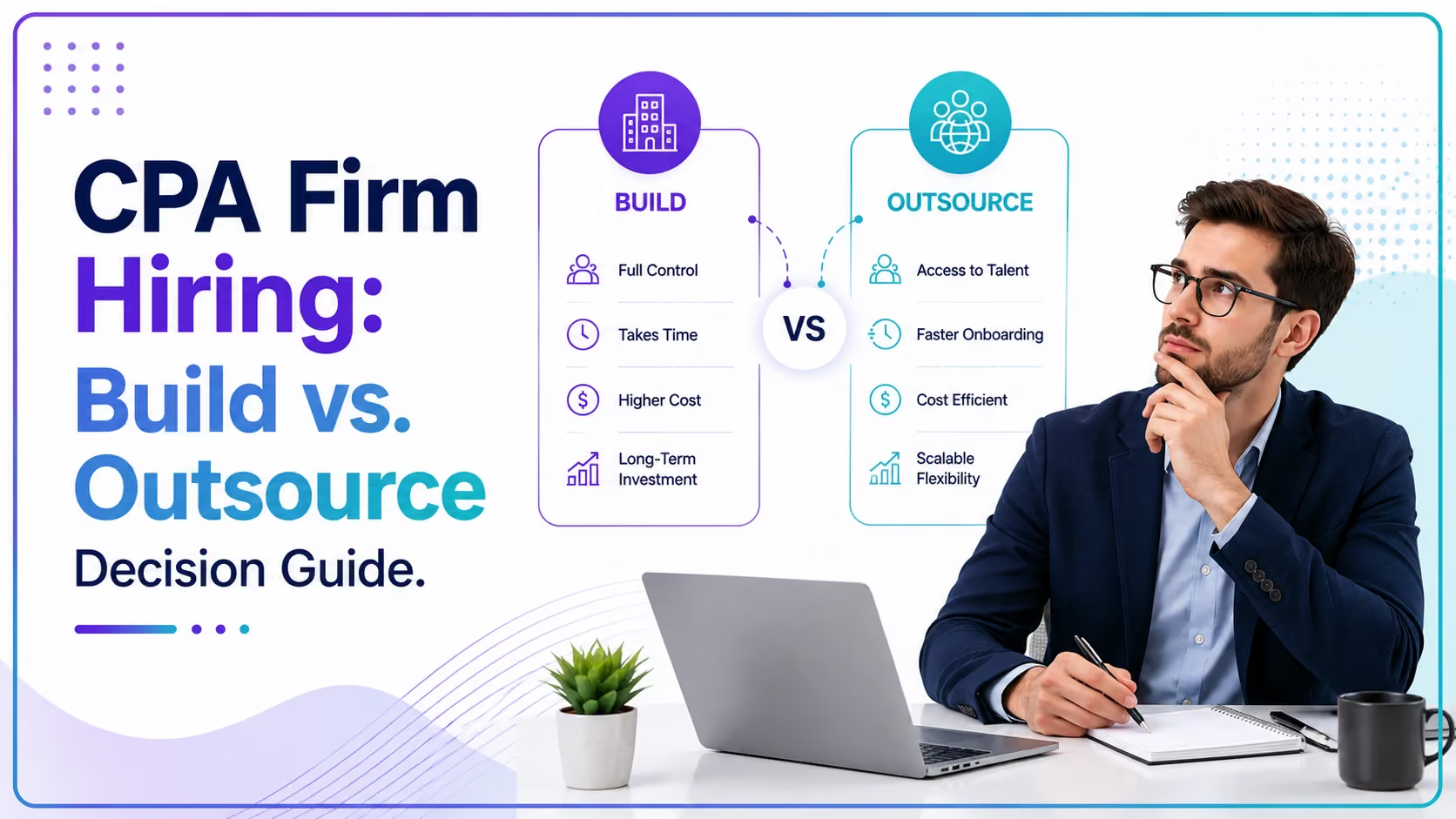
Building means hiring, training, and managing accounting staff directly as employees of your public accounting firm.
Outsourcing means contracting with an external provider or offshore staffing partner to handle some or all of that work.
A risk-free 40-hour pilot is often included in outsourcing models like Etisson's, letting a firm test the fit before committing to a full engagement.
Most firms end up with a hybrid model, keeping senior review in-house while outsourcing high-volume, repeatable tasks.
Why Does CPA Firm Hiring Matter So Much Right Now for Finance Professionals?
The accounting talent shortage has made cpa firm hiring slower and more expensive than it was even five years ago.
Firms that delay this decision often end up understaffed during busy season, working partners and staff past sustainable hours.
Getting the staffing model right directly affects client retention, since missed deadlines are one of the fastest ways to lose a client.
Qualified finance professionals with the right mix of tax preparation and advisory services experience are especially hard to find and retain right now.
Who Should Consider Outsourcing Over Building?
Firms with unpredictable or seasonal workload benefit from outsourcing's flexibility to scale up and down.
Growing firms not yet ready to commit to a full US salary for a role that is not fully billable also benefit.
Firms struggling specifically with turnover, rather than workload volume, may find outsourcing offers more staffing stability.
This also affects internal career paths. When senior staff are not buried in transactional work, firms can invest more in developing them toward advisory and client-facing roles.
When Should a Firm Build an In-House Tax Manager or Staff Accountant Role Instead?
Building in-house makes more sense for roles requiring deep, ongoing client relationships, like a client-facing controller or tax manager.
Firms with strong, consistent workload and the management capacity to train and retain staff often prefer building.
It also makes sense when a firm has the cash flow to absorb a slower hiring timeline without workload backing up.
Roles built around proactive tax planning and strategic advisory work, not just tax preparation, are usually worth keeping in-house given how much they depend on direct client trust.
A standard path for a staff accountant in public accounting includes progression toward Manager and eventually Partner or Director roles, and public accountants must hold a valid CPA license to advance through that path.
A firm hiring in-house should confirm any candidate's CPA license status and adherence to ethical standards as a baseline requirement, regardless of which staffing model the firm otherwise uses.
Where Do Firms Typically Land After Weighing Both Options?
Most firms land on a hybrid model, keeping client-facing and review roles in-house while outsourcing transactional work.
This typically means bookkeeping, reconciliation, and data entry go to an outsourced or offshore team.
Senior review, client communication, and advisory work stay with in-house staff who know the client relationships directly.
Bookkeeping supports a CPA firm's broader financial management processes, and accurate bookkeeping is essential for compliance and reporting regardless of who performs it.
Monthly reconciliations are a key bookkeeping task, and effective bookkeeping can meaningfully reduce overhead costs when handled by a dedicated offshore team instead of stretched in-house staff.
A modern CPA firm is generally expected to be proficient with popular accounting software like QuickBooks and Xero, whether that work happens in-house or through an outsourcing partner.
How Do You Decide Which Model Fits Your Firm?
Start by mapping your current workload into two buckets: transactional and repeatable work, and judgment-heavy client work.
Estimate the fully loaded cost of hiring in-house for the transactional bucket, including salary, benefits, and management time.
Compare that against outsourcing or offshore staffing costs for the same volume of work.
Factor in how much partner or manager time is currently spent on hiring and training, since that is real cost too.
What Should You Look For When Evaluating an Outsourcing Partner?
Look for a provider that supports cloud accounting platforms and follows strong data security practices, since client financial records will pass through their systems.
Ask about industry experience specific to your client base, since a provider familiar with the compliance and reporting needs of your niche will ramp up faster.
Check communication style and responsiveness during the evaluation process itself. How a provider handles questions before you sign is a good preview of how they will operate after.
Ask for client references and look at how long their existing engagements have lasted, since staffing partnerships that turn over quickly are a red flag.
Get clear on fees and pricing structure upfront, and ask specifically whether a trial period, such as a limited-scope pilot engagement, is available before committing fully.
An ideal candidate for a staffing partner, whether a local hire or an outsourcing firm, should be able to state clearly who is responsible for which duties and responsibilities before the engagement starts.
Request a written proposal outlining scope, execution timeline, and pricing, rather than relying on a verbal understanding that can shift once work begins.
The goal of this evaluation is business success on both sides. A staffing decision made without this diligence tends to cost more in wasted time than the money it was meant to save.
What Types of Work Should Stay In-House Regardless of Staffing Model?
Audit and assurance engagements almost always need in-house ownership, given the direct impact a misstep can have on a firm's professional services reputation and its standing with regulators.
Complex taxation work, including corporations with multi-state exposure or estate and trust returns, benefits from staff who understand the client's full financial goals, not just the current year's numbers.
Anything requiring direct interpretation of shifting tax laws or IRS guidance is worth keeping in-house, since that judgment is exactly what clients are paying a CPA firm for.
Tax compliance services are essential for business financial management, and this work includes examining financial records for accuracy before anything gets filed.
Public accountants offer a range of tax compliance services and often provide educational assistance on tax laws directly to clients, which is part of why this work benefits from continuity with in-house staff.
Transactional work like data entry, bank reconciliation, and routine bookkeeping rarely requires this same depth, which is why it outsources well without compromising quality.
Does Staffing Model Affect Compliance and Federal Reporting Deadlines?
Compliance risk generally comes from process gaps, not from whether staff are in-house or outsourced, as long as review and sign-off stay with a licensed professional in-house.
A firm should confirm that any outsourced provider follows the same documentation standards it would expect from an in-house hire, particularly for anything tied to federal filing deadlines.
Ultimately, a CPA holding the firm's license is accountable for the work regardless of who performed the underlying data entry, which is exactly why final review should never be outsourced.
Real Scenario: A Firm Stuck Mid-Decision During Tax Season
A twelve-person CPA firm in Georgia hired a staff accountant in November, expecting them ready for tax season by February.
The new hire needed more training time than expected and was not fully productive until April, well past the busiest period.
Meanwhile, existing staff absorbed the extra workload, leading to two resignations shortly after the season ended.
The firm shifted its transactional bookkeeping work to an outsourced offshore team the following year, ahead of the next busy season.
Existing staff focused on review and client work during peak months, with far less overtime than the previous year.
The firm now hires in-house only for client-facing and senior roles, using outsourcing for predictable, high-volume work.
Build vs. Outsource vs. Hybrid Comparison
Decision Criteria Overview
How Do You Actually Transition Without Disrupting Client Service?
Start the transition during a slower stretch of the year, not right before your busiest season, so the provider has time to ramp up on your specific workflows.
Move one or two clients over first as a pilot, rather than shifting your entire transactional workload at once, so any process gaps show up on a small scale.
Keep the same review checkpoints you would use for an in-house hire during their first few months, since a new outsourcing relationship deserves the same scrutiny a new employee would get.
Communicate internally with your existing team about what is changing and why, since staff who feel blindsided by an outsourcing decision are more likely to disengage or leave.
Most firms find that after the first full quarter, the review burden on senior staff drops noticeably, which is usually the clearest sign the transition is working.
How Etisson Can Help
Etisson provides dedicated offshore staff for the transactional side of this decision, letting your in-house team focus on client work.
Our company works directly with firms of varying size, and every engagement is structured to serve the specific mix of tasks a firm actually needs covered.
Firms working with Etisson typically keep review and advisory roles in-house while shifting bookkeeping and reconciliation offshore, often starting with a limited pilot period before scaling up.
See how this played out for one client in our Accruity case study.
Learn more about staffing models in our guide to outsourced accounting services.
FAQs
Is outsourcing cheaper than hiring in-house?
For transactional, repeatable work, outsourcing is typically less expensive once fully loaded in-house costs are considered.
Can I outsource only part of my accounting work?
Yes, most firms use a hybrid model, outsourcing transactional work while keeping client-facing roles in-house.
How long does it take to transition to an outsourced model?
Most firms see a functioning transition within three to six weeks, including onboarding and process handoff.
Does outsourcing affect client relationships?
Not if senior staff and client communication remain in-house, which is the standard approach for most hybrid arrangements.
What tasks should never be outsourced?
Client-facing advisory conversations and final review sign-off are best kept in-house for continuity and accountability.
How do I know if my firm is ready to outsource?
If transactional workload is consistent and predictable, and hiring locally has become slow or expensive, it is worth evaluating.
What is the biggest risk of building an in-house team right now?
The primary risk is a longer hiring timeline than your workload can absorb, leading to burnout among existing staff.
Conclusion
Ready to Explore a Hybrid Staffing Model?
The right staffing model comes down to matching each task to whoever has the ability and skills to handle it well, in-house or outsourced.
Talk to Etisson about which parts of your workload are the best fit for offshore support.
Book a 15-Minute Demo