.avif)

Blog summary
- Most teams can finish month-end close in 5 to 10 business days.
- A true 5-day close is possible, but only with clear cutoffs, clean subledgers, disciplined reconciliations, and a tight review path.
- This guide gives you a realistic month end close schedule, a fast month end close process, and an accounting close timeline template you can adapt.
What is a month-end close timeline?
A month-end close timeline is the day-by-day plan your team follows to finalize the books for a period. It includes cutoffs, reconciliations, accruals, reviews, and reporting.
It also defines who owns each task. And it sets the handoffs between AP, AR, payroll, and the controller review layer. Without that structure, “close” becomes a moving target.
A strong timeline does one thing well. It makes the work predictable, even when the month is messy.
How long does month end close take?
Most organizations close in 5 to 10 business days. Some take longer when revenue recognition, inventory, or multi-entity consolidations add complexity.
Here’s the operational truth. Close speed has less to do with how fast people work, and more to do with how early upstream work stops changing.
If transactions keep arriving late, your team keeps reopening reconciliations. That is not “slow close.” That is uncontrolled cutoffs.
Typical close ranges by complexity
| Company profile | Typical close time | Why it lands there |
|---|---|---|
| Simple services, low transaction volume | 3–6 days | Few accruals. Clean bank feeds. Limited balance sheet accounts. |
| Growing SMB with payroll, AP, AR, basic reporting | 5–10 days | More reconciliations. More handoffs. More estimates. |
| Inventory, deferred revenue, multi-entity, consolidations | 8–15+ days | Subledger timing. Valuation steps. Allocation logic. Intercompany. |
If you want a faster close, measure what drives rework. Late vendor bills. Unposted cash. Unreconciled clearing accounts. Missing support for accruals.
Closing the books in 5 days: what it takes
A 5-day close is a system design decision. It is not a “push harder” decision.
You need three conditions in place. Clean inputs. Standard work. And a short review loop.
The non-negotiables for a 5-day close
- Hard cutoffs for AP, expenses, payroll changes, and revenue events.
- Daily posting discipline during the month, not a month-end pileup.
- Pre-close reconciliations that start before the last day of the month.
- A single source of truth for schedules and support.
- Controller-level review built into the timeline, not tacked on at the end.
Most teams miss one of these. Then they wonder why day 5 feels impossible.
A better question is this. Which inputs are you still discovering after the month ends?
The fast month end close process (a practical framework)
A fast close works best when you run it like a production process. You separate work into phases, and you keep decisions from piling up at the end.
Use this four-phase framework.
Phase 0: Pre-close (runs during the month)
This is where speed is created. Not on day 1.
You clear bank and credit card items weekly. You reconcile key accounts mid-month. You chase missing invoices before the last business day.
If you wait until month-end, you will close late. Every time.
Phase 1: Intake and posting (days 1–2)
You lock down what “complete” means. Then you post what is still pending.
This includes bank activity through cutoff. It also includes AP bills received by the deadline, expense reports, and payroll entries.
Phase 1 ends when the subledgers stop moving.
Phase 2: Reconcile and adjust (days 2–4)
This is the heart of close.
You reconcile cash, AR, AP, payroll liabilities, and key balance sheet accounts. You book accruals and deferrals with support that a reviewer can follow.
You also investigate anomalies right away. No “we will fix it next month” items should survive this phase.
Phase 3: Review, lock, and report (days 4–5)
A fast close dies in review. Not because review is wrong, but because review arrives too late.
Build review into the timeline. Use threshold rules. Route only exceptions to partners and senior reviewers.
Then you lock the period. And you publish the financial package with variance notes.
A month end close schedule you can actually run (5-day model)
Many close calendars look great on paper. Then they ignore dependencies.
This schedule works because it assumes two things. Your cutoffs are real. And your team knows what “done” means for each task.
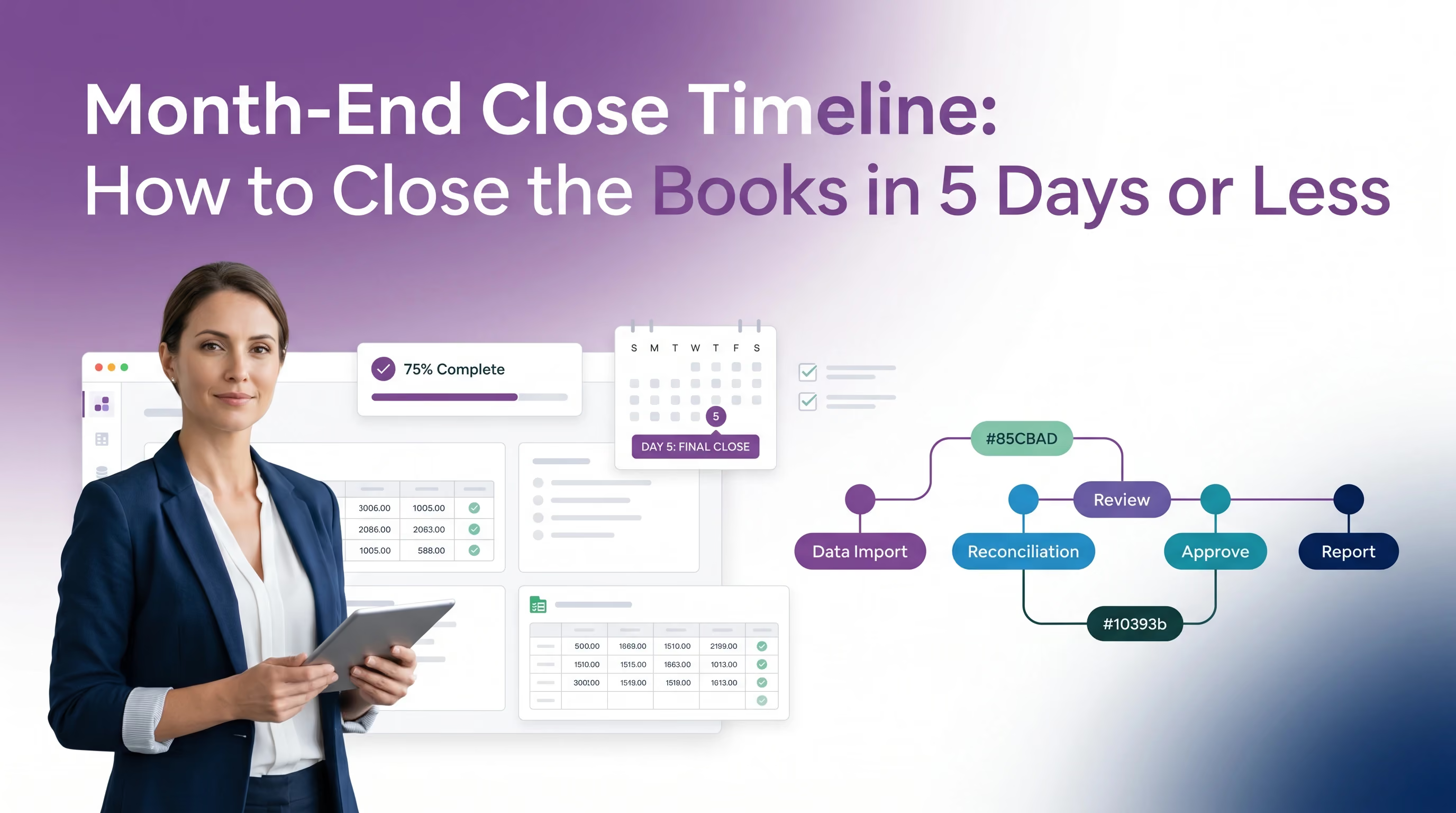
Month-end close timeline (5 business days)
| Day | Primary objective | Key tasks | Owner(s) |
|---|---|---|---|
| Day 1 | Stop the bleeding | Close AP intake by cutoff. Post bank and credit card through cutoff. Confirm payroll final numbers. | AP. Staff accountant. Payroll. |
| Day 2 | Get the subledgers stable | Close AR posting window. Tie AR and AP to GL. Post recurring entries. Start cash rec. | AR. AP. Staff accountant. |
| Day 3 | Reconcile the balance sheet | Finish cash recs. Reconcile payroll liabilities. Clear suspense and clearing accounts. Prepare schedules for accruals. | Staff accountant. Senior accountant. |
| Day 4 | Adjust and explain | Post accruals and deferrals. Review revenue recognition support. Run variance checks. Draft flux notes. | Senior accountant. Controller. |
| Day 5 | Review and release | Controller review. Fix exceptions only. Lock period. Issue reporting package and KPI summary. | Controller. Finance lead. |
If you cannot complete Day 1 in one day, do not “extend the close.” Fix the cutoff and intake steps first.
Accounting close timeline template (copy and adapt)
A timeline is not a checklist. It is a checklist plus dates, dependencies, and review gates.
Below is a clean template structure you can put into Excel, Google Sheets, ClickUp, Asana, or your close software.
Accounting close timeline template fields
- Task name
- Category (AP, AR, Cash, Payroll, Revenue, Fixed assets, Reporting)
- Dependency (what must be completed first)
- Owner (role, not person, if possible)
- Start day and due day (Day 0, Day 1, Day 2, etc.)
- Status (Not started, In progress, Ready for review, Complete)
- Reviewer (controller or partner)
- Evidence link (support file, report screenshot, reconciliation)
- Materiality / threshold rule (what triggers escalation)
- Notes (exceptions only)
Example close timeline tasks (starter list)
- Import bank feeds and post bank rules results.
- Reconcile operating accounts and merchant accounts.
- Tie out AR subledger to GL.
- Tie out AP aging to GL.
- Book payroll and reconcile payroll liabilities.
- Review deferred revenue rollforward, if applicable.
- Book prepaid amortization and fixed asset depreciation.
- Reconcile intercompany, if applicable.
- Review accruals with prior-month comparison.
- Run P&L variance report and document explanations.
- Final balance sheet review and sign-off.
If you want this to run fast, keep each task small. One owner. One output. One review point.
Why close timelines slip (and how to fix them)
Close delays look like staffing issues. They usually start as process issues.
Here are the most common root causes I see in accounting teams and outsourced models.
Before troubleshooting your own calendar, it can help to see the specific bottlenecks that usually block a fast close, since most delays trace back to the same handful of root causes.
Common close bottlenecks
- No true cutoff policy, so late items keep entering the period.
- Clearing accounts used as trash bins, so reconciliations turn into investigations.
- Reconciliations built from scratch each month, instead of rolled-forward workpapers.
- Review happens in big batches, so fixes come back too late.
- Too many manual journal entries, because upstream automation never got finished.
Fixes that shorten the close without lowering quality
- Set documented cutoffs and enforce them for 2–3 cycles.
- Create standard rollforward workpapers for every key balance sheet account.
- Use recurring entries and schedules for anything predictable.
- Add review gates on Day 2 and Day 4, not just Day 5.
- Track “days to subledger freeze” as a core metric.
Speed comes from stability. Not heroics.
Best-practice controls for a faster close (without rework)
A fast close process still needs controls. Otherwise you just move errors earlier.
Use simple controls that fit the size of your client or company.
Close controls that scale well
- Bank rec completeness rule: every cash and merchant account reconciled to statement or cutoff date.
- AR/AP tie-out control: subledger totals match GL control accounts.
- Accrual support standard: every accrual has a calc, source, and reversal policy.
- Flux threshold: require explanations for variances over a set amount or percentage.
- Balance sheet review checklist: every account has an owner and a normal balance expectation.
These controls reduce partner review time. They also make close quality consistent across staff levels.
When a 5-day close is a bad idea
Yes, that happens.
A 5-day close can be the wrong target when the business needs accuracy more than speed. Or when key inputs arrive late by nature.
Common examples include inventory counts that finalize on day 6. Or revenue data that depends on third-party platform settlements after month-end.
In those cases, the better approach is often a two-step close.
- Day 5 “flash close” for leadership KPIs and directional results.
- Day 10 “final close” for GAAP-level accuracy and external reporting readiness.
That keeps momentum without forcing estimates where they do not belong.
Structured outsourcing as an operational close accelerator (and where Etisson fits)
Some firms and finance teams use outsourcing to “add hands.” That rarely fixes close. It often adds coordination overhead.
It helps to understand how firms structure the close when part of it is outsourced, since the sequencing above still applies even when some tasks move offshore.
Structured outsourcing works differently. It treats close like a managed workflow, with standards that do not change when people change.
In practice, that means a few operational elements.
- Process discipline through documented SOPs, role clarity, and consistent workpapers.
- Automation-first workflows so bank rules, AP coding, and recurring entries reduce manual touch.
- Visibility and control through shared close dashboards, due dates, and reviewer gates.
- Reduced partner review burden by standardizing support and routing only exceptions for escalation.
- Scalable growth without hiring risk by adding trained capacity in defined roles and timelines.
Etisson fits best in that structured model. Teams use Etisson as an operational extension staffed with qualified US- and UK-trained professionals, backed by SOP discipline and tight communication.
That combination matters because close speed depends on consistency. Not on one strong senior who holds everything together.
Month-end close KPIs to track (so the timeline improves each month)
If you do not measure close, you will repeat the same friction.
Track a small set of metrics that show where work gets stuck.
Close performance metrics
- Days to close (calendar and business days).
- Days to subledger freeze (when AP, AR, cash stop changing).
- Reconciliation completion rate by Day 3.
- Number of post-close entries (and why they happened).
- Review cycle time (time from “ready for review” to “approved”).
- Aging of unreconciled items in clearing and suspense accounts.
Then hold a 30-minute post-close retro. One change per month is enough to create real speed over a quarter.
FAQ (direct answers)
How long does month end close take?
Most teams complete month-end close in 5 to 10 business days. Complex environments with inventory, multi-entity consolidations, or heavy accruals often take 8 to 15+ days.
Is closing the books in 5 days realistic?
Yes, a 5-day close is realistic when you enforce cutoffs, reconcile key accounts during the month, stabilize subledgers by Day 2, and build controller review into the schedule.
What should be included in a month end close schedule?
A month end close schedule should include cutoff deadlines, task owners, dependencies, reconciliation targets, journal entry timing, review gates, and report release timing.
What is the fastest month end close process?
The fastest close process uses pre-close work during the month, then follows a tight sequence: post and freeze subledgers, reconcile balance sheet accounts, book supported accruals, complete review, lock, and report.
What is an accounting close timeline template?
An accounting close timeline template is a structured tracker that lists tasks, owners, due days, dependencies, review steps, and links to support. It turns close from a checklist into a managed workflow.
What is the biggest cause of a slow close?
The biggest cause of a slow close is late-changing inputs, usually from weak cutoffs, incomplete subledgers, and unreconciled clearing accounts that force rework during review.
Conclusion
A fast close starts before month-end. It depends on stable subledgers, clean reconciliations, and short review loops.
If you want “close in 5 days,” build the timeline around dependencies. Then enforce cutoffs and standardize support so review becomes a decision step, not a scavenger hunt.
That is how month-end close becomes predictable. And predictability is what your partners, controllers, and clients actually want.