.avif)

Blog Summary / Key Takeaways
• Offshore accounting services provide dedicated, trained professionals working inside your systems on your clients. The dedicated model is what distinguishes a successful engagement from a failed one.
• Services covered include the full production accounting stack: bookkeeping, close, tax prep, controller tasks, cleanup, and migration work.
• Offshore services cost 40 to 65% less than a fully loaded US hire depending on role level and provider location.
• Verify six things before signing: security certifications, US training curriculum, staff retention rate, dedicated model confirmation, onboarding timeline, and pilot availability.
• India-based providers are typically 15 to 20% less expensive than Philippines-based providers for comparable roles. Provider quality matters more than country.
• Etisson offers 48-hour onboarding and a 40-hour free pilot for all new engagements.
Offshore Accounting Services: What They Include, How They Work, and How to Choose the Right Provider
Every CPA firm owner has heard the pitch. Offshore accounting services. Trained professionals. Fraction of the US cost. 48-hour onboarding.
Some of them have tried it and it worked. Some tried it and it did not. The difference between those two outcomes is almost never the country where the professional is located. It is the provider model, the onboarding structure, and whether the firm set up the engagement correctly on their end.
This guide explains what offshore accounting services actually include for CPA firms, how the top providers differ, what questions to ask, and what to verify before you commit to anyone.
What Are Offshore Accounting Services?
Offshore accounting services means hiring accounting professionals in another country to handle defined accounting work for your firm. They work inside your systems, on your client files, under your oversight and review process. You review the output. They handle production.
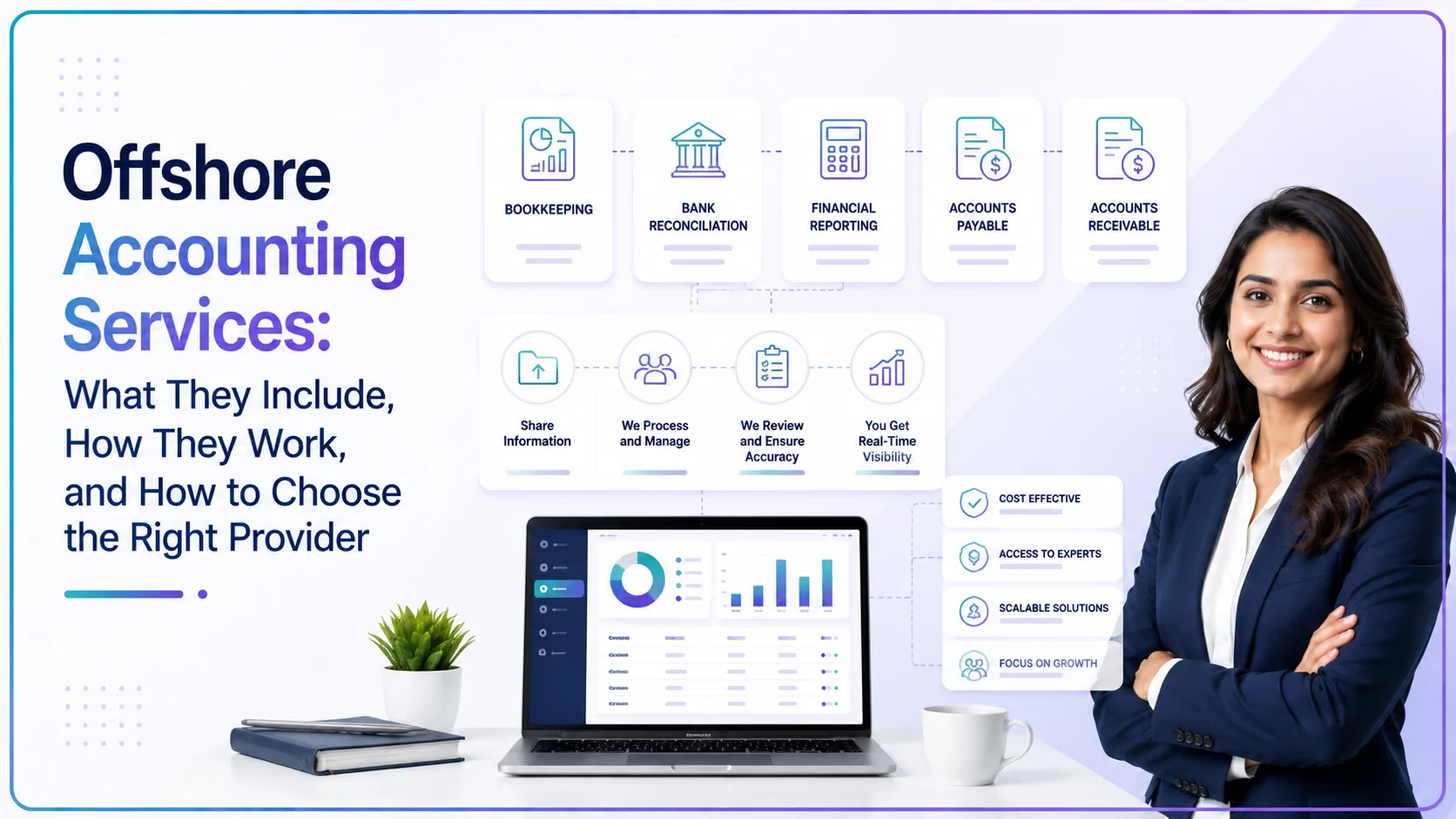
For US CPA firms, this typically covers bookkeeping, reconciliations, month-end close, tax return preparation, controller-level tasks like accruals and prepaids, and workpaper preparation. The offshore professional produces the work. Your internal team reviews it before it reaches clients.
The defining characteristic of legitimate offshore accounting services for CPA firms is the dedicated model. The professional works exclusively for your firm. They are not processing work for 20 other companies simultaneously. They are not a processing center that returns files with no accountability. They are an extension of your team who happens to sit in a different country and time zone.
That distinction separates the offshore arrangements that work from the ones that generate the LinkedIn posts about what a disaster it was.
Firms weighing this setup often want to understand how to decide between a dedicated offshore hire and project-based outsourcing before committing to either model.
What Services Do Offshore Accounting Providers Cover?
The range of services available through offshore accounting providers has expanded significantly. Here is what reputable providers cover today.
| Service | Covered by Most Providers | Notes |
|---|---|---|
| Daily bookkeeping | Yes | Transaction coding, bank feeds, payroll entries |
| Bank reconciliations | Yes | Standard, high-volume task |
| Month-end close prep | Yes | Tie-outs, journal entries, supporting schedules |
| Tax return preparation | Yes | 1040, 1065, 1120S, 1120 |
| Accruals and prepaids | Yes | Requires senior-level professional |
| Depreciation schedules | Yes | Standard task |
| Workpaper preparation | Yes | Audit-ready documentation |
| Controller-level close | Yes | Budget vs actuals, inter-company recs |
| Catch-up and cleanup | Yes | Backlog work, messy books |
| Migration work | Yes | QBO to Xero, desktop to cloud |
| Financial statement review | Partial | Final review stays with CPA |
| Client advisory | No | Always stays internal |
The breadth of services means offshore professionals can handle nearly all production-level accounting work. What stays internal is anything that requires professional judgment, direct client communication, or final sign-off under your license.
Since month-end close prep is one of the most commonly delegated tasks, it's worth reviewing how offshore bookkeepers should adapt a month-end close checklist so the handoff does not create rework for your reviewing team.
How Do Offshore Accounting Services Differ From Domestic Outsourcing?
Three core differences matter in practice.
Cost.
A domestic outsourced bookkeeper in the US costs $25 to $45 per hour. An offshore dedicated professional costs the equivalent of $10 to $18 per hour when priced as a monthly FTE rate. The annual savings versus a fully loaded US hire run 40 to 65% depending on role level. That gap is not marginal. It is structural.
Talent availability.
India and the Philippines produce hundreds of thousands of accounting graduates annually. The US pipeline has been declining for years. Finding a qualified offshore professional through a structured provider takes days to weeks. Finding a qualified US hire in the current market takes three to six months per search. The talent supply problem is not getting better.
Scale speed.
Adding a second or third offshore professional through an established provider takes one to two weeks once you have a working engagement. Adding a second or third US hire takes three to six months per hire. For a firm that is growing, the speed difference compounds.
Time zone is the most cited concern. It is manageable. India Standard Time is 9.5 to 13.5 hours ahead of US time zones. The solution is a clear daily handoff process: tasks assigned at end of your day, completed overnight, ready for morning review. Most firms adapt within two to three weeks and stop thinking about it. The firms that struggle with time zone coordination are almost always the ones that never defined the handoff protocol explicitly. The ones that documented the handoff from day one report that the time zone gap became invisible within 30 days.
A shared task board in Karbon, Asana, or even a simple spreadsheet is enough to manage the daily workflow. You do not need real-time availability for production accounting work. You need clear task assignments, defined output formats, and a review process. All three of those exist in your firm already.
What Do Offshore Accounting Services Cost in 2026?
Costs vary by role level, provider location, and engagement model. Here is a realistic breakdown.
| Role | US Fully Loaded Annual | Offshore Annual | Savings |
|---|---|---|---|
| Staff Bookkeeper | $75,000 to $95,000 | $18,000 to $28,000 | 50% to 65% |
| Senior Accountant | $95,000 to $120,000 | $28,000 to $42,000 | 45% to 60% |
| Tax Associate | $85,000 to $110,000 | $22,000 to $36,000 | 45% to 60% |
| Controller Support | $50,000 to $80,000 equiv | $18,000 to $32,000 | 45% to 65% |
These are total engagement costs including provider overhead, not salary-to-salary comparisons. The US figures include FICA, health insurance, 401k, PTO, and recruiting fees that the offshore model eliminates entirely.
India-based providers are typically 15 to 20% less expensive than Philippines-based providers for comparable roles. Both are significantly below US hire cost. The cost difference between the two offshore destinations is far smaller than the cost difference between either and a US hire.
What Should CPA Firms Verify Before Choosing an Offshore Provider?
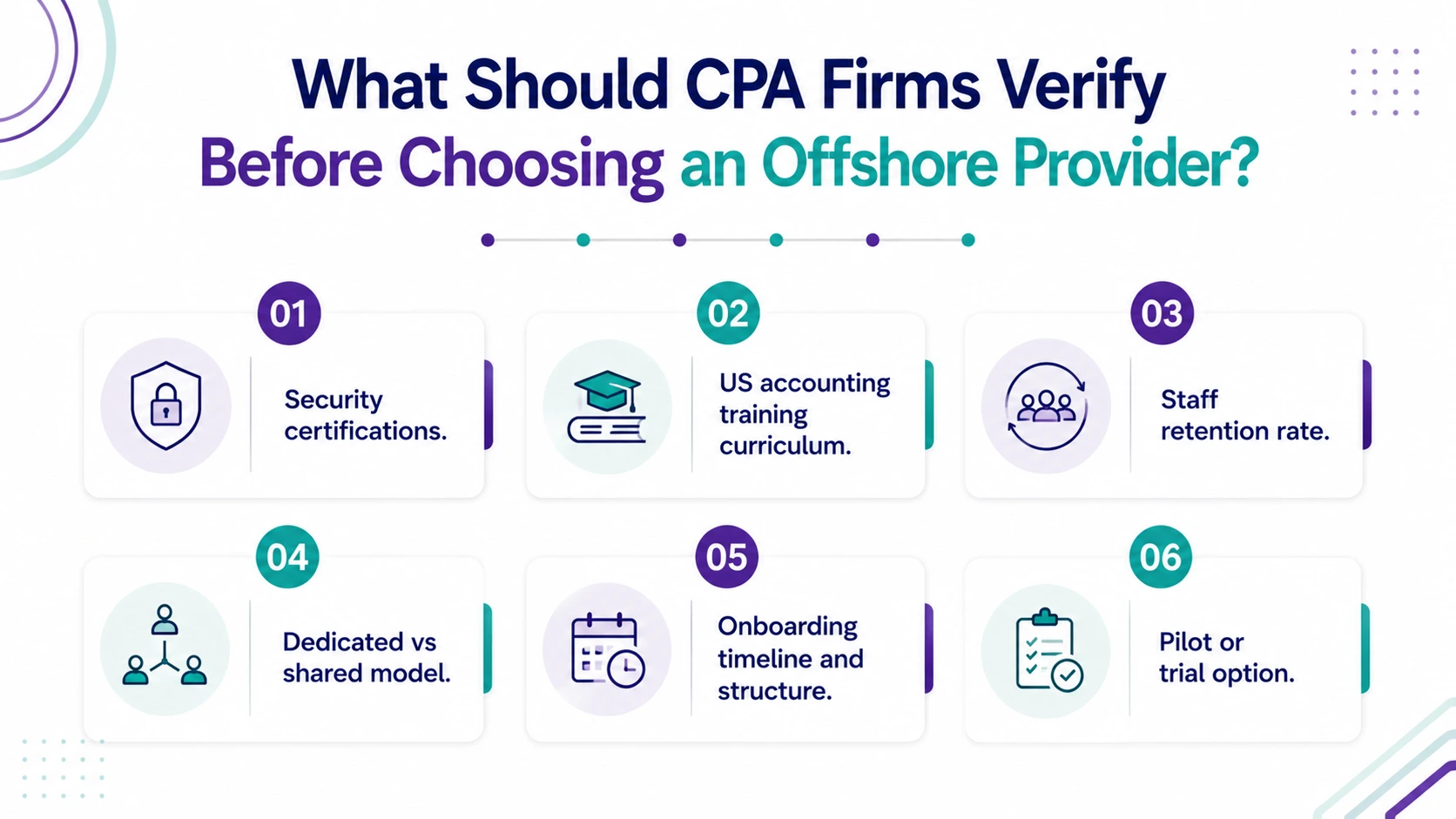
Six things to check before signing with any offshore accounting services provider.
Security certifications.
SOC 2 Type II and ISO 27001 are the two relevant standards for firms handling US client financial data. The FTC Safeguards Rule requires your firm to ensure any third party handling client financial information maintains appropriate safeguards. Ask for the actual certificate documents, not a claim on a website or a marketing PDF.
US accounting training curriculum.
Ask specifically which IRS forms their professionals train on, which accounting software platforms, and what the training pathway looks like from hire to placement. Vague answers
about 'comprehensive training programs' are a warning sign. Good providers name the specific forms, the specific platforms, and the specific US GAAP concepts their training covers.
Staff retention rate.
A provider with 40% annual staff attrition means you restart the onboarding process and the client-familiarity learning curve every 9 to 12 months. Ask for the actual annual retention number. Anything below 80% is a red flag. Anything above 90% suggests a well-run operation.
Dedicated vs shared model.
Confirm explicitly that your assigned professional works only for your firm. Shared models produce inconsistent results for CPA-level work where client familiarity and format consistency matter. Do not assume. Ask directly.
Onboarding timeline and structure.
Ask for a day-by-day onboarding breakdown, not a general promise of getting you up and running quickly. Vague onboarding language usually means a three to four week ramp that costs you significant partner oversight time. Etisson completes onboarding in 48 hours from agreement to first task assignment.
Pilot or trial option.
Any provider confident in their output should offer a way to evaluate work quality on your actual client files before a long-term commitment. Etisson's 40-hour free pilot is structured exactly for this. You see real work on real files. You decide based on actual output, not a sales conversation.
How Do the Top Offshore Accounting Services Compare?
| Provider | Location | Best For | Onboarding | Pilot | Cost vs US |
|---|---|---|---|---|---|
| Etisson | India | Small to mid CPA firms (3-25 staff) | 48 hours | Yes, 40 hrs free | ~40% |
| QX Accounting | India | Mid to large firms, audit support | 1-2 weeks | Case by case | ~40-45% |
| TOA Global | Philippines | Long-term staffing, all sizes | 1-3 weeks | No | ~45-55% |
| Entigrity | India | CPA-only firms | 1-2 weeks | No | ~40-48% |
The differences come down to onboarding speed, pilot availability, cost, and firm size fit. For a small to mid-size CPA firm making their first offshore engagement, the 40-hour pilot and 48-hour onboarding at Etisson reduces the risk of the first decision significantly.
A Real Scenario: A 10-Person Firm Moving Controller-Level Close Offshore
A 10-person CPA firm in the Mountain West had been handling controller-level close in-house for 22 business clients. Their one internal controller was working 55-hour weeks every month-
end. The firm was turning away two or three new controller-service clients per quarter because there was simply no internal capacity to take them on.
They added one Etisson senior accountant with controller-level training. That professional took over accruals, prepaids, depreciation, and budget-vs-actuals analysis for 8 of the 22 clients in month one. By month three, they were handling 14 clients independently with a weekly review from the internal controller.
The internal controller shifted to review and client advisory on all 22 accounts. She began onboarding the three clients the firm had previously turned away. Her hours dropped from 55 to 42 per week during close periods.
Revenue from the three new controller-service clients covered the Etisson engagement cost more than four times over in the first six months. The firm is now the largest controller-services provider in their local market.
How Etisson Delivers Offshore Accounting Services
Etisson provides dedicated offshore accounting professionals from India, trained on US GAAP and the software platforms CPA firms use. Every engagement is dedicated. Your professional works exclusively for your firm on your client files.
Services covered include bookkeeping, controller services, close and finalization, tax prep support, catch-up and cleanup, and migration work. Onboarding takes 48 hours from agreement. The 40-hour free pilot is available for every new engagement.
FAQs
What are offshore accounting services for CPA firms?
Offshore accounting services means hiring trained accounting professionals in another country to handle production accounting work for your firm under your review and oversight.
Are offshore accounting services reliable for CPA firms?
Yes, when the provider has strong US-specific training, documented security certifications, and a dedicated model. Reliability comes from setup, not from location.
How much do offshore accounting services cost?
A staff bookkeeper offshore runs $18,000 to $28,000 per year versus $75,000 to $95,000 fully loaded in the US. Savings across roles are 40 to 65%.
What is the difference between offshore accounting services and a staffing agency?
Staffing agencies place candidates for temporary assignments. Offshore accounting service providers place dedicated professionals who work exclusively for your firm long-term. The continuity and institutional knowledge built are fundamentally different.
Which country provides the best offshore accounting services for US CPA firms?
India and the Philippines are the two primary markets. India-based providers are typically lower cost. Philippines-based providers like TOA Global have strong internal training programs. Both are credible options with different cost and culture trade-offs.
How do I verify an offshore accounting provider's security standards?
Ask for their SOC 2 Type II certificate and ISO 27001 certificate as physical documents. Do not accept website claims or marketing materials as substitutes.
Does Etisson provide offshore accounting services for small CPA firms?
Yes. Etisson works with firms from solo CPAs to 25-person practices. The 40-hour free pilot and 48-hour onboarding specifically lower the barrier for smaller firms making their first offshore engagement.
Want to see offshore accounting working inside your firm before you commit?
Start your 40-hour free pilot: https://meetings.hubspot.com/nick2204
Conclusion
Offshore accounting services are no longer just a cost-saving option, they've become a strategic advantage for CPA firms looking to grow without the challenges of constant hiring. By building a dedicated offshore team, firms can increase capacity, maintain quality, and free their onshore staff to focus on advisory work and client relationships. The key is choosing a provider with strong security, proven accounting expertise, and a dedicated staffing model that integrates seamlessly into your existing workflows. With the right partner, offshore accounting becomes more than operational support...it becomes a foundation for long-term, scalable growth.