.avif)

Blog Summary / Key Takeaways
- Leads with what is actually included in outsourced bookkeeping, task by task, not pricing
- Full inclusion list for standard monthly packages plus QuickBooks-specific deliverables
- A 4-step bookkeeping cleanup workflow for messy historical books
- Covers the 3 delivery models, virtual, offshore, and hybrid
- Includes a what-to-outsource-vs-keep-internal decision table
- 5 FAQs covering inclusions, cleanup timelines, and offshore safety
Quick answer
Outsourced bookkeeping means an external team records transactions, completes reconciliations, and prepares month-end close packages under your firm's standards and review requirements. Your CPA firm retains final sign-off and client responsibility.
Most guides lead with cost. This one leads with what you actually get, task by task, plus how a proper cleanup gets done when books arrive messy.
What is outsourced bookkeeping?
Outsourced bookkeeping is when your firm assigns bookkeeping production to an external team instead of performing it fully in-house. The work follows your chart of accounts, close calendar, and documentation rules.
In practice it covers two distinct needs. Ongoing monthly production work, and one-time cleanup after a messy period.
The controls and cadence look different for each. Do not use the same SOP for both, or the cleanup will drag while monthly work slips.
If you are deciding how to structure the engagement itself, see our breakdown of the four engagement models for outsourced bookkeeping.
What is included in outsourced bookkeeping services
Standard monthly package, US environment
- Bank and credit card reconciliations, all accounts, tied to statements
- Transaction coding using your chart of accounts, class, and location rules
- AP support, invoice processing, coding, payment run prep
- AR support, customer invoicing, payment application, aging management
- Payroll posting from ADP, Gusto, Paychex, or Rippling payroll reports
- Accrual entries and recurring journal entries with reversal logic
- Month-end close package, reconciliations, supporting schedules, exception notes
- IRS Form 941 payroll liability reconciliation to GL
- Sales tax payable reconciliation to state filing schedule
QuickBooks-specific deliverables
QBO environments carry their own checklist items that generic scopes tend to miss.
- Transaction Detail by Account report reviewed
- Ask My Accountant cleared to zero
- Unapplied Cash Payment Income checked
- Bank feed exceptions resolved rather than force-matched
- Closing date password set after period lock
If a provider cannot speak to these specifically, they are describing bookkeeping in the abstract rather than in your actual file.
What to outsource vs keep internal
| Good for outsourced bookkeeping | Keep internal or tightly controlled |
|---|---|
| Recurring bank rules and coding with clear SOPs | Revenue recognition judgment calls |
| Standard reconciliations with consistent source docs | Complex accrual estimates without strong source systems |
| Fixed monthly accrual templates | Equity and cap table activity |
| Close tick-and-tie packages | Tax-sensitive classification decisions without clear policies |
| Cleanup work with defined scope and timeline | Client relationship management and escalation calls |
Rule of thumb: if your team argues about a task every month, do not outsource it yet. Fix the policy first, then outsource the execution.
Bookkeeping cleanup: the 4-step workflow for messy books
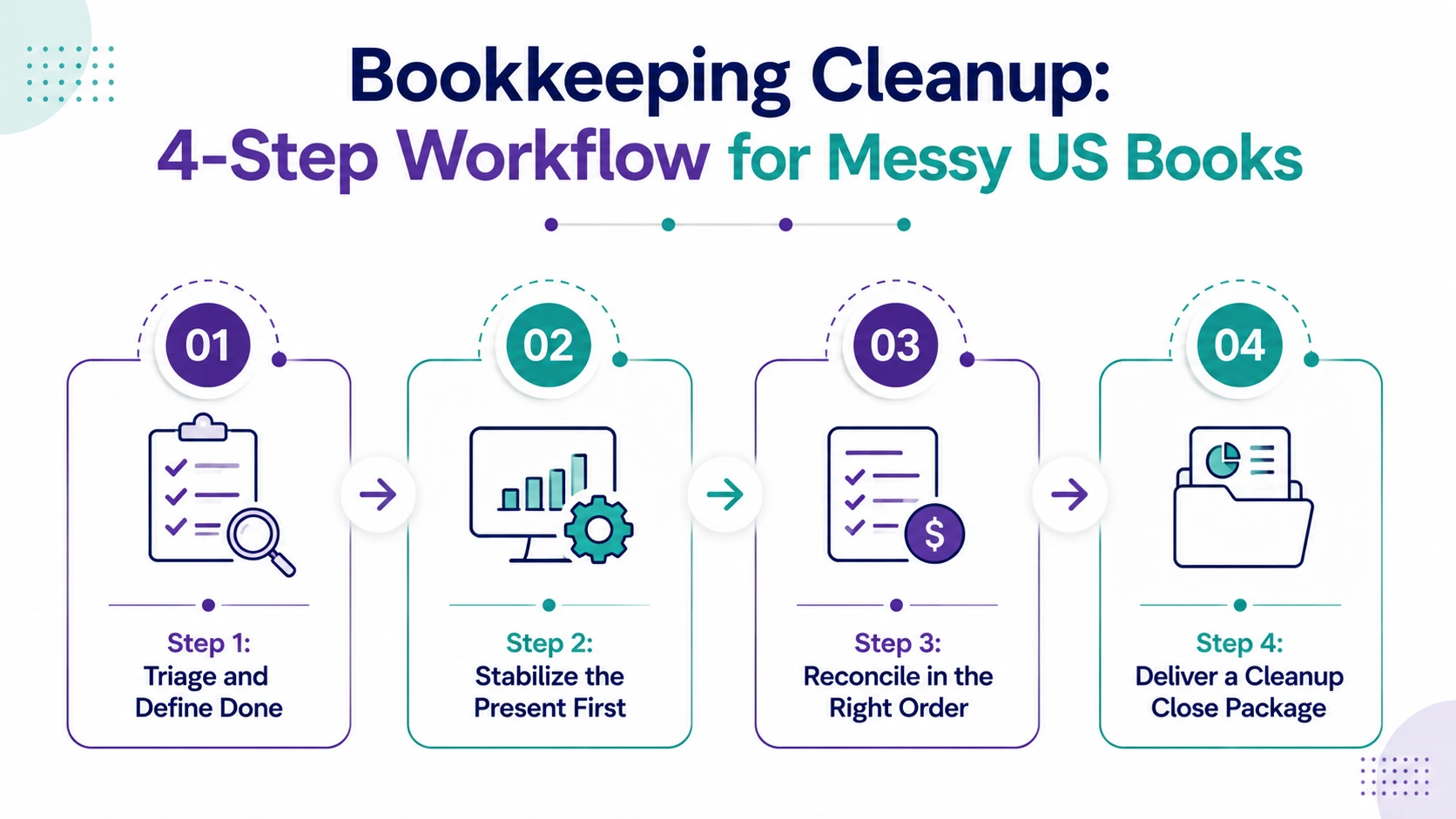
This is where inclusion lists fall short. Cleanup is not the same deliverable as monthly bookkeeping, and the workflow needs its own structure.
Step 1: Triage and define done
Define the target period and deliverables before touching the file. For example: all bank accounts reconciled through December, AR and AP tied to subledgers, loan balances agreeing to statements.
Classify issues into four buckets. Structural problems in the chart of accounts, data problems like missing statements, process problems like absent cutoff rules, and judgment problems like owner draws and mixed-use expenses.
Step 2: Stabilize the present first
Set up bank feeds correctly in QBO. Turn off broken rules. Confirm the posting approach for payroll and merchant deposits.
If the client keeps creating chaos in real time, your cleanup team will chase its tail in history. Stop the inflow before working backward.
Step 3: Reconcile in the right order
Order matters here more than most firms expect. Working out of sequence means redoing work when an upstream account changes.
- Bank and credit card reconciliations first
- Payroll clearing accounts and IRS 941 tax liabilities next
- Loan accounts and interest allocations
- AR and AP subledgers and aging
- Equity accounts and owner distributions last
Step 4: Deliver a cleanup close package
Do not just make the file match. Deliver workpapers a reviewer can rely on.
- Reconciliation reports for each account
- Adjustment explanations tied to source documents
- An open items list with what is still unresolved
- A summary of process gaps found during cleanup
That last item matters most. It tells the client what to fix so the same cleanup is not needed again next year.
The three delivery models
| Model | What it means | Best for | Key risk |
|---|---|---|---|
| Virtual (US-based remote) | Remote delivery, US-based bookkeeper | Clients needing real-time US communication | Higher cost, harder to scale |
| Offshore | Production work outside the US | High-volume repeatable production | Requires strong SOPs and documented processes |
| Hybrid | Offshore production plus onshore review and PM layer | Most CPA firms scaling CAS | Documentation must be tight, work moves between layers |
A virtual bookkeeper is a single remote professional and carries key-person risk. An outsourced service provides a team with SOPs and backup coverage, but requires stronger SOP alignment on your side.
What it costs, briefly
Pricing runs from hourly offshore rates through fixed monthly retainers, and it depends heavily on account count, cleanup level, and complexity.
Track cost per closed set of books rather than hourly rate. That is the number that reflects partner and manager review time, which is where the real cost sits.
How to evaluate providers: a 5-point scorecard
| # | Criterion | What to ask |
|---|---|---|
| 1 | Process discipline | Show me your close checklist. How do you handle client-to-client differences inside QBO? |
| 2 | Pre-review QC | What does your internal review look like before work reaches the firm reviewer? |
| 3 | Communication and handoffs | How does work move from preparer to reviewer and back? Who owns that loop? |
| 4 | Security and access | Do you use MFA? Who holds admin rights? How do you handle staff turnover? |
| 5 | Automation-first workflows | Which steps do you automate, which stay manual, and why? |
Ask for a sample close package before signing. A sales conversation does not equal a close process.
Etisson provides US GAAP-trained bookkeepers with 48-hour onboarding and a free 40-hour pilot, with no long-term commitment required.
FAQ
What is outsourced bookkeeping?
Outsourced bookkeeping is when an external team records transactions, completes reconciliations, and prepares month-end close workpapers under your firm's standards, while your firm retains final review and client responsibility.
What do outsourced bookkeeping services include?
Standard services include transaction coding, bank and credit card reconciliations, AP and AR support, payroll posting from provider reports, recurring journal entries, IRS 941 reconciliation, sales tax payable reconciliation, and month-end close package preparation.
How long does bookkeeping cleanup take?
A simple six-month cleanup typically takes two to four weeks. Multi-year cleanup with messy payroll can take six to ten weeks. Projects move fastest when you stabilize current-month processing first.
Is offshore bookkeeping safe for US CPA firms?
Yes, when you set strong controls: role-based access, MFA, documented SOPs, secure file storage, and clear review checkpoints. Risk increases when approvals happen through informal channels.
What is included in bookkeeping cleanup services?
Cleanup typically includes catching up historical transaction coding, completing past-due reconciliations for bank accounts, credit cards, payroll liabilities and loans, correcting chart of accounts mapping, and producing reliable financial statements for the cleaned period.
What is the difference between a virtual bookkeeper and outsourced bookkeeping?
A virtual bookkeeper is a single remote professional and carries key-person risk. Outsourced bookkeeping services provide a team with SOPs and backup coverage, which mitigates that risk.
How do CPA firms choose outsourced bookkeeping companies?
Evaluate on process discipline, internal QC before work reaches your reviewer, communication rhythm, security controls, and whether they can work inside your tech stack without constant hand-holding.
Conclusion
Outsourced bookkeeping frees your CPA firm to focus on advisory and client relationships by handling the production layer, reconciliations, transaction coding, payroll posting, and month-end close packages.
Know what is actually included before you compare pricing. Treat cleanup as its own workflow, not an extension of monthly bookkeeping.
When you separate production from judgment, outsourced bookkeeping becomes the capacity layer that scales without sacrificing firm standards.