.avif)

Blog summary
- Outsourced controller services give you controller-level oversight without adding a full-time hire.
- They strengthen month-end close, clean up reporting, and enforce controls.
- For CPA firms, they also reduce partner review time and stabilize delivery when staffing gets tight.
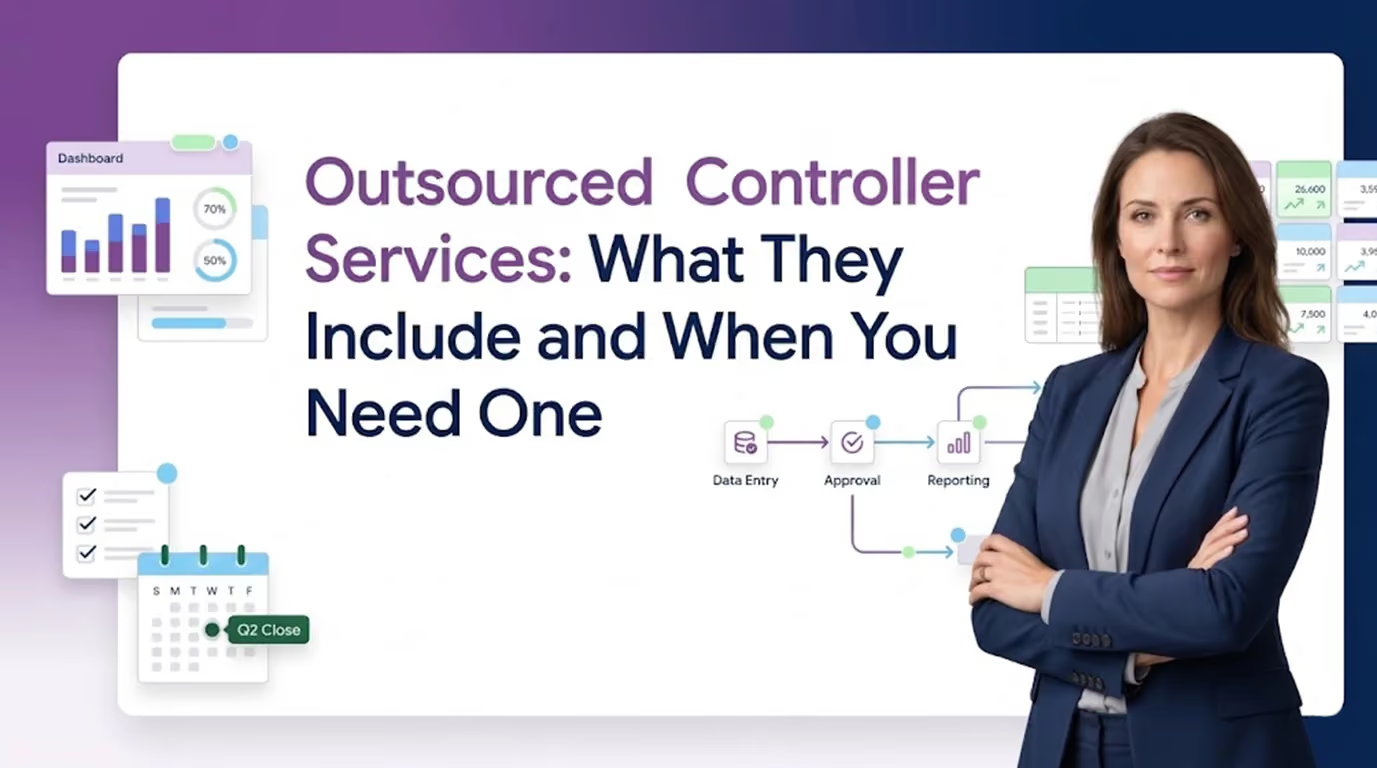
- This guide explains what an outsourced controller does, when to hire one, and how to scope fractional controller services without creating rework.
Outsourced controller services are not bookkeeping. That is the point.
Most accounting teams do not struggle because they cannot enter bills or code bank transactions.
They struggle because nobody owns the quality of the close.
They also struggle because nobody enforces standards across clients, staff, and months.
An outsourced accounting controller fills that gap.
They operate at the controller layer, which sits between day-to-day bookkeeping and CFO advisory.
They focus on accuracy, completeness, controls, and repeatability.
If you run a CPA firm, you already know this pain.
Bookkeeping can be outsourced. Payroll can be outsourced.
But when the close breaks, partners still get pulled in.
What is an outsourced controller?
An outsourced controller is an experienced accounting professional who manages controller responsibilities for your business or your client accounts on a part-time or contracted basis.
They own the close process, financial statement quality, and control environment.
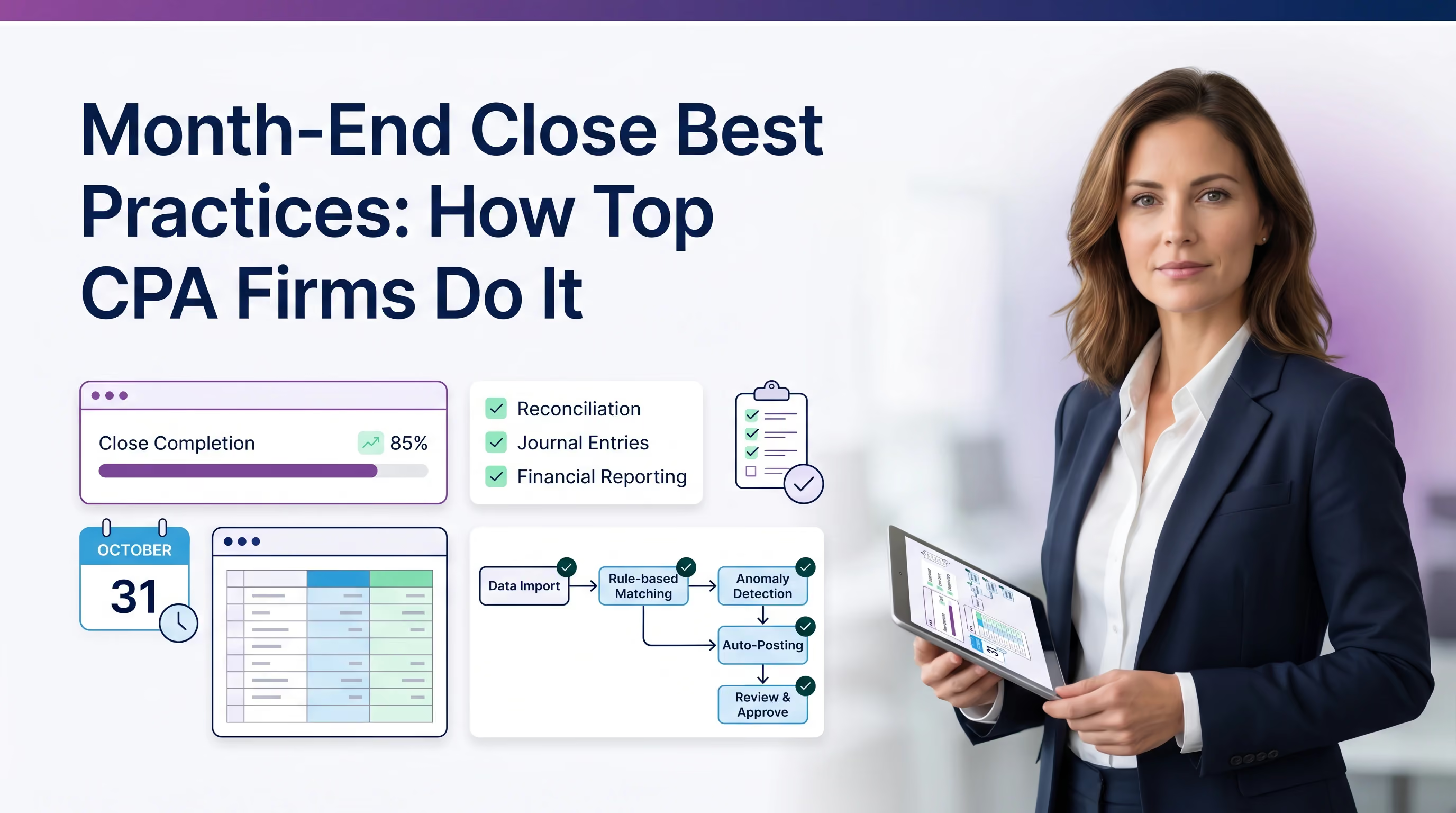
For a day-by-day breakdown of how a fast close actually runs, see this month-end close timeline.
They also make sure the books can stand up to tax work, audits, lender reviews, and due diligence.
They do not replace your bookkeeper.
They make your bookkeeper's output reliable.
They also create the structure that keeps your team from relearning the same lessons every month.
Outsourced controller vs. fractional controller services
People use both phrases, but the intent usually differs.
Fractional controller services describe capacity and schedule. Think days per week or hours per month.
Outsourced controller services describe delivery model. Think external team, defined scope, and SLAs.
In practice, many firms deliver both at once.
You outsource the function and staff it fractionally.
The key is to define what the controller owns, and what your team still owns.
Controller-level accounting services, explained in plain terms
Controller services exist to answer one question.
"Can we trust these financials enough to make decisions and file taxes without surprises?"
That is the operational bar.
Here is what controller level accounting services typically include.
These are the items that stop partner fire drills.
Core responsibilities you should expect
- Close calendar ownership and close management.
- Balance sheet reconciliations review and enforcement.
- Journal entry review, approval, and support for complex entries.
- Revenue recognition policy support, when relevant.
- Accruals, prepaids, and fixed asset accounting coordination.
- Financial statement package preparation and variance explanations.
- Internal controls and segregation of duties design for smaller teams.
- Cleanup projects and historical catch-up planning.
- Audit, tax, and lender support tied to workpaper quality.
A good outsourced controller also standardizes how work gets done.
They do not just "fix this month."
They prevent next month from breaking in the same way.
Why CPA firms buy controller services for CPA firms
A CPA firm rarely needs "more bookkeeping."
It needs more review capacity and more consistent quality.
It also needs a way to scale without turning partner time into a quality control department.
Controller services for CPA firms usually support one of three models.
Client accounting services (CAS) delivery.
A controller layer inside the firm's internal finance team.
Or technical close support for specific client segments.
Common CPA firm use cases
Your CAS team grew fast, but your close quality did not.
Your seniors can produce, but they cannot review at a controller standard yet.
Your partners review too much because they do not trust the workpapers.
Those are controller problems.
Not bookkeeping problems.
You solve them by putting controller ownership back into the workflow.
Outsourced controller vs. in-house controller: the operational trade-off
This is less about cost and more about risk.
In-house controllers can work well when you have stable volume and strong bench strength.
Outsourced controllers work well when volume fluctuates or quality varies across staff.
Here is a simple comparison you can use internally.
| Decision factor | In-house controller | Outsourced controller services |
|---|---|---|
| Speed to start | Slower due to hiring | Faster with defined onboarding |
| Scalability | Adds headcount steps | Adjusts hours and coverage |
| Process maturity | Depends on the hire | Often comes with SOP discipline |
| Continuity | Single point of failure risk | Coverage model can reduce gaps |
| Partner review burden | Improves over time | Can drop quickly with structured review |
| Your current problem | Best-fit support | Why |
|---|---|---|
| Transactions are behind and messy | Bookkeeping support | You need production capacity |
| Close is slow and unreliable | Outsourced controller services | You need close ownership and controls |
| You need forecasts, fundraising, strategy | Fractional CFO | You need forward-looking leadership |
| Taxes always require large cleanup | Controller + tax-ready workpapers | You need balance sheet integrity |
| Partners review everything | Controller services for CPA firms | You need consistent review standards |
If your pain shows up at month-end, you usually need a controller.
If your pain shows up in next-quarter decisions, you usually need a CFO.
FAQ:
What is an outsourced controller?
An outsourced controller is an external accounting professional who manages controller responsibilities like close management, reconciliations review, reporting quality, and internal controls on a contracted or part-time basis.
What do outsourced controller services include?
Outsourced controller services usually include managing the month-end close, reviewing balance sheet reconciliations, overseeing journal entries, producing financial statements with variance explanations, and strengthening internal controls and documentation.
Are fractional controller services the same as outsourced controller services?
Not always. Fractional controller services describe part-time access to a controller. Outsourced controller services describe using an external provider to deliver the controller function, often with defined processes and coverage.
When should a CPA firm use controller services?
A CPA firm should use controller services when close quality varies across staff, partner review time stays high, reconciliations do not get reviewed consistently, or tax work requires repeated cleanup and reclass entries.
When should a business hire an outsourced accounting controller?
A business should hire an outsourced accounting controller when the close takes too long, the balance sheet cannot be supported quickly, reporting swings cannot be explained, or lenders and tax preparers need reliable workpapers.
What is the difference between a bookkeeper and a controller?
A bookkeeper records transactions and completes first-pass reconciliations. A controller owns the close, validates the balance sheet, enforces controls, and ensures the financial statements are accurate and decision-ready.
Do controller-level accounting services help with audits and taxes?
Yes. Controller-level accounting services improve workpaper quality, ensure reconciliations tie out, and reduce last-minute adjustments. That makes audits smoother and tax prep faster and less disruptive.
Conclusion
Outsourced controller services work when you need repeatable close quality and stronger controls.
They fail when you treat them like "extra hands" with no authority.
Define ownership, standardize the close, and measure rework and review time.
That is how controller support becomes a scalable operating model.
Not another moving part.
Related reading: outsourced controller services pricing, how to compare top outsourced controller providers, Etisson home, and more CPA firm accounting guides.