.avif)

Blog Summary
- Catch-up bookkeeping means getting your books current after you have fallen behind.
- It covers bank and credit card reconciliations, transaction coding, cleanup, and review so your financial statements become usable again.
- This guide explains the catch up bookkeeping definition, what a bookkeeping backlog means, when you need catch up accounting, and what to do if you are behind on bookkeeping.
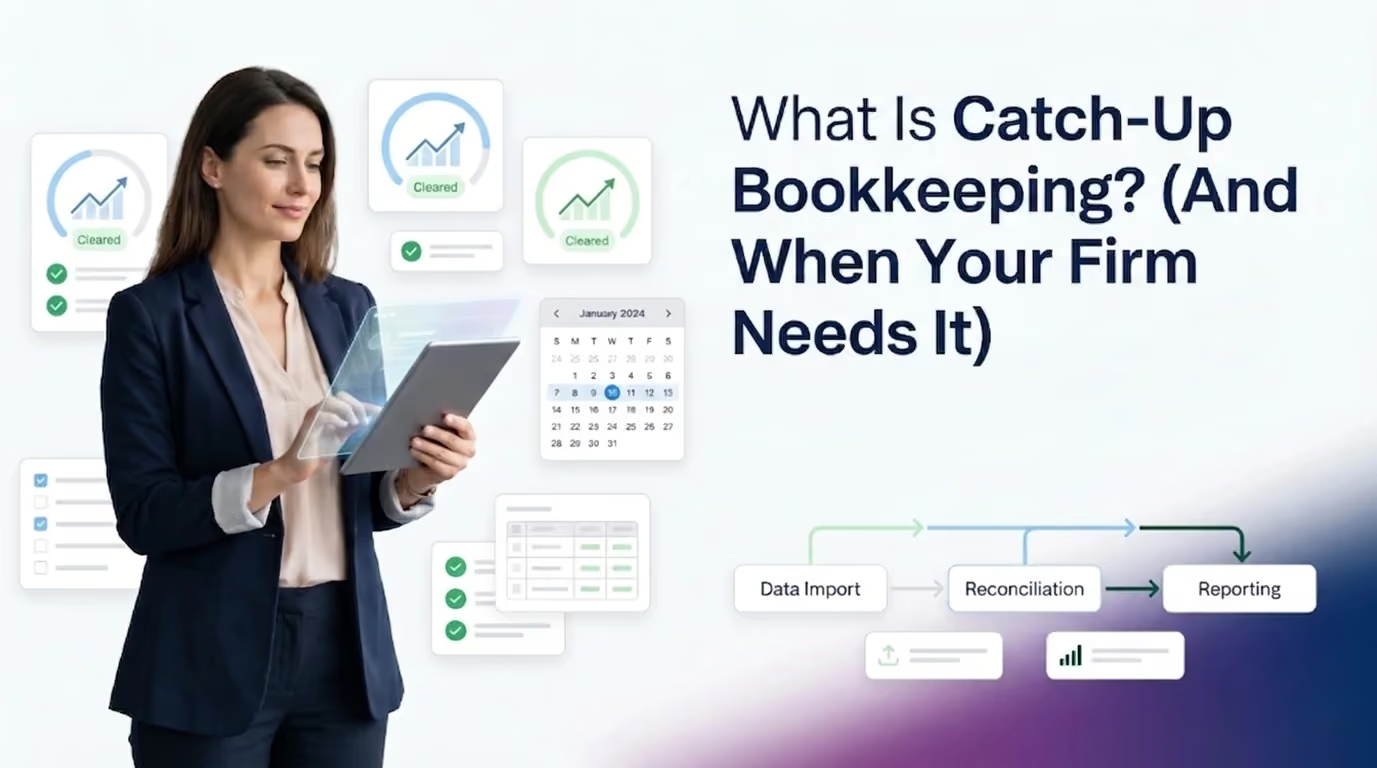
What is catch-up bookkeeping?
Catch-up bookkeeping is the process of bringing accounting records up to date after a business falls behind. It focuses on completing missing months, reconciling accounts, and correcting coding so reports become reliable.
It is not the same as “ongoing bookkeeping.” Ongoing work keeps you current each week or month. Catch-up work clears the backlog so ongoing processes can restart cleanly.
Most firms treat catch up accounting as a short project with a clear finish line. The goal is simple. Produce accurate month-by-month financials that you can use for tax, lenders, payroll filings, and decision-making.
Catch up bookkeeping
Here is a working catch up bookkeeping definition you can use with clients and internal teams.
Catch-up bookkeeping = completing and reconciling past-due bookkeeping periods so the general ledger matches real-world activity and supports accurate financial statements.
That includes five core outcomes.
- All bank and credit card accounts reconciled for each missing month
- Income and expenses categorized consistently
- Loans, payroll, sales tax, and clearing accounts cleaned up
- Duplicate entries and uncategorized transactions resolved
- Financial statements reviewed for reasonableness and obvious errors
If you cannot close a month with confidence, you are still in catch-up mode.
Bookkeeping backlog meaning (and why it gets expensive fast)
A bookkeeping backlog means you have unposted, uncategorized, unreconciled, or unreviewed activity from prior periods. It can be one month behind. It can be eighteen months behind. The pattern matters more than the number.
Backlogs compound because errors stack on top of missing work. A single unreconciled bank month often hides duplicates, missing deposits, and timing issues. Those issues then distort the next month, and the next.
This is why “we will catch up later” rarely works. Later usually means more volume, more missing documents, and more partner time spent untangling avoidable issues.
When do you need catch-up bookkeeping?
You need catch-up bookkeeping when your accounting records stop supporting tax filings, operational decisions, or compliance. That sounds broad. In practice, the triggers are usually obvious.
You likely need catch-up bookkeeping if any of these are true.
- Bank accounts have not been reconciled for 60+ days
- You cannot explain cash balance changes month to month
- Financial statements arrive late, or not at all
- Payroll, sales tax, or 1099s rely on estimates
- You have a tax deadline and the books are not closed
- You are applying for financing and the lender wants clean financials
- You changed bookkeepers, systems, or chart of accounts mid-year
- You have multiple “miscellaneous” and “ask my accountant” accounts growing
If more than two apply, you are probably looking at a backlog project, not a monthly fix.
What is the difference between catch-up bookkeeping and bookkeeping cleanup?
Firms use both terms. The distinction matters for scoping and staffing.
Catch-up bookkeeping: the books are missing periods. Months have not been entered at all. The task is to build the history.
Bookkeeping cleanup: the periods exist, but they are wrong. Miscoding, bad reconciliations, payroll errors, or chart-of-accounts inconsistencies make the data unreliable. The task is to correct the record.
Many clients need both. Their books are behind and messy. That is common after a system migration, a bookkeeper departure, or a year of self-managed accounting.
How long does catch-up bookkeeping take?
This is usually the first question. The honest answer is: it depends on three things.
- How far behind are the books?
- How many accounts and entities are in scope?
- How available are source documents?
Here is a general operational range for planning purposes.
| Months behind | Simple file (1-2 accounts) | Moderate file (3-5 accounts) | Complex file (6+ accounts) |
|---|---|---|---|
| 1-3 months | 3-7 days | 1-2 weeks | 2-3 weeks |
| 4-6 months | 1-2 weeks | 2-3 weeks | 3-5 weeks |
| 7-12 months | 2-4 weeks | 4-6 weeks | 6-10 weeks |
| 13-24 months | 4-6 weeks | 6-10 weeks | 10-16 weeks |
These ranges assume source documents are available. Missing statements add time. Multi-entity work adds time. Prior-year conversions add time.
What does catch-up bookkeeping cost?
Pricing varies by provider and model. Most charge by the hour, by the month, or as a flat project fee.
See this catch-up bookkeeping pricing guide for real 2026 cost ranges.
Hourly pricing is common for smaller backlogs or unclear scope. It feels flexible but can become unpredictable if document issues add time.
Flat-fee project pricing is better for defined scope. It creates accountability and makes budgeting easier.
Monthly rate pricing is common when the backlog size is known. The provider charges a rate per period and a fixed number of periods.
The real cost driver is not the provider rate. It is scope creep from missing documents and expanding complexity. Firms that define scope early control cost better.
Catch-up bookkeeping checklist: how to know when it is done
One of the hardest parts of catch-up work is knowing when to call it complete. Here is a practical completion checklist.
- All bank accounts reconciled, with a saved reconciliation report for each period
- All credit card accounts reconciled, with statements matched
- Cash balance ties to bank statements for each period end
- AR and AP sub-ledgers reviewed and reasonably explained
- Loan balances tie to statements or amortization schedules
- Payroll liabilities reconcile to tax filings or provider reports
- Sales tax payable matches filed returns
- Clearing accounts and undeposited funds are resolved or explained
- No significant uncategorized or suspense account balances remain
- Financial statements reviewed for obvious errors and material variances
If you can check every item, the books are clean. If three or more are not checkable, there is still work to do.
What happens after catch-up bookkeeping?
Catch-up is only the first half. Once the books are current, you need a system to keep them current.
That usually means a monthly close workflow with defined owner, a recurring document request, and a locked-period policy. Without those, the backlog returns.
The most common mistake after catch-up: assuming the problem is solved because the backlog is cleared. The cause of the backlog usually has not changed. If the bookkeeper is overwhelmed, the workflow is broken, or documents arrive unpredictably, the backlog comes back within two or three months.
Catch-up bookkeeping for CPA firms: what the operations look like
For CPA firms running CAS or client accounting, catch-up bookkeeping is an operational workflow challenge, not just a task.
You need to run catch-up work across multiple clients without degrading your monthly close quality. That means keeping catch-up production separate from ongoing bookkeeping.
Firms that handle this well usually use one of two models.
Dedicated catch-up staff who work on backlog projects full time.
Or a defined catch-up engagement model with specific staffing, timelines, and deliverables that your regular team can pick up on a rotational basis.
Either model beats the common alternative: pulling your best bookkeeper off regular clients to fix the backlog, then losing ground on both.
How Etisson supports catch-up bookkeeping for accounting firms
Etisson works alongside CPA firms and outsourced accounting teams to handle catch-up engagements with a consistent, structured approach.
That means bringing the same reconciliation standards, documentation discipline, and review-ready workpapers to catch-up projects that you expect in your ongoing close work.
The operational benefit is predictable output. You define the scope and the finish line. Etisson delivers period-by-period in a format your team can review without starting over.
After catch-up, the same team transitions to ongoing monthly bookkeeping if needed. No re-onboarding. No second intake. Just a cleaner forward cadence.
FAQ:
What is catch-up bookkeeping?
Catch-up bookkeeping is the process of bringing overdue or incomplete financial records up to date. It involves entering missing transactions, reconciling accounts for each open period, and correcting errors so financial statements become reliable.
How far back can catch-up bookkeeping go?
As far back as source documents exist. Practically, quality drops significantly when bank statements, payroll records, and invoices are missing. Most firms anchor to the last cleanly reconciled month and build forward from there.
What is the difference between catch-up and cleanup in bookkeeping?
Catch-up means completing missing periods. Cleanup means correcting periods that already exist but contain errors. Many engagements involve both. The client is behind and the existing months are messy.
How long does catch-up bookkeeping take?
From a few days to several months, depending on how many periods are behind, how many accounts are in scope, and how quickly source documents can be obtained. A 3-month backlog on a simple file takes one to two weeks. A 12-month backlog on a complex file takes six to ten weeks.
What documents are needed for catch-up bookkeeping?
Bank statements, credit card statements, payroll summaries and filings, loan statements, merchant processor summaries, and prior year returns when applicable. Missing documents are the most common cause of delay.
Does catch-up bookkeeping fix the balance sheet?
Yes, when done properly. A complete catch-up reconciles all balance sheet accounts, resolves clearing account balances, and ensures loan and payroll liabilities match external records. If only the P&L is addressed without reconciling the balance sheet, the books are not fully caught up.
Can I outsource catch-up bookkeeping to an outside team?
Yes. Outsourcing catch-up is common, especially when the backlog is too large for an internal team to handle without disrupting ongoing work. The key is to provide access to source documents early and define what “done” looks like before the engagement starts.
Conclusion
Catch-up bookkeeping is a project with a clear purpose: bring the books current so they can be used for tax, reporting, and decisions.
Define the scope. Get the documents. Reconcile in sequence. Review against a clear completion standard. Then build the forward process so the backlog does not return.
That is what makes catch-up work sustainable, not just done.