.avif)

Blog summary
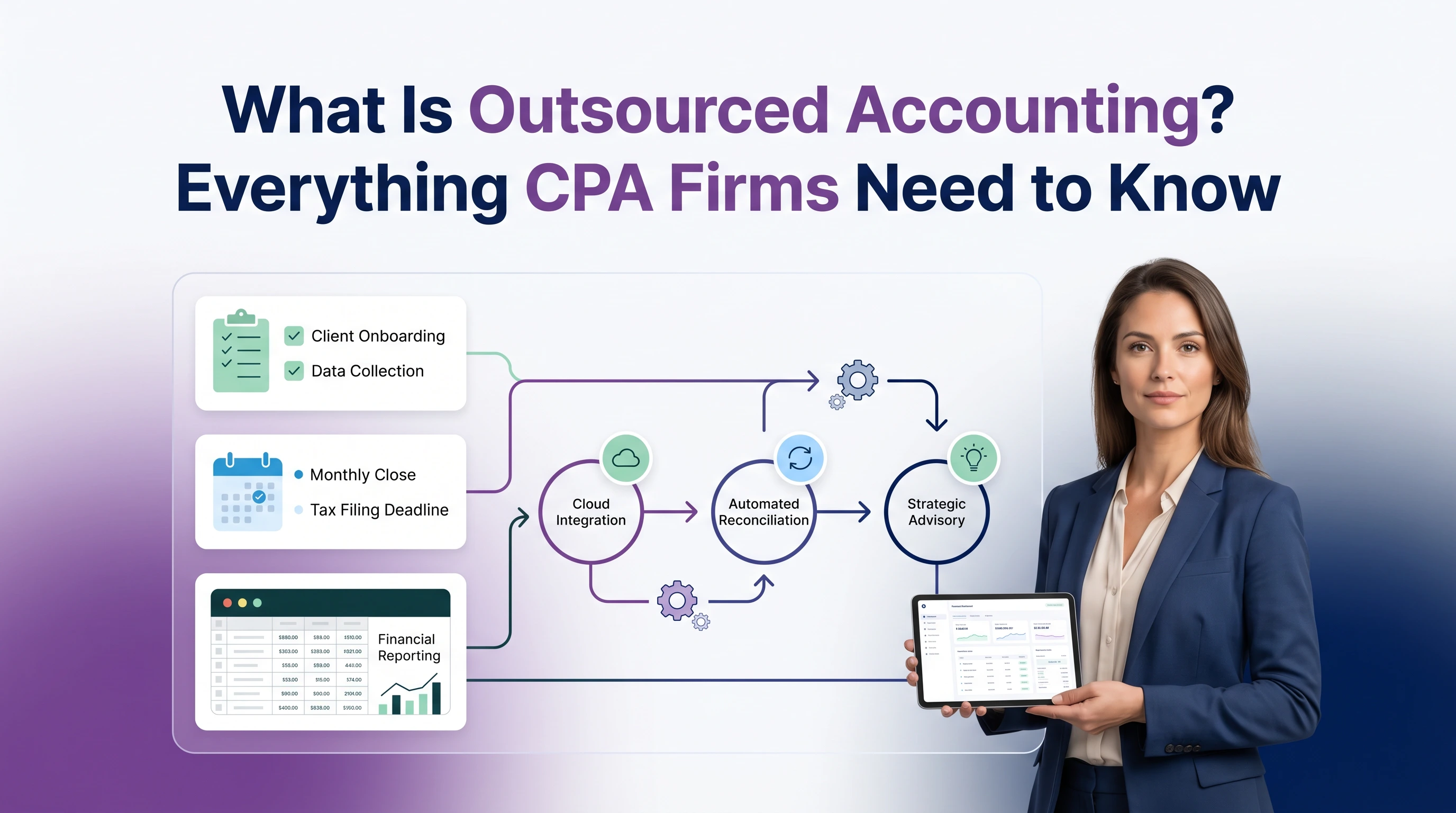
Outsourced accounting means delegating accounting work to an external team instead of doing it fully in-house.
It can cover bookkeeping, month-end close support, controller review, and back-office tasks for CPA firms.
This guide explains outsourced accounting, how it works, and how to compare outsourced accounting vs in-house.
It also lays out practical workflows, controls, and a decision framework you can use right away.
What is outsourced accounting?
Outsourced accounting is a service model where a business or CPA firm assigns some or all accounting tasks to an external team.
That team handles defined processes, uses agreed tools, and delivers work to a set schedule.
Most firms outsource to increase capacity, stabilize turnaround times, and reduce internal bottlenecks.
The best results come when the scope stays clear and the process stays consistent.
Outsourced accounting meaning (what people usually mean in practice)
When most leaders say “outsourced accounting,” they usually mean more than basic data entry.
They mean a managed workflow that produces reliable financial outputs.
That includes clean reconciliations, consistent close packages, and predictable review notes.
It can also include recurring client communications and documentation support.
Accounting outsourcing definition (for accounting firms and businesses)
Here is a practical accounting outsourcing definition you can use internally.
Accounting outsourcing is the planned transfer of accounting activities, controls, and reporting outputs to a third-party team that follows your standards and timelines.
If you cannot define the outputs, you cannot outsource it well.
That is the line most firms learn the hard way.
Outsourced accounting explained: what gets outsourced most often
Outsourced accounting can be small and targeted.
Or it can run end-to-end from transaction processing through controller review support.
Most firms start with repeatable work.
Then they expand scope once quality and rhythm stay stable.
Common outsourced accounting services include:
- Bank and credit card reconciliations
- AP processing and vendor management support
- AR posting and cash application support
- Payroll entry support and basic payroll reconciliations
- Month-end journal entry preparation
- Balance sheet account rollforwards
- Fixed asset schedules support
- Close checklists and close package assembly
- Financial statement prep in your template
- Supporting schedules for tax workpapers
Many firms also use managed accounting services for ongoing close ownership.
That usually means a recurring close calendar, recurring deliverables, and enforced SLAs.
Virtual accounting services explained (and how they differ from “outsourcing”)
Virtual accounting services usually describe the delivery method.
The work happens remotely, in your cloud stack, with scheduled meetings and shared dashboards.
Outsourcing describes the resourcing model.
Someone outside your org completes the work.
In practice, most outsourced teams operate virtually anyway.
So you will often see the terms used together.
Outsourced accounting for accounting firms (the real use case)
Accounting firm leaders rarely outsource because they dislike accounting work.
They outsource because the operating model breaks under volume.
Month-end becomes a traffic jam.
Partners become the quality control department.
And managers burn hours fixing preventable issues.
A remote accounting team for a CPA firm can stabilize throughput.
But only if you run it like operations, not like “extra hands.”
CPA firm back-office support: where outsourcing fits best
CPA firm back-office support works best when it protects your client-facing team.
Think of it as shielding your managers from repetitive assembly work.
Then managers can focus on review, client questions, and advisory.
This is where outsourcing often lands first:
- Write-up work and recurring monthly bookkeeping cleanup
- Close support for CAS and controller services
- Workpaper prep for tax teams
- Documentation and SOP support for standard workflows
Done well, it reduces rework.
Done poorly, it just moves the mess to another place.
Outsourced accounting vs in-house (a clear comparison)
This decision is not about which model is “better.”
It is about which model fits the workflow and risk profile.
Here is a simple comparison table you can use with partners and ops leaders.
If your process lives in someone’s head, in-house feels safer.
If your process lives in SOPs and templates, outsourcing becomes very workable.
Outsourced accounting: how it works (a real operational flow)
Most leaders want to know the mechanics.
So let’s walk it from intake to delivery.
A functional outsourced accounting workflow usually follows seven steps.
1) Scope and service catalog
You define exactly what the team does.
You also define what they do not do.
That sounds obvious, but it prevents 80% of downstream friction.
2) Tool stack and access model
You decide the system of record.
You define access, roles, and approvals.
You set rules for where documentation lives and how it gets updated.
3) SOPs, templates, and examples
You provide step-by-step instructions.
You also provide examples of “good.”
Teams do not guess well in accounting.
They follow what you show them.
4) Daily and weekly production rhythm
You set a cadence for:
- Transaction posting windows
- Bank feed review
- Exception handling
- Client questions intake
This reduces end-of-month surprises.
5) Month-end close calendar
You lock a close schedule.
You set cutoffs.
You assign owners.
You define when reviews happen and what “done” means.
6) Review, coaching, and corrections
Your reviewer should not redo the work.
They should review exceptions and coach pattern fixes.
That requires tracking error types and rework root causes.
7) Reporting and visibility
You track completion status.
You track aging items.
You track open questions and blockers.
Without visibility, leaders assume outsourcing failed.
Even when it just lacked reporting.
What should you outsource first? (A practical sequencing framework)
Firms get better outcomes when they phase this.
So start where work stays repeatable and review stays objective.
Use this three-tier approach.
Tier 1: Repeatable production
These tasks have clear steps and clear outputs.
- Reconciliations
- AP coding and bill entry
- AR posting support
- Basic month-end JE prep
- Close checklist management
Tier 2: Close package assembly
These tasks need accounting judgment, but they still follow structure.
- Flux analysis support using your template
- Balance sheet rec rollforwards
- Support schedules for accruals and prepaids
- Financial statement package formatting
Tier 3: Controller-level support
These tasks require more experience and tighter oversight.
- Complex accruals and allocations support
- Revenue recognition support for defined policies
- Internal control testing support
- Multi-entity consolidation support
If you jump to Tier 3 first, quality usually wobbles.
Then partners lose confidence.
Controls and risk: what to protect when you outsource accounting
Outsourcing does not remove responsibility.
It changes where the work happens.
So controls matter more, not less.
Here are the controls I expect in a mature model:
- Segregation of duties in AP and payments
- Approval workflows for vendor setup and bank changes
- Standardized close checklists by entity and industry
- Required support for every balance sheet account
- Exception logs for unreconciled items and stale reconciling items
- Version control for working files and schedules
- Defined reviewer sign-off points before statements go out
If you run CAS, build these into the package.
If you run tax, require these before workpapers move forward.
Managed accounting services vs staff augmentation (know the difference)
Some outsourcing is basically staff augmentation.
You get capacity.
You manage the day-to-day.
Managed accounting services are different.
You get a defined process with defined outputs and reporting.
Use this quick decision guide.
Most firms think they want capacity.
What they actually want is throughput with fewer review cycles.
How structured outsourcing improves accounting operations (and where Etisson fits)
Outsourcing works when it improves operating discipline.
Not when it simply moves tasks outside your walls.
A structured model forces you to clarify scope, tighten SOPs, and standardize outputs.
That is why mature firms see partner review time drop over time.
They stop reviewing mess.
They start reviewing exceptions.
In practice, this structure usually includes:
- Process discipline: documented close steps, required support, and clear acceptance criteria
- Automation-first workflows: rules, templates, and tool-driven controls that reduce manual rework
- Visibility and control: dashboards, status reporting, and blocker logs tied to close dates
- Reduced partner review burden: cleaner workpapers and consistent schedules that make review predictable
- Scalable growth without hiring risk: capacity expands without waiting on recruiting cycles
Etisson supports this kind of structured outsourcing with qualified US- and UK-trained professionals.
Etisson teams operate inside defined SOPs, use automation-first workflows, and maintain structured communication and reporting.
That makes Etisson function like an operational extension of your firm.
It also helps maintain control while scaling capacity across bookkeeping, close support, and back-office execution.
Common failure points (and how to avoid them)
Most outsourced accounting problems come from a few patterns.
They are avoidable if you address them early.
Failure point 1: No standard close package
If every client’s close looks different, the team cannot stabilize.
Fix it with templates, checklists, and required support standards.
Failure point 2: Reviewer redoes the work
That means your acceptance criteria stayed unclear.
Fix it with a definition of done and a recurring error log.
Failure point 3: Uncontrolled client communication
Clients do not know who to talk to.
Fix it with a single intake channel and response SLAs.
Failure point 4: Tool sprawl
Teams waste time hunting files and logins.
Fix it by standardizing the stack and locking storage rules.
Outsourced accounting for CPA firms: a simple implementation plan
If you want a plan that works in the real world, use a 30-60-90 day build.
Keep it boring.
Boring scales.
Days 1–30: Set the foundation
- Define scope by service line and client segment
- Standardize templates for reconciliations and close packages
- Build SOPs for the top 10 recurring workflows
- Lock your close calendar and cutoffs
Days 31–60: Start production with tight review
- Transition a small client set with similar profiles
- Hold weekly quality calibration meetings
- Track error types and fix root causes
- Tighten SOPs based on real exceptions
Days 61–90: Expand and stabilize
- Add clients in controlled batches
- Add reporting and status dashboards
- Reduce partner touchpoints by moving review to manager-level checkpoints
- Document edge cases and update SOPs
If you skip the calibration step, issues repeat.
If you skip documentation, issues multiply.
FAQs
What do you mean by outsourced accounting?
Outsourced accounting means an external team completes some or all accounting tasks that an internal team would normally do. It runs through defined workflows, timelines, and deliverables.
What is the difference between outsourced accounting and bookkeeping?
Bookkeeping focuses on recording transactions and keeping the general ledger organized. Outsourced accounting usually includes bookkeeping plus close, reconciliations, financial reporting, and controller-level review support.
How does outsourced accounting work?
Outsourced accounting works by defining scope, tools, SOPs, and a close calendar. The external team processes transactions, prepares reconciliations and schedules, and delivers a close package for review and final reporting.
Is outsourced accounting the same as virtual accounting services?
Not exactly. Virtual accounting services describe remote delivery of accounting work. Outsourced accounting describes who performs the work, meaning an external team rather than internal staff. Many outsourced teams operate virtually.
Outsourced accounting vs in-house: which is better?
Neither is universally better. In-house works well when processes are informal and knowledge is tribal. Outsourced accounting works well when workflows are standardized with SOPs, templates, and clear review checkpoints.
What tasks should a CPA firm outsource first?
Most CPA firms should outsource repeatable production work first, like reconciliations, AP entry support, and close checklist management. Then they can expand into close package assembly and controller-level support.
Can a remote accounting team work inside our tech stack?
Yes, if you standardize the tools and access model. The firm should define system of record, permissions, approvals, and file storage rules before transitioning work.
What are the biggest risks of outsourced accounting?
The biggest risks include unclear scope, inconsistent SOPs, weak approval controls, and poor visibility into work status. You reduce risk with standardized templates, required support, and structured reporting.
Conclusion
Outsourced accounting is not a shortcut.
It is an operating model.
If you define scope, standardize outputs, and enforce SOPs, it can improve close speed and reduce partner review time.
If you treat it like random extra help, it usually increases review burden and client friction.
The difference comes down to structure, controls, and visibility.