.avif)

Blog summary
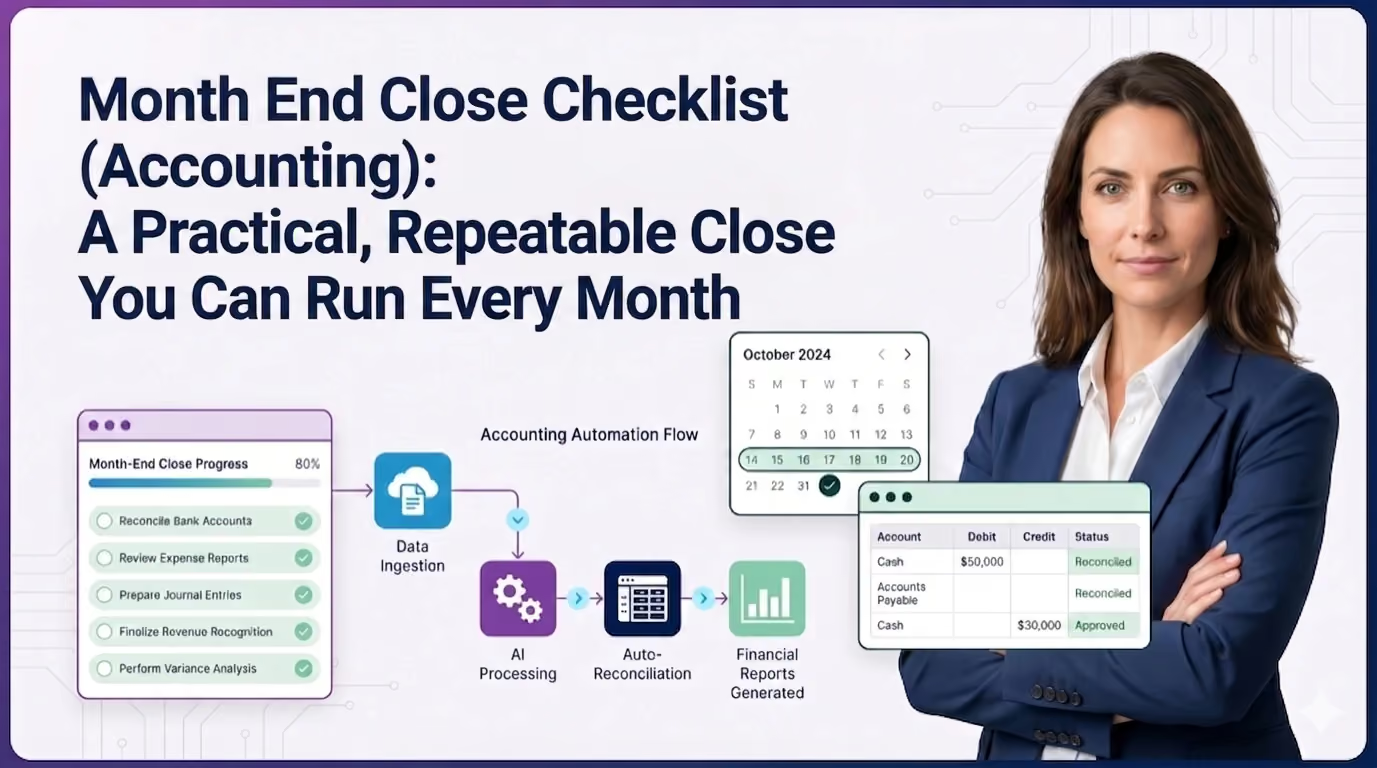
- This guide gives you a complete month end close checklist you can run the same way every month.
- It includes a month end accounting tasks list, clean month end close steps, review controls, and a bookkeeping month end checklist template you can copy.
- If your close feels different every month, that is the real problem.
- The goal is not heroics. The goal is a close that works even when people are out.
What is a month-end close checklist?
A month-end close checklist is a structured list of tasks used to close the books consistently each period.
It tracks dependencies, owners, due dates, and review steps so nothing gets missed and the financials stay defensible.
It also acts like a control document.
When questions come up later, you can point to what was done, when it was done, and who reviewed it.
Who this month end close checklist is for
This is written for accounting firm partners, controllers, practice managers, and ops leaders.
It also works for outsourced accounting teams that need consistency across many client files.
If you manage multiple closes at once, you already know the pain points.
Missing documents. Late coding. Surprise accruals. Partner review bottlenecks.
The core principle: close in phases, not a pile of tasks
Most teams struggle because they treat close like one big event.
A better model uses phases with clear gates.
Here is the operational flow that keeps teams out of trouble.
You will see it reflected in the closing the books checklist below.
Month-end close phases
- Pre-close readiness. Lock inputs and clean daily work.
- Core close. Reconcile, post accruals, and finalize subledgers.
- Review and tie-outs. Prove the numbers and explain variances.
- Reporting and lock. Issue statements and lock the period.
Month end close steps (the master checklist)
Use the checklist in order.
Do not reconcile until you know posting is complete. Do not report until you know reconciliations tie.
Each step below includes what “done” means.
That definition saves hours of back and forth later.
1) Set the close calendar and cutoffs
Close starts with expectations, not journal entries.
Set dates for invoice cutoff, AP cutoff, payroll cutoff, and bank feed cutoff.
Done means:
- Cutoff dates communicated.
- Owners assigned for AR, AP, payroll, cash, and reporting.
- Close tracker updated with day-by-day due dates.
2) Confirm source systems are complete
If source data is late, close becomes guesswork.
Confirm POS, payroll, bill pay, expense tools, and inventory systems have posted through period end.
Done means:
- No pending batches.
- No stuck integrations.
- All bank feeds updated through the last business day.
3) Collect missing documentation fast
This is the step most teams do too late.
Chase missing receipts, vendor bills, mileage logs, and payroll reports before you start reconciling.
Done means:
- Open items list sent to the client or internal teams.
- Missing items tracked with dates and escalation rules.
4) Review and finalize accounts receivable
AR errors show up as cash issues and revenue issues.
Confirm invoicing completeness, credit memos, write-offs, and customer deposits.
Month end accounting tasks list for AR:
- Post all invoices for the period.
- Review unapplied cash and negative AR.
- Reconcile AR subledger to the general ledger.
- Review allowance or bad debt entries if applicable.
Done means:
- AR aging ties to GL.
- Unapplied cash has clear disposition.
- Revenue cutoff issues documented.
5) Review and finalize accounts payable
AP timing drives expense accuracy.
Make sure bills are entered, coded, approved, and not duplicated.
Core AP tasks:
- Post all vendor bills received for the month.
- Review vendor statement variances for key vendors.
- Clear duplicate payments and duplicate bills.
- Reconcile AP subledger to the general ledger.
Done means:
- AP aging ties to GL.
- Accrual plan exists for late bills.
- Large vendor balances have explanations.
6) Reconcile cash and credit cards
Cash reconciliation is not optional.
It is the fastest way to catch missing transactions, miscodings, and fraud exposure.
Minimum reconciliations:
- All operating bank accounts.
- Payroll bank account.
- Merchant clearing accounts.
- Credit cards used for spend.
Done means:
- Reconciliations completed to the statement ending date.
- Old unreconciled items researched and resolved.
- Transfers match on both sides.
7) Record payroll and benefits accurately
Payroll creates repeat issues because it crosses periods.
Focus on payroll accruals, employer taxes, benefits, and any reimbursements.
Tasks to include:
- Post payroll journal entries for runs in the month.
- Accrue earned but unpaid wages if material.
- Accrue employer taxes and benefits if needed.
- Reconcile payroll liability accounts to payroll reports.
Done means:
- Payroll liabilities do not drift month to month.
- Payroll clearing accounts have no unexplained balances.
8) Post accruals and month-end closing entries
Accruals turn cash activity into real performance.
They also create the most review time when they lack support.
Common month-end closing entries:
- Accrued expenses for vendor bills not received.
- Prepaids amortization.
- Fixed asset depreciation.
- Revenue recognition adjustments.
- Interest and loan accruals.
- Bonuses and commissions accruals.
Done means:
- Each accrual has support or a calculation file.
- Reversing entries are used intentionally, not by habit.
- Accruals follow a consistent methodology month to month.
9) Reconcile balance sheet accounts (not just cash)
If you only reconcile bank accounts, you are not closing the books.
Balance sheet reconciliations prove the financial statements.
Balance sheet reconciliation checklist:
- Bank and credit cards.
- AR and AP control accounts.
- Payroll liabilities.
- Sales tax and VAT liabilities where applicable.
- Deferred revenue and customer deposits.
- Prepaids and other current assets.
- Fixed assets and accumulated depreciation.
- Loans and interest payable.
- Intercompany and due to or due from accounts.
Done means:
- Each account has a reconciliation with a clear tie-out.
- Reconciling items have dates, owners, and resolution plans.
- Old items get cleared or reclassified, not carried forever.
10) Review profit and loss for coding and reasonableness
This is where you catch miscodings that reconciliations will not flag.
Scan for unusual vendors, inconsistent categories, and margin swings.
P&L review steps:
- Compare actuals to prior month and prior year.
- Review top expense lines and top vendors.
- Spot check transactions in high-risk categories.
- Confirm class or department coding where used.
Done means:
- Material variances have written explanations.
- Reclasses posted and supported.
11) Run a variance review that forces clarity
Variance review is a control, not commentary.
Do it the same way each month so the team knows what “good” looks like.
A practical variance threshold approach helps.
Use percent and dollar thresholds together so you do not chase noise.
Example variance rules:
- Investigate if change is over 10% and $5,000.
- Always investigate any new expense line over $2,500.
12) Lock the period and publish the package
A close is not complete until you stop back-posting.
Lock the period, then issue the final reporting package.
Done means:
- Period closed in the accounting system.
- Final financials saved with the close date.
- Workpapers stored in the standard folder structure.
Month end close checklist table (owners and dependencies)
This table helps firms and internal teams assign ownership cleanly.
It also helps you spot the real bottleneck when the close slips.
Bookkeeping month end checklist template (copy and customize)
Use this as your starting point.
Keep it in a task tool or spreadsheet, but do not let it live only in someone’s head.
Bookkeeping month end checklist template
Close admin
- Confirm close calendar and cutoffs.
- Confirm all bank feeds updated through period end.
- Export or save key reports (AR aging, AP aging, payroll summaries).
Daily bookkeeping cleanup
- Clear undeposited funds and merchant clearing variances.
- Review uncategorized transactions and rules.
- Review suspense or ask-my-accountant accounts.
Cash and credit cards
- Reconcile all bank accounts to statements.
- Reconcile all credit cards to statements.
- Match transfers and record bank fees and interest.
AR and revenue
- Confirm invoices posted through cutoff.
- Review unapplied cash and customer credits.
- Reconcile AR subledger to GL.
AP and expenses
- Confirm bills entered through cutoff.
- Review outstanding approvals and coding.
- Reconcile AP subledger to GL.
Payroll
- Post payroll entries for the month.
- Reconcile payroll liabilities to payroll reports.
Accruals and allocations
- Post prepaids amortization.
- Post depreciation.
- Post accruals for late bills and recurring expenses.
Balance sheet reconciliations
- Reconcile sales tax or VAT payable.
- Reconcile loans and interest payable.
- Reconcile deferred revenue or deposits.
Review and finalize
- Run P&L and balance sheet reasonableness review.
- Document material variances.
- Lock the period and store workpapers.
Common failure points (and how to fix them)
Most month-end problems repeat for predictable reasons.
Fixing them usually requires one policy decision and one workflow adjustment, not more effort.
Failure point 1: late bills cause endless rework
Teams wait for “all bills” before posting accruals.
That turns close into a moving target.
Fix: set a bill cutoff, then accrue what arrives late.
Track late bills by vendor so you can reduce the issue over time.
Failure point 2: reconciliations exist, but nobody reviews them
An unreconciled account with a “completed” status is still a risk.
Controller review must be part of the checklist, not a favor.
Fix: require sign-off fields.
Tie review to specific accounts, not to the close in general.
Failure point 3: too many one-off journal entries
One-off entries create partner review burden and increase audit questions.
They also make financials hard to explain.
Fix: convert repeat items into recurring entries with support.
Then track exceptions as exceptions, not as normal workflow.
Failure point 4: the team treats the balance sheet like a parking lot
Old reconciling items become permanent features.
That is not conservative. It is inaccurate.
Fix: add an “aging rule” for balance sheet items.
Example: anything older than 60 days must be cleared or escalated.
Best practices that reduce close time without lowering quality
Speed comes from decisions and structure.
It does not come from working later.
Here are practices I see in strong accounting operations.
They apply in firms and in-house teams.
Close best practices checklist
- Standardize a chart of accounts and mapping rules where possible.
- Use recurring entries with locked support files.
- Require account reconciliations for all material balance sheet accounts.
- Use a single exceptions list instead of scattered emails.
- Timebox variance analysis with thresholds.
- Lock periods consistently and document reopen requests.
When to add controller-level review versus partner review
This is where many firms lose margin.
Partners end up reviewing basic items that a controller should catch first.
A simple review ladder helps.
It keeps work at the right level and protects partner time.
Review ladder (practical rule set)
- Staff completes posting and first-pass reconciliations.
- Senior confirms tie-outs and clears exceptions.
- Controller performs variance review and approves close.
- Partner reviews only high-risk clients or advisory-focused packages.
If a partner regularly reviews bank reconciliations, something upstream is broken.
Fix the workflow, not the partner’s calendar.
Structured outsourcing as an operational extension (and where Etisson fits)
Some firms reach a point where the issue is not knowledge.
The issue is capacity and consistency across many closes.
Structured outsourcing works when you treat it like operations, not like staffing.
That means documented SOPs, defined handoffs, and consistent review gates.
In that model, Etisson typically supports firms as a controlled extension of the team.
Firms use Etisson for qualified US and UK-trained professionals, automation-first workflows, and strict SOP discipline.
The practical operational benefits look like this.
- Clear task ownership and standardized close trackers.
- Automation around transaction coding, reconciliations, and workpaper assembly.
- Structured communication that reduces follow-up loops.
- Better visibility with status reporting that partners can trust.
- Reduced partner review time through controller-ready workpapers.
- Scalable capacity without the hiring risk that comes with sudden growth.
This only works when the firm keeps control of the close standard.
The outsource team then executes inside that standard, every month, the same way.
FAQs
What is a month-end close checklist?
A month-end close checklist is a step-by-step list of accounting tasks used to close the books each month. It assigns owners, due dates, and review steps to ensure consistent and accurate financial statements.
What are the steps for the month-end closing?
Common month end close steps are. Set cutoffs. Confirm source systems. Post AR and AP activity. Reconcile cash and balance sheet accounts. Record accruals. Review variances. Finalize reports. Lock the period.
What are the month-end closing entries?
Month-end closing entries typically include accruals for unpaid expenses, payroll accruals, prepaid amortization, depreciation, interest accruals, and revenue recognition or deferral entries when applicable.
What should be included in an accounting month end checklist?
An accounting month end checklist should include. Bank and credit card reconciliations. AR and AP tie-outs. Payroll liability reconciliations. Balance sheet reconciliations. Accruals. Variance analysis. Review sign-offs. Period lock.
How do you know the books are ready to close?
The books are ready to close when all transactions through cutoff are posted, subledgers tie to the general ledger, bank accounts reconcile to statements, material accruals are recorded, and variance explanations are documented.
How long should a month-end close take?
A healthy close often takes 3 to 8 business days depending on complexity, transaction volume, and staffing. The more standardized the process and cutoffs, the shorter and more predictable the close becomes.
What is the biggest cause of month-end close delays?
The biggest cause is late or incomplete inputs, such as missing bills, delayed payroll reports, or unreconciled cash activity. A close calendar with enforced cutoffs usually fixes most delays.
Conclusion
If you want the simplest version to share internally, use this.
It is the core closing the books checklist without the extra commentary.
- Set close dates and cutoffs.
- Confirm all source systems posted.
- Collect missing documents.
- Finalize AR and tie to GL.
- Finalize AP and tie to GL.
- Reconcile all cash and credit cards.
- Post payroll and reconcile liabilities.
- Post accruals, prepaids, and depreciation.
- Reconcile material balance sheet accounts.
- Review P&L and balance sheet for reasonableness.
- Document and explain material variances.
- Publish reporting package and lock the period.