.avif)

Blog Summary
- Outsource bookkeeping services work best when treated as an operating model, not just a staffing patch
- Explains why outsource bookkeeping and how it supports efficiency, scalability, and accuracy
- Covers how virtual bookkeeper services and offshore bookkeeping fit into your workflow
- Breaks down what outsourced bookkeeping rates really mean for cost and value
- Shows how to avoid review-heavy messes and maintain control over financial accuracy
- Includes a vendor scorecard to evaluate providers objectively and select the right partner
- Provides a clean handoff workflow to protect month-end close and tax season
- Offers a bookkeeping clean-up plan to fix issues while minimizing disruption to ongoing operations
Partners and controllers usually ask the same question.
“Should we outsource your bookkeeping work, or keep building in-house?”
The right answer depends less on philosophy.
It depends on workflow maturity, review tolerance, and how quickly you need capacity without breaking close.
This article focuses on CPA firm realities.
Multiple clients. Multiple industries. Multiple file states. And a busy season that never really ends.
What it means to outsource bookkeeping services
Outsourced bookkeeping means an external team performs day-to-day bookkeeping tasks inside your client’s accounting system.
Your firm still owns the client relationship, standards, and final deliverables.
Most firms outsource one of three ways.
Each model changes your risk, your margins, and your review time.
Common outsourced bookkeeping models
- Task-based support. Bank recs, AP entry, catch-up, or payroll coding support.
- Client-level monthly bookkeeping. Full month-end package for selected clients.
- Pod support for your CAS team. A steady team that works your SOPs across many clients.
If you want fewer surprises, pick a model and document it.
Firms get into trouble when they “kind of” outsource everything.
Streamline Your Outreach & Grow Faster
Automate workflows, improve conversions, and scale your business with smarter tools.
Book a Free CallWhy outsource bookkeeping in the first place
The operational reasons usually beat the financial ones.
Cost matters, but the real driver is throughput with controlled quality.
Here is what I see inside CPA firms.
Outsourcing succeeds when it removes bottlenecks that partners and managers feel every week.
Top reasons CPA firms outsource bookkeeping
- You need capacity for monthly close without hiring risk.
- You want predictable turnaround times for bank recs and reconciliations.
- You want controller-level staff focused on review, not data entry.
- You need bookkeeping clean up to stabilize tax work and year-end.
- You want extended coverage across time zones for client responsiveness.
- You want more consistency through SOP-driven processing.
Ask a simple question.
Where does work wait today, and who feels the pain?
When outsourcing is a good operational fit, and when it is not
Outsourcing fits best when the work is repeatable.
It also fits when you can define “done” without partner interpretation.
Outsourcing tends to fail when inputs stay messy.
If clients do not send documents, no external team can “process” what does not exist.
Good fit
- Monthly transactional bookkeeping with stable bank feeds.
- Clean AP workflows with consistent approvals.
- Recurring accruals and amortizations with clear support.
- Standard month-end checklists and close calendars.
Not a good fit yet
- Clients who commingle heavily with no documentation.
- “Fix it later” cultures with constant retroactive changes.
- Entities with complex revenue recognition managed ad hoc.
- Situations where partners expect outsourcing to replace review.
You can still outsource in the “not yet” cases.
You just need a clean up phase first, plus tighter client controls.
Virtual bookkeeper services vs offshore bookkeeping
These terms get mixed together.
They are not the same.
Virtual bookkeeper services means remote delivery.
The team might be US-based, nearshore, or offshore.
Offshore bookkeeping means the work happens outside the US.
It can be excellent, but you must design controls for time zones, documentation, and review.
Here is the practical difference.
Virtual describes location. Offshore describes jurisdiction and labor market.
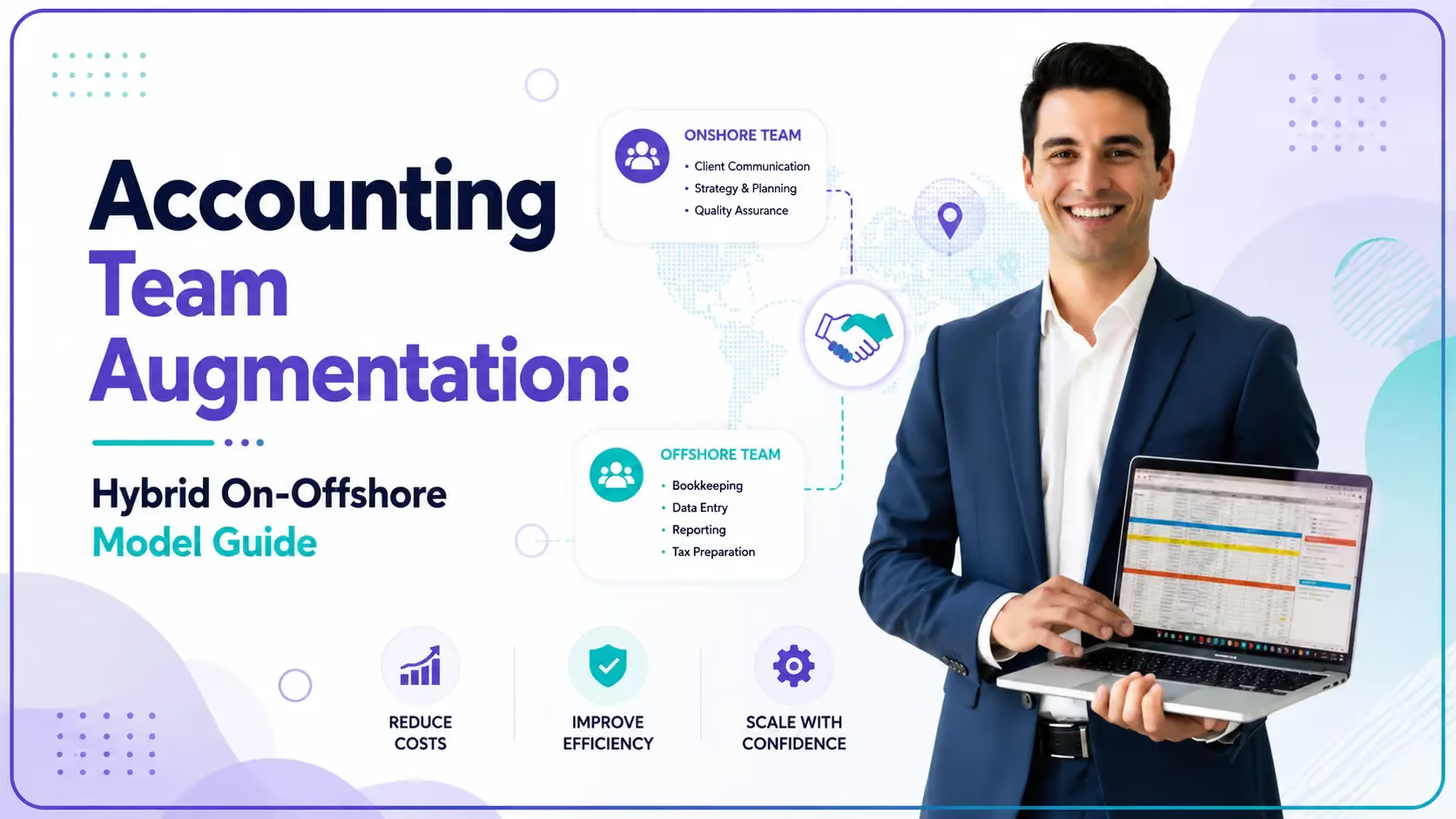
For CPA firms, offshore bookkeeping often works best in a pod model.
You pair offshore production with onshore controller review and client communication.
What outsourced bookkeeping services typically include
Scope clarity prevents margin leakage.
It also prevents the “we thought you were doing that” problem.
Most outsourced bookkeeping companies for CPA firms offer some combination of these activities.
Typical inclusions
- Bank and credit card reconciliations
- Transaction coding and rules maintenance
- AP entry and vendor management support
- AR posting support and deposit matching
- Journal entries, accruals, and reclasses per policy
- Fixed asset support, prepaid schedules, loan schedules
- Month-end close package preparation
- Financial statement prep for firm review
- Bookkeeping clean up and catch-up work
Often excluded unless you define it
- Client chasing and document collection
- Revenue recognition design
- Complex inventory costing decisions
- Sales tax filing and nexus decisions
- Payroll processing ownership
- CFO-style analysis and forecasting
If your scope stays fuzzy, rates do not matter.
You will pay in review time and write-offs.
Outsourced bookkeeping rates: how to think about pricing without getting trapped
Firms fixate on hourly rates.
That is understandable, but it is not the whole math.
You should evaluate cost in three layers.
Production cost. Review cost. Rework cost.
A low hourly rate can still be expensive.
It becomes expensive when your managers spend hours rewriting workpapers and untangling reconciliations.
Common rate structures you will see
- Hourly. Flexible, but can hide inefficiency if you do not track outputs.
- Fixed monthly. Works well with stable scope and clear SLAs.
- Per-entity or per-close package. Helpful when you standardize deliverables.
- Clean up project pricing. Better than open-ended hourly when books are messy.
The simplest way to compare providers
Compare cost per “closed month,” not cost per hour.
Track how many manager minutes you spend to approve the month.
If you want a quick internal benchmark, use this.
Your outsourcing is “working” when partner review time drops and close timelines tighten.
A decision table for choosing the right outsourcing model
Use this when you decide between in-house, virtual, and offshore options.
It forces an operational conversation instead of a rate-only conversation.
| Need | Best fit | Why it works | Watch-outs |
|---|---|---|---|
| Fast capacity for bank recs | Offshore pod + onshore review | High volume, repeatable | Needs strong SOPs and QC |
| Complex client communication | US virtual bookkeeper services | Same time zone, direct calls | Higher cost, limited scale |
| Stabilize messy books | Bookkeeping clean up project team | Focused remediation | Scope creep without rules |
| Scale CAS across many clients | Managed outsourced bookkeeping company for CPA firms | Standardization, reporting | Requires process ownership |
| Seasonal overflow | Task-based support | Easy to start | Fragmented workflow if unmanaged |
If you cannot define your “done,” choose task-based first.
Then graduate to full monthly bookkeeping after you standardize.
How to outsource your bookkeeping without creating a review nightmare
Most outsourcing failures look the same.
The firm outsourced production, but kept the chaos.
You avoid that by building a simple handoff system.
Inputs. Processing. Review. Exception handling.
The 7-step handoff workflow (CPA firm version)
- Client data intake rules. Define what must arrive by what date.
- Document capture process. One place only. No email archaeology.
- Chart of accounts and mapping. Lock categories and memo standards.
- Monthly close checklist. Same steps. Same order. Every client.
- Reconciliation standards. Define tolerances and required support.
- Controller review pack. Variance notes, reclass log, open items list.
- Feedback loop. Track errors by type, then update SOPs.
Do not skip step seven.
Outsourcing improves over time only when your process learns.
The controls that matter most
Controls reduce partner review burden.
They also protect you during tax season and audits.
Minimum control set
- Dual review on bank recs above a defined threshold.
- Mandatory support links for unusual entries and large reclasses.
- Exception log for unreconciled items and missing documentation.
- Locked periods after close, with a change request process.
- Standard workpapers for loans, payroll liabilities, and sales tax payable.
If you put these controls in place, offshore bookkeeping becomes far safer.
Without them, even a great team will struggle.
Bookkeeping clean up: a practical plan that does not blow up your month-end
Clean up work fails when firms treat it like regular monthly bookkeeping.
It is a different job with different rules.
Your goal in bookkeeping clean up is not perfection on day one.
Your goal is a defensible baseline that stays clean going forward.
The clean up framework I recommend
Phase 1. Triage and lock the timeline.
Pick the target period, like “Jan 1 through last month-end.”
Freeze the scope, and stop the client from adding new accounts midstream.
Phase 2. Reconcile cash first.
Cash drives everything. If cash is wrong, nothing else matters.
Phase 3. Clean the balance sheet next.
Loans. Payroll liabilities. Undeposited funds. Clearing accounts. Suspense.
Phase 4. Then fix P&L classification.
Do not burn time perfecting P&L while the balance sheet stays broken.
Phase 5. Build a forward-looking close pack.
Create a recurring checklist so you do not pay for clean up twice.
Clean up ends when you can close a month cleanly.
Not when every old transaction feels “beautiful.”
What to look for in outsourced bookkeeping companies for CPA firms
You are not just buying labor.
You are buying process reliability.
Use a scorecard so your team evaluates providers consistently.
It also helps you defend the decision internally.
Vendor evaluation scorecard (use this in interviews)
Process and quality
- Do they provide written SOPs or follow yours.
- Do they use checklists per client and per close cycle.
- Do they maintain an issue log and reclass log.
- Do they show sample workpapers and rec formats.
People and capability
- Who does production vs review.
- How they handle escalation and complex items.
- Experience with QuickBooks Online, Xero, and your app stack.
Communication
- Response time standards.
- Meeting cadence.
- Clear owner for each client or pod.
Security and access
- MFA and password management.
- Role-based access design.
- Secure document portal policies.
Reporting
- Daily or weekly status reporting.
- Work-in-progress visibility by client.
- SLA tracking and close timeline performance.
If a provider cannot explain their QA process clearly, move on.
Quality without a system does not scale.
AI, automation, and outsourced bookkeeping: what actually changes
Many firms worry that AI is replacing bookkeepers.
In practice, AI replaces parts of bookkeeping, not the operational ownership.
Automation works best in three areas.
Data capture, coding suggestions, and anomaly detection.
It still needs humans for judgment.
Client context. Documentation discipline. Accrual logic. And clean explanations for reviewers.
When you outsource, require an automation-first workflow.
Not because it sounds modern, but because it reduces manual touch and rework.
Structured outsourcing and operational control (and how Etisson fits)
Two clients rarely need the same outsourcing setup, even inside the same firm. A solo consultant with 40 transactions a month needs a light-touch monthly close. A multi-location retailer with three bank accounts, a merchant processor, and biweekly payroll needs weekly touchpoints and a tighter reconciliation cadence.
Etisson scopes engagements around that difference instead of a flat-rate package. Lower-volume clients get a standard monthly cycle. Higher-volume or multi-entity clients get a named accountant working a defined weekly cadence, with the same close calendar and documentation standard either way.
What stays constant across both is the operational layer underneath: a documented list of what gets reconciled and when, a single channel for open questions instead of scattered email threads, and status visibility your team can check without pinging the bookkeeper directly.
That consistency is what actually reduces review time. Volume changes the workload. It should not change whether you can trust the file.
Implementation roadmap: a realistic 30-60-90 day plan
Most firms want outsourcing to “start next week.”
You can start quickly, but you still need a ramp plan.
Here is a plan that works without overwhelming your managers.
Days 1–30: Stabilize
- Pick 5–10 similar clients first.
- Standardize COA mapping and close checklist.
- Create a single intake channel for documents.
- Define what reviewers expect in the close pack.
Days 31–60: Standardize
- Expand to more clients with the same pattern.
- Add exception logs and reclass logs.
- Track review notes by category and update SOPs weekly.
Days 61–90: Scale
- Move from task-based to pod ownership where possible.
- Add SLA reporting by client.
- Tighten cutoffs and lock periods after close.
If you skip standardization, scaling makes everything worse.
More volume just produces more rework.
FAQ
What does it mean to outsource bookkeeping?
Outsourcing bookkeeping means a third-party team performs transaction processing, reconciliations, and close support in your accounting system while your firm retains oversight, standards, and final review.
Why outsource bookkeeping instead of hiring in-house?
You outsource to add capacity faster, reduce hiring risk, improve turnaround time, and shift internal staff toward higher-value review and advisory work, especially during month-end and tax season.
How much do outsourced bookkeeping services cost?
Outsourced bookkeeping rates vary by scope, complexity, and service model. Most providers price hourly, fixed monthly, or per-close package. The best comparison metric is cost per closed month including review time.
Are virtual bookkeeper services the same as offshore bookkeeping?
No. Virtual bookkeeper services are delivered remotely and can be onshore or offshore. Offshore bookkeeping specifically means the team is located outside the US.
What should be included in outsourced bookkeeping for CPA firms?
At minimum, include reconciliations, coding standards, recurring journals, close checklist completion, and a reviewer-ready close pack. Also define what is excluded, like client chasing or complex accounting decisions.
How do you outsource your bookkeeping without losing control?
You keep control by using standardized SOPs, a close calendar, reconciliation tolerances, an exception log, and consistent reporting. You should also lock periods after close and require change requests.
What is bookkeeping clean up, and when do you need it?
Bookkeeping clean up is a remediation project to fix historical records and create a stable baseline. You need it when cash does not reconcile, balance sheet accounts are unsupported, or tax work relies on unreliable books.
Is AI replacing bookkeepers?
AI automates parts of bookkeeping like data capture and coding suggestions. It does not replace the need for human judgment, documentation discipline, and controller-level review, especially in a CPA firm environment.
Conclusion
Outsource bookkeeping services succeed when you engineer the workflow first.
Model choice, scope definition, and control design matter more than rates.
If you want outsourcing to reduce partner review time, insist on structure.
Clear close checklists. Reviewer-ready workpapers. Exception logs. And visible reporting.
That is how you turn outsourced bookkeeping into operational capacity.
Not just more transactions processed somewhere else.
Related reading: how catch-up bookkeeping works, our account reconciliation services guide, Etisson home, and more CPA firm accounting guides.
.avif)