.avif)
.avif)

Blog Summary
- Outsourcing bookkeeping succeeds when treated as a strategic operating model, not a last-minute fix
- Explains what tasks can be outsourced and how to structure them
- Details how virtual bookkeeper services operate month to month
- Covers factors that drive outsourced bookkeeping rates
- Provides guidance on controlling quality in outsourced bookkeeping
- Includes a clean handoff checklist for smooth transitions
- Offers a cleanup framework for fixing existing bookkeeping issues
- Contains FAQs with direct answers to common outsourcing questions
Why small businesses outsource bookkeeping in the first place
Most small businesses do not fail because they lack a bookkeeper. They struggle because bookkeeping becomes a background task. It slips behind sales, hiring, and client work.
Then the month ends. Reconciliations lag. Reports look wrong. The tax deadline shows up. Someone spends a weekend sorting transactions. That cycle creates stress and bad decisions.
When you outsource bookkeeping for small business, you are buying consistency. You are also buying a close process that runs even when the owner is busy. That is the real value.
Small business bookkeeping services also reduce key-person risk. One in-house person gets sick or quits. The books stop. Outsourced accounting services should not stop. They should flex.
What “outsourced bookkeeping” actually means
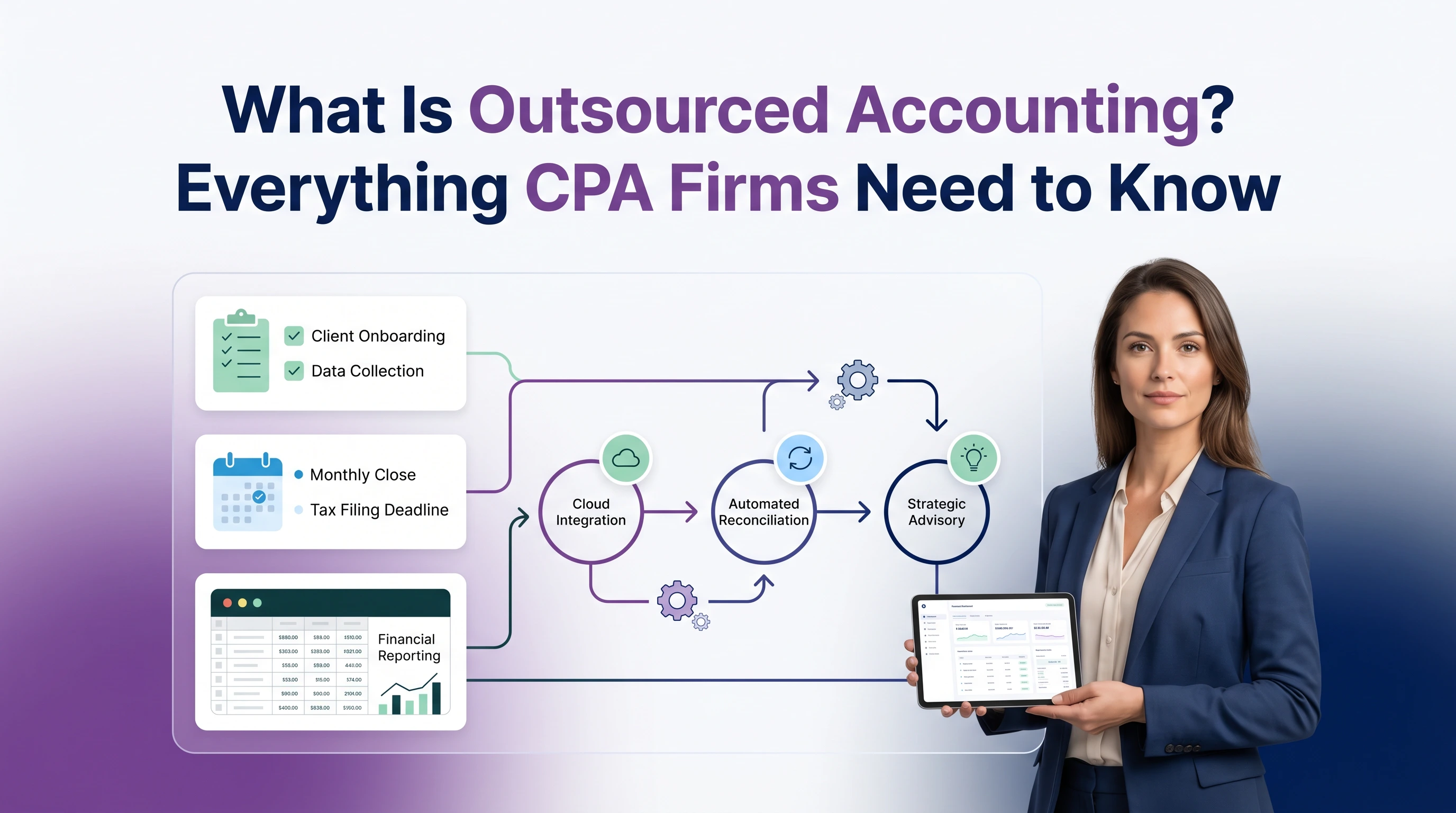
Outsourced bookkeeping means a third party runs your day-to-day transaction processing and monthly close tasks. They do it inside your accounting system, using your bank feeds, rules, and documents.
Virtual bookkeeper services usually include a recurring monthly workflow. They categorize activity, reconcile accounts, and produce financial statements. They also manage questions and exceptions.
Outsourced bookkeeping is not the same as tax prep. It supports tax. It does not replace your CPA’s filing role. It also does not replace management decisions. It gives you clean inputs.
Think of it as a small finance operations function. You still own approvals, cash decisions, and policy. The bookkeeper owns execution and documentation.
What services are typically included in outsourced bookkeeping
Most bookkeeping and accounting services for small business fall into three layers. The right fit depends on transaction volume and how clean your processes are today.
Layer 1: Core bookkeeping (baseline)
These tasks keep the books current and defensible. You should expect them in almost any package.
- Bank and credit card reconciliations
- Transaction coding and rules maintenance
- Accounts payable entry or bill capture support
- Accounts receivable posting and basic matching
- Monthly financial statements (P&L, balance sheet)
- General ledger reviews for obvious mis পোস্টings
Layer 2: Close support (controls and accuracy)
This is where quality improves and partner review time drops. Many “affordable bookkeeping services” skip this layer, which creates problems later.
- Accrual entries and recurring journals
- Loan and interest schedules updates
- Payroll posting review and mapping
- Deferred revenue or prepaid expense tracking
- Balance sheet tie-outs and supporting schedules
- Close checklist management and cutoff questions
Layer 3: Controller-style support (decision readiness)
This layer turns bookkeeping into management reporting. It is often bundled under outsourced accounting services.
- Month-end close leadership and variance notes
- KPI dashboards and cash forecasting inputs
- Job or class profitability review
- Sales tax support coordination
- Audit-ready documentation standards
- Policy cleanup for revenue, expenses, and owner items
When outsourcing is the right move, and when it is not
Outsourcing fits best when the business needs consistency and the owner needs time back. It also works when the business wants better reporting without hiring a full-time role.
It is a strong fit when:
- Books stay 30 to 90 days behind
- Reconciliations do not happen monthly
- The CPA keeps asking for fixes at tax time
- The owner uses the bank balance as the “budget”
- You need clean statements for lending or investors
It is not a fit when the business refuses to follow basic process. If no one will approve bills, upload receipts, or answer questions, outsourcing will stall. The provider cannot guess.
It is also a weak fit if leadership wants “perfect” reports but will not commit to close deadlines. A clean close needs responses, even if they are quick.
Bookkeeping clean up: the step-by-step framework that actually works
Most new clients do not need “more bookkeeping.” They need bookkeeping clean up first. Cleanup is not just recoding transactions. It is restoring control.
Here is the cleanup framework I use in operations reviews. It is simple. It is also the difference between clean books and recurring mess.
Step 1: Freeze the scope and set a cutoff month
Pick the first month you want to rely on for decisions and tax support. Do not try to fix three years unless you have a reason. Start with what matters.
Define the scope in writing: which entities, which systems, which accounts, and which periods. This avoids never-ending cleanup.
Step 2: Reconcile cash and debt first
Cash drives almost every downstream number. If cash is wrong, your P&L is noise.
Reconcile in this order:
- Operating bank accounts
- Credit cards
- Payroll clearing accounts
- Loans and credit lines
Step 3: Fix the chart of accounts and mapping rules
Many small businesses accumulate accounts like a junk drawer. Cleanup requires consolidation and clear naming.
Then set rules. Bank feed rules should reflect how the business actually spends money. This reduces recoding every month.
Step 4: Address the “big three” problem areas
These accounts create the most rework and CPA questions. Clean them early.
- Undeposited funds and payment processors
- Payroll liabilities and owner draws
- Suspense, uncategorized, and “ask my accountant” buckets
Step 5: Rebuild a month-end close checklist
Cleanup without a close checklist fails. The checklist makes quality repeatable. It also creates a review trail.
Your checklist should include due dates, owners, and evidence. Evidence can be a reconciliation report, a schedule, or a note. It just needs to exist.
How the monthly workflow should run with a virtual bookkeeper
A good outsourced model runs on a rhythm. That rhythm makes deadlines real and reduces surprises. It also keeps your CPA out of the weeds.
A practical monthly cadence looks like this:
- Daily or weekly: transaction review, receipt capture, exception questions
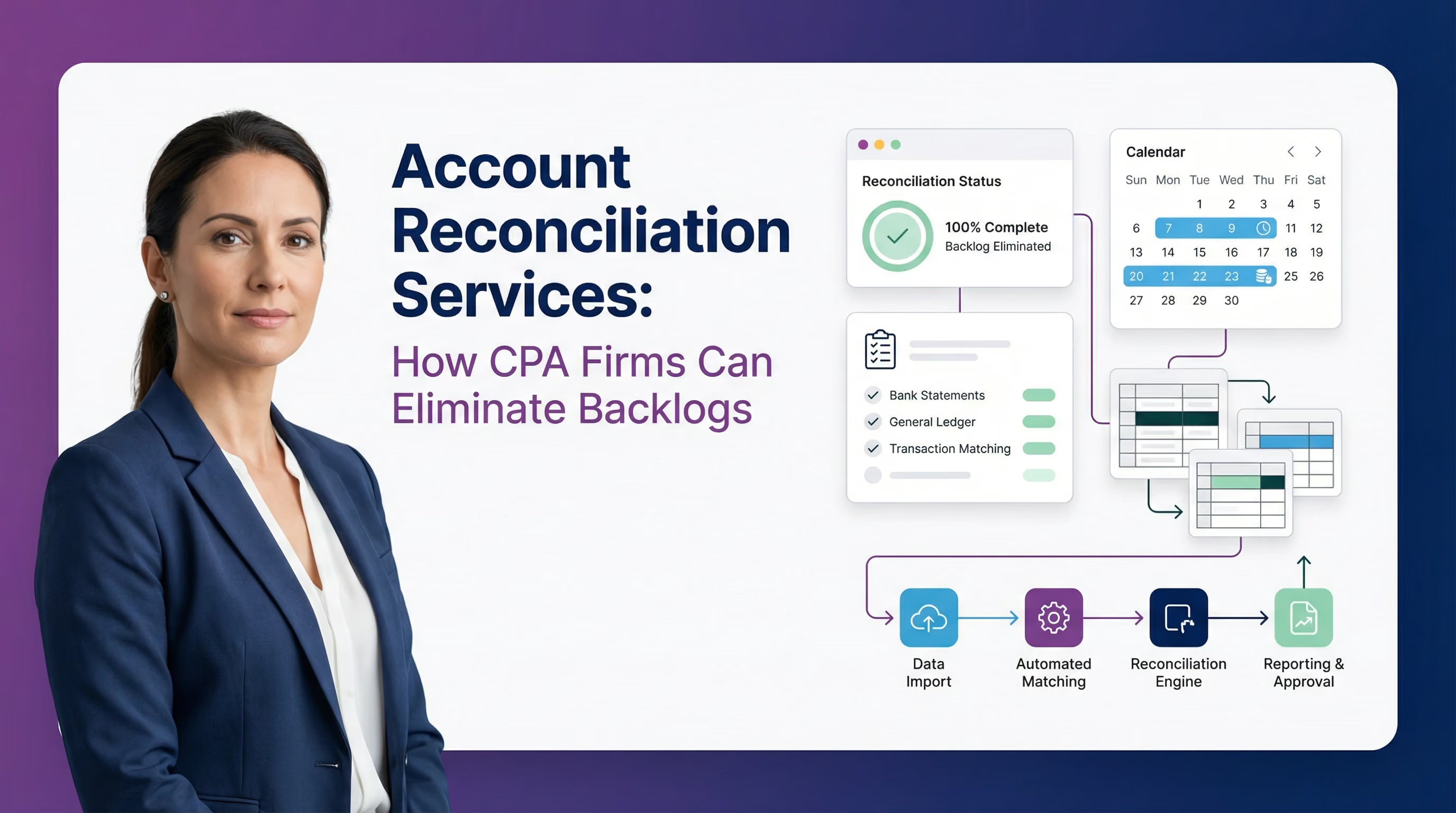
- Week 1 after month-end: reconcile all cash and credit cards
- Week 2: post accruals, review payroll mapping, update schedules
- Week 3: deliver financials, variance notes, and open questions
- Week 4: clean up exceptions, lock the month, prep for next cycle
If your provider cannot explain their cadence, that is a signal. You want a process, not a person “logging in when they can.”
Outsourced bookkeeping rates: what really drives the price
Most small business owners ask about cost first. That is normal. The better question is what drives cost, and which levers you control.
Outsourced bookkeeping rates typically depend on:
- Monthly transaction volume and bank accounts
- Number of credit cards and loan accounts
- Payroll complexity and number of states
- A/R and A/P volume and systems used
- Inventory or job costing requirements
- Cleanup needs and age of backlog
- Reporting expectations and close speed
Hourly pricing can work for cleanup. Fixed monthly fees often work better for steady-state services. Fixed fees also force the provider to build efficient workflows.
Be careful with “cheap” offers that do not include reconciliations and balance sheet review. That is not bookkeeping. That is data entry. The bill comes later.
A simple decision table: in-house vs outsourced bookkeeping
Use this table when a client or partner asks, “Should we hire or outsource?” It keeps the decision operational and grounded.
This is not about which is “better.” It is about what your business can support right now.
The controls you must keep, even when you outsource
Outsourcing does not remove responsibility. It changes the line between execution and approval. That line needs to be explicit.
Keep these controls in-house:
- Approving vendor setup and bank detail changes
- Approving payments and signing authority
- Approving write-offs and credits
- Reviewing monthly financials and asking questions
- Setting accounting policies for gray areas
Outsourced teams should own documentation. They should also maintain an audit trail for key accounts. That trail reduces year-end scramble.
If you want fewer errors, require two things. A monthly reconciliation package. And a close checklist with sign-off.
What to ask before you choose outsourced accounting services
Selection problems usually come from vague scope. Or from not testing how the provider thinks about close and controls.
Ask these questions and listen for clear answers.
Operational questions
- What is your month-end close timeline. And what do you need from us to hit it.
- Do you deliver a reconciliation package each month. What does it include.
- How do you handle exceptions like missing receipts or unclear charges.
- What does your handoff look like if the assigned bookkeeper changes.
Quality questions
- Who reviews the work before financials go out.
- How do you prevent repeated miscoding. Rules, SOPs, or both.
- How do you handle balance sheet accounts that require schedules.
System questions
- Which accounting systems do you support. QuickBooks Online is common, but details matter.
- Which apps do you prefer for bill pay, receipts, and expense management.
- How do you secure access. And how do you document approvals.
If the answers sound like “we will figure it out,” you will feel that pain later. You want a provider who already has a playbook.
How structured outsourcing improves bookkeeping operations (and how Etisson supports it)
Outsourcing works best when you treat it like a production process. Clear inputs. Standard work. Defined review points. Visible status. That structure is what most small businesses lack.
Structured outsourcing improves operations through:
- Process discipline: a documented close checklist, defined cutoff rules, and standard coding guidance
- Automation-first workflows: bank rules, receipt capture routines, and exception queues that reduce manual touches
- Visibility and control: status reporting, aging lists, and monthly reconciliation packs that show what is done and what is pending
- Reduced partner review burden: fewer “why is this here” questions because the support schedules and notes exist
- Scalable growth without hiring risk: added capacity during growth or cleanup without betting on a single new hire
Etisson supports firms that want this kind of operating model. Teams use qualified US- and UK-trained professionals, supported by SOP discipline and structured communication.
The practical outcome is simple. Cleaner books, faster close, and fewer surprises in partner or controller review. You keep control, but you stop carrying the execution load.
A practical onboarding checklist for outsourcing bookkeeping
If you want outsourcing to succeed in the first 30 days, you need a clean handoff. This checklist prevents rework and confusion.
Access and systems
- Accounting file access and admin permissions
- Bank feeds connected and stable
- Credit card accounts mapped correctly
- Payroll reports access or provider portal access
- Bill pay system access with role-based permissions
Policies and references
- Chart of accounts and class or location structure
- Owner draw and personal expense policy
- Revenue recognition basics, even if simple
- Receipt requirements and documentation rules
Close and communication
- Close deadlines and reporting dates
- Primary contact and backup contact
- Weekly question cadence and response SLA
- Agreement on what gets escalated, and when
If you do not define this, you will get a slow drip of questions. Then the close will slip. Then everyone blames the provider.
Common mistakes that make “affordable bookkeeping services” expensive later
You can absolutely find affordable bookkeeping services. You just need affordability to include quality controls. Otherwise, it becomes deferred cost.
Watch for these mistakes:
- Skipping reconciliations to “save time”
- Treating uncategorized expenses as acceptable
- Letting undeposited funds sit for months
- Posting payroll without tying to payroll reports
- Never reviewing the balance sheet, only the P&L
- No documented close checklist and no sign-off
If you fix these, your CPA will feel it immediately. The tax file becomes easier to support. Extensions become less likely.
FAQ: Outsource bookkeeping for small business
What is the best bookkeeping method for a small business?
The best method depends on tax and reporting needs. Many small businesses use cash basis for simplicity. Businesses with inventory, lending needs, or more complex operations often use accrual basis for clearer performance reporting.
How does outsourcing bookkeeping work each month?
A provider categorizes transactions, reconciles bank and credit card accounts, posts needed journal entries, and delivers monthly financial statements. Strong providers also include a reconciliation package and a close checklist with documented review steps.
What is included in virtual bookkeeper services?
Virtual bookkeeper services usually include transaction coding, bank and credit card reconciliations, and monthly financial reporting. Many packages also include A/P or A/R support, receipt management, and month-end accrual entries.
How much do outsourced bookkeeping services cost?
Costs vary based on transaction volume, backlog, number of accounts, payroll complexity, and reporting needs. Cleanup work often prices separately from steady monthly services. Fixed monthly pricing is common once the books are stable.
What hourly rate should a bookkeeper charge?
Hourly rates vary by market and complexity. Basic bookkeeping often ranges from roughly $50 to $100 per hour. Specialized work, cleanup, and controller-level support can run higher, depending on experience and scope.
Can outsourcing help with bookkeeping clean up?
Yes. Outsourcing is often the fastest way to complete bookkeeping clean up because a team can apply a structured reconciliation-first approach. The key is to define the cleanup period, fix cash and debt first, and rebuild a month-end close checklist.
Is AI replacing bookkeepers?
AI reduces manual coding and helps with document capture and matching. It does not replace reconciliations, judgment, policy decisions, or exception handling. The best model blends automation with disciplined review and clear controls.
How do I know if my outsourced books are accurate?
Ask for a monthly reconciliation package and balance sheet support schedules. Accuracy shows up in reconciled cash, cleared suspense accounts, tied payroll liabilities, and a consistent close process with documented sign-off.
Conclusion
Outsourcing works when you outsource a process, not a mess.
If you want reliable financials, you need more than transaction coding. You need reconciliations, documentation, and a close rhythm that repeats every month.
Outsourced bookkeeping can deliver that. But only if you define scope, keep approvals in-house, and require a real control package.
If you do that, small business bookkeeping services stop being a fire drill. They become an operating system you can grow on.