
.avif)

Blog Summary / Key Takeaways
• Outsourced tax return preparation means an offshore professional prepares the return and your CPA reviews and signs. Your PTIN and professional responsibility remain unchanged.
• Standard 1040s, 1065s, 1120Ss, and Schedule C returns are all suitable for offshore prep. Complex advisory situations stay internal.
• The five-step review process is identical to internal review. The client experience does not change at all.
• Per-return pricing runs $40 to $120. A seasonal FTE costs $8,000 to $14,000 for a 4-month engagement.
• A US seasonal tax associate costs $16,000 to $22,400 in wages alone for the same period. The offshore model saves 40 to 60%.
• Risk management requires clear return-type boundaries, SOC 2 certified providers, defined weekly capacity caps, and prior-year client notes in your source document package.
• Etisson offers a 40-hour free pilot and 48-hour onboarding for all tax prep engagements.
Outsource Tax Return Preparation for CPA Firms: How It Works and What to Expect
It is the first week of March. You have 60 returns queued. Your three tax associates are already at capacity. Your senior is pulling double hours. And a client just emailed asking for a status update on a return that has not been touched yet.
This is the scenario that drives most CPA firms to explore outsourced tax prep for the first time. Not a strategic planning session. A moment of operational pressure that forces the question: is there a better way to handle tax season volume?
The answer, for hundreds of US CPA firms, is outsourced tax return preparation. This guide explains exactly what it looks like. What gets outsourced. What stays internal. How the review process works. What it costs. And what to watch out for when choosing a provider.
What Is Outsourced Tax Return Preparation for CPA Firms?
Outsourced tax return preparation means a trained professional outside your firm completes the data entry, calculation, and return assembly for a tax filing. Your internal team reviews, adjusts if needed, and signs off. The CPA or firm partner retains full responsibility for the final return.
The outsourced professional never communicates with your client directly. They work from the source documents you provide, inside the tax software your firm uses, and deliver a prepared-but-not-signed return for your review.
This model is legal and widely used. The IRS requires preparers to have a valid PTIN, and the signing CPA or enrolled agent on your team takes responsibility for the final submission. Offshore prep professionals work under that structure every tax season across hundreds of US CPA firms. The IRS Form 8879 process remains unchanged. Your workflow remains unchanged. The only thing that changes is who does the prep work.
For CPA firms specifically, this model solves the seasonal capacity problem without creating a year-round overhead problem. You do not need three additional full-time tax associates for 52 weeks when you only need the extra capacity for 12 to 14 weeks.
Why Are CPA Firms Outsourcing Tax Prep Now More Than Ever?
Three pressures have converged to make outsourced tax prep the default choice for growing CPA firms.
Tax season is a capacity problem, not a staffing problem.
Most CPA firms do not need three more full-time tax associates year-round. They need additional capacity for 10 to 14 weeks between January and April. Hiring full-time for a seasonal need creates an overhead problem for the other 38 weeks when those professionals are underutilized or idle.
Qualified tax prep staff are genuinely hard to find.
The AICPA's 2023 Trends Report confirmed that accounting pipeline issues are worsening. Accounting graduate enrollment has declined for several consecutive years while firm workloads have grown. Entry-level and mid-level tax professionals are in short supply in most US markets, especially at the salary range a 5 to 15 person firm can offer. The cost to recruit, hire, train, and retain a qualified seasonal tax associate has increased significantly in the last three years.
Offshore tax prep professionals are trained on US returns.
India in particular has a large and growing pool of professionals trained specifically on US individual, partnership, and corporate returns. Providers like Etisson train their professionals on Drake, ProConnect, UltraTax, and CCH Axcess before placement. The learning curve on software and form types is minimal when the provider's training is US-tax-specific rather than general accounting.
Which Tax Returns Can Be Prepared Offshore?
Most standard return types can be prepared offshore. The key distinction is between data-driven returns and judgment-heavy returns.
The rule of thumb: if you can hand a staff accountant a source document checklist and they can complete the return with minimal judgment calls, it can be prepared offshore. If the return requires significant interpretation of client-specific business decisions, it stays internal.
How Does the Review and Sign-Off Process Work?
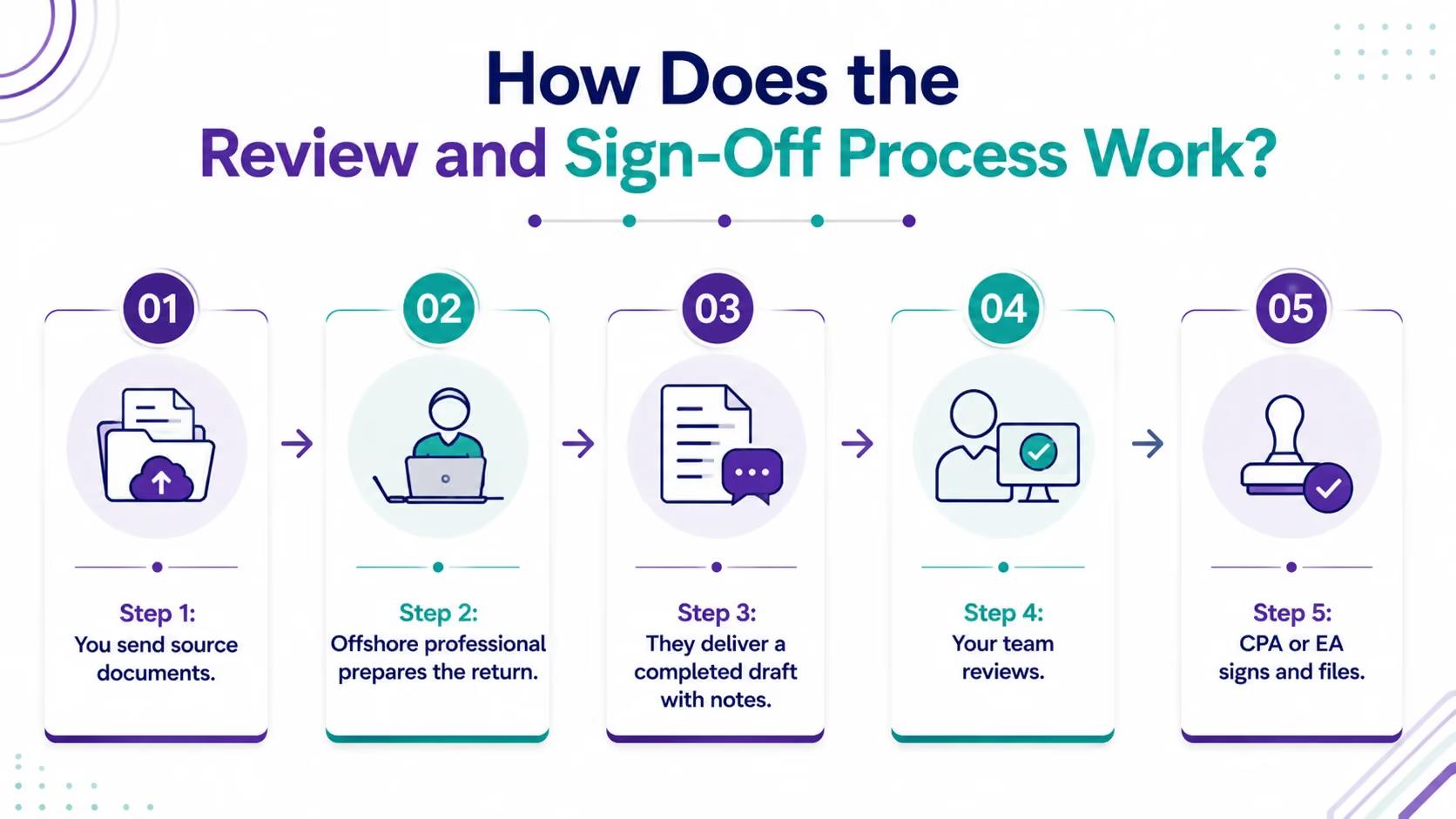
This is the part that concerns most CPA firm owners. The short answer: it works exactly like internal review, just with a different person doing the prep work.
Step 1: You send source documents.
Your client uploads documents to your portal. You or your admin organizes them and sends a package to the offshore professional with your standard preparation instructions and any prior-year notes.
Step 2: Offshore professional prepares the return.
They work in your tax software, follow your firm's preparation standards, and flag any missing documents or unclear items before completing the return. They do not guess. They flag and wait for clarification.
Step 3: They deliver a completed draft with notes.
The return comes back to you with a preparation notes sheet noting any items flagged, any assumptions made, and any areas that need review attention. This notes sheet is what distinguishes a well-run offshore prep process from a sloppy one.
Step 4: Your team reviews.
Your internal reviewer goes through the return against your standard checklist. They make any adjustments. If something needs client clarification, that communication goes through your team. The offshore professional is never in your client's inbox.
Step 5: CPA or EA signs and files.
The return is filed under your firm's PTIN. The offshore professional is never named on the filing. Your professional standards and client relationship are fully intact.
The entire process runs inside your existing systems. The offshore professional needs access to your tax software and a secure file transfer method. Nothing about the client-facing experience changes at all.
What Does Outsourced Tax Prep Cost in 2026?
Two pricing models dominate the market. Understanding which one fits your situation before comparing provider prices is the most important step.
Compare this to a US seasonal tax associate. A qualified entry-level tax associate costs $25 to $35 per hour plus recruiting time. For a 16-week tax season at 40 hours per week, that is $16,000 to $22,400 in wages alone, before benefits, onboarding time, training, and the reality that many seasonal hires do not return the following year.
The offshore model is not just cheaper. It is more predictable. You agree to a fixed monthly rate for a defined period. No overtime. No benefits overhead. No recruiting cost if the previous seasonal hire does not return.
What Are the Risks and How Do You Manage Them?
.avif)
Four risks come up consistently with outsourced tax prep. All are manageable with the right setup before tax season starts.
Risk 1: Accuracy on complex returns.
Offshore professionals are trained on standard return types. Complex, judgment-heavy returns need internal handling. Define clearly which return types go offshore and which stay internal before the season starts. Document that boundary. Do not send a complex multi-entity return with unusual tax positions to an offshore professional on their first week.
Risk 2: Data security.
Your clients' tax documents are among the most sensitive data your firm handles. Your offshore provider must hold SOC 2 Type II or ISO 27001 certification. IRS Publication 4557 defines the safeguard requirements for firms handling taxpayer data. Ask for the actual certificate documents before engagement. A claim on a webpage is not sufficient.
Risk 3: Turnaround time during peak load.
If your offshore professional is handling more volume than they can process accurately, turnaround slips. Define a weekly capacity cap before tax season starts. Know how many returns per week they can complete at acceptable quality before you send 30 returns in week one.
Risk 4: Missing context from prior year.
The first year with an offshore professional is always the hardest because they have no prior-year knowledge of your clients. Build a prior-year notes sheet into your source document package. Flag recurring issues, unusual items, and client-specific quirks. This alone cuts review time significantly in year one and nearly eliminates the extra review burden in year two.
What to Look for When Choosing an Outsourced Tax Prep Provider
Not all tax prep outsourcing providers are structured the same way. These six criteria separate the ones worth engaging from the ones worth avoiding.
US tax form training.
Ask specifically which IRS forms their professionals are trained on. Not just 1040s. Ask about 1065, 1120S, Schedule C, Schedule E, and multi-state filings. Ask which software platforms they train on. If the answer is vague, the training is vague.
Dedicated vs shared model.
A dedicated professional works only for your firm during the engagement. A shared model means they are splitting time between multiple client firms simultaneously. For tax prep, dedicated is worth the modest cost difference. The professional learns your clients' recurring situations, your review preferences, and your firm's formats in a way that a shared model never produces.
Security certifications.
SOC 2 Type II and ISO 27001 are the two standards to require. Ask for the documents. Do not accept a marketing claim or a screenshot.
Pilot or trial option.
Any provider confident in their output should let you evaluate real tax return prep quality before a seasonal commitment. Etisson's 40-hour free pilot applies to tax prep engagements. You assign real returns. You evaluate the output. You decide before committing.
Onboarding speed.
If you need a tax associate for January, engaging in late December is cutting it close. Engaging in November gives you time for proper onboarding and a few trial returns before the season starts. Ask any provider how long onboarding takes and what it involves.
A Real Scenario: How One Firm Handled 40 Extra Returns in Tax Season
A CPA firm with nine staff was heading into tax season with a backlog of 40 individual and small business returns they had taken on after a local competitor closed. Their three existing tax associates were already fully allocated to the firm's regular client load.
They engaged one Etisson tax associate in the second week of January. That professional was onboarded in 48 hours, given access to Drake, and started on 1040 returns the following Monday morning.
Over 12 weeks, they completed 38 of the 40 additional returns. Two complex multi-state partnership returns stayed with the firm's internal senior associate. The managing partner reviewed all 38 offshore-prepared returns. Average review time per return was 22 minutes. Before outsourcing, preparation plus review had averaged 4.5 hours per return when done entirely internally.
The firm billed the 40 new clients at their standard rates. The cost of the Etisson engagement for the season was $9,800. The revenue from those 40 returns was approximately $68,000. The net contribution after engagement cost was $58,200 on work the firm otherwise could not have handled.
The firm renewed the engagement the following January and added a second tax associate.
How Etisson Can Help with Tax Prep Support
Etisson places dedicated tax associates trained on US individual, partnership, and corporate returns. They work in the software your firm already uses including Drake, ProConnect, UltraTax, and CCH Axcess. Seasonal and year-round engagements are both available.
Every engagement starts with a 40-hour free pilot. You assign real returns. You evaluate the output. You decide before making any financial commitment.
FAQs
Is it legal to outsource tax return preparation to an offshore provider?
Yes. The IRS requires that any compensated preparer have a valid PTIN. The signing CPA or EA at your firm retains responsibility for the final return. Offshore prep professionals work under this structure legally across hundreds of US firms every tax season.
What tax software do offshore tax prep professionals use?
Etisson professionals are trained on Drake, ProConnect, UltraTax, and CCH Axcess. Confirm software compatibility with any provider before engagement.
How does the client experience change when you outsource tax prep?
It does not change. All client communication stays with your internal team. The offshore professional never contacts your client directly.
How many returns can one offshore tax associate complete per week?
For standard 1040 returns, 8 to 12 per week is a typical pace. For 1065 or 1120S returns, 4 to 6 per week is more realistic. Define a weekly capacity expectation before the season starts.
What happens if an offshore-prepared return has an error?
Your review process catches errors before filing. The responsibility for the final return rests with the signing CPA, the same as it would for an in-house preparer. This is why review checklists are non-negotiable.
How far in advance should a CPA firm engage an offshore tax prep provider?
At minimum four to six weeks before your busy season starts. Engaging in November for a January start is ideal. It allows for proper onboarding and a few trial returns before peak volume hits.
Does Etisson offer seasonal tax prep engagements?
Yes. Etisson supports both seasonal and year-round tax prep engagements. The 40-hour free pilot applies to both.
Conclusion
Outsourcing tax return preparation isn't about replacing your in-house team.
It's about giving them the capacity to handle more work without sacrificing quality or burning out during tax season. With the right provider, clear review processes, and strong security standards, CPA firms can scale efficiently, improve turnaround times, and take on more clients with confidence. Whether you need extra support for busy season or a long-term extension of your team, outsourcing can be a practical way to grow your firm while maintaining the high standards your clients expect.
Ready to handle more returns this tax season without hiring?
Book a 15-minute call with Etisson: https://meetings.hubspot.com/nick2204
.avif)
.avif)