.avif)

Blog summary
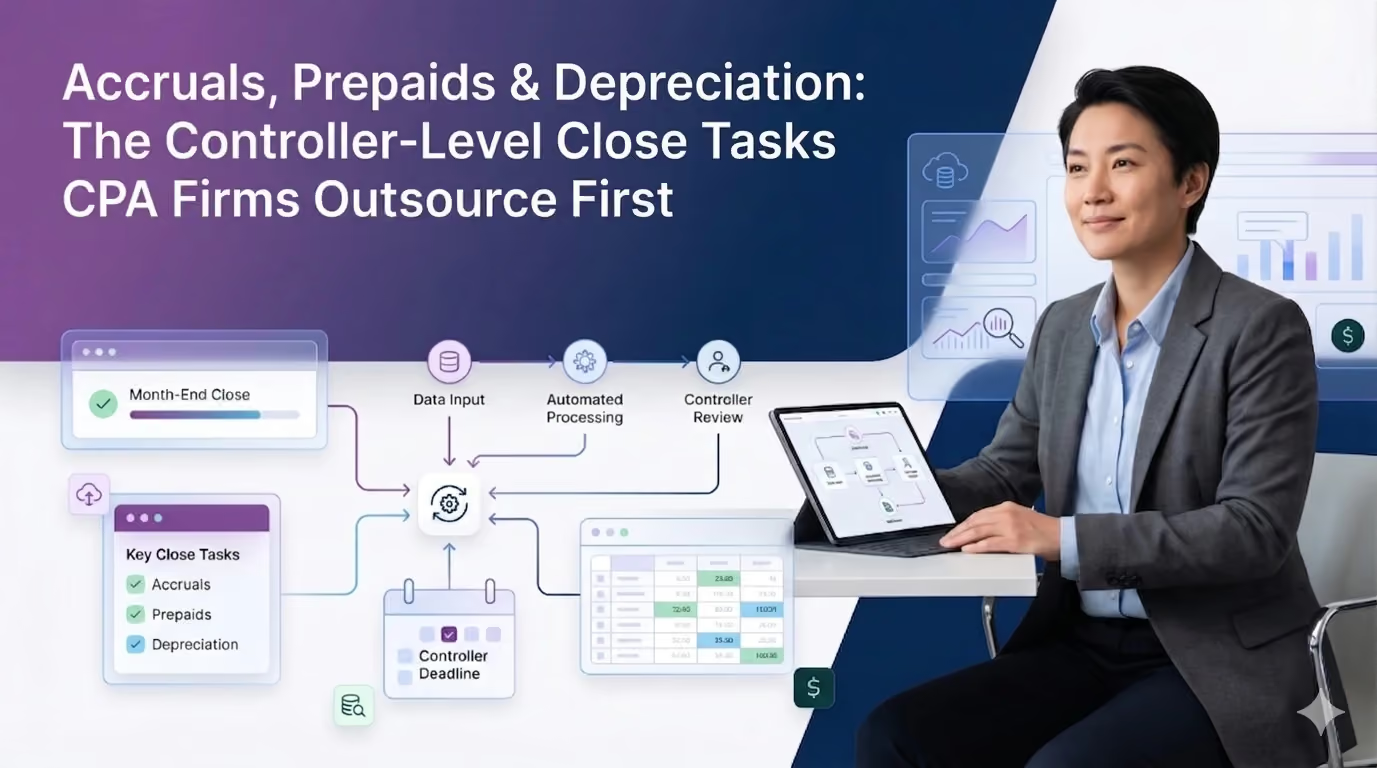
- Accruals, prepaids, and depreciation are the month-end entries that most often create rework.
- Not because they are complex. Because they depend on timing, support, and consistency.
- This guide breaks down controller level close tasks for CPA firms.
- You will get a practical checklist, example month end accrual entries accounting teams use, and review controls that reduce partner review time.
- You will also see when it makes sense to consider outsourcing accruals and prepaids.
- The goal stays the same either way. Clean entries, clear support, and predictable close outcomes.
Why these three entries drive so much month-end pain
Accruals, prepaids, and depreciation sit right at the intersection of operations and accounting. Somebody ordered the service. Somebody approved the invoice. Somebody paid it. And accounting has to match it to the right month.
That creates gaps. Missing invoices. Vague vendor descriptions. Late approvals. And unclear capitalization decisions. When the support is weak, the controller pays for it in review time.
If your firm supports multiple clients, the problem multiplies. Every client has different habits. Different cutoffs. Different bank timing. And different tolerance for estimates.
What “controller level close tasks” really means in a CPA firm
Controller level close work is not data entry. It is judgment, quality control, and risk management. It is also the layer that protects partners from rereviewing the same accounts every month.
In practice, controller level close tasks for CPA firms usually include:
- Setting materiality thresholds for adjusting entries
- Enforcing cutoff rules for accruals and prepaids
- Reviewing depreciation inputs and fixed asset activity
- Performing reasonableness checks and variance explanations
- Signing off on reconciliations and support packages
The best controllers do one more thing. They make the work repeatable through SOPs and templates. That is what shortens close timelines without lowering quality.
Quick definitions you can use with staff and clients
Teams move faster when everyone uses the same language. Here are simple working definitions that fit month-end close conversations.
Accrual. An entry to recognize expense or revenue in the period incurred, even if the invoice or cash has not posted yet.
Prepaid. A cost paid in advance that gets recognized as expense over future months.
Depreciation. The monthly allocation of a capital asset’s cost over its useful life, recorded through a recurring journal entry.
These definitions sound basic. But they prevent common misclassifications during rush week.
The close sequence that reduces rework
A lot of teams post adjusting entries too early. Then they reconcile. Then they discover bank timing. Then they reopen entries. That is how you get messy audit trails.
A tighter sequence works better:
- Lock transactional cutoff. Capture late bills and known timing issues.
- Complete core reconciliations. Cash, AP, AR, payroll clearing.
- Post accruals. Then post prepaid amortization. Then depreciation.
- Re-run analytics. Variance review, margin review, trend checks.
- Package support. Tie-out schedules and entry support in one place.
This flow matters because accruals, prepaids, and depreciation depend on stable balances. Stable inputs produce stable entries.
Month-end accrual entries: what to post, how to support, how to review
Accruals are where “good enough” can turn into ongoing noise. A weak accrual process creates reversals, duplicates, and permanent cleanup work.
Common month end accrual entries accounting teams should standardize
Most CPA firm clients need the same buckets every month. Standardize these first.
- Accrued payroll and related taxes
- Accrued contractor or professional fees
- Accrued utilities and telecom
- Accrued interest
- Accrued bonuses or commissions
- Accrued revenue, if applicable, tied to service delivery
Once these are consistent, you can handle the odd items. One-offs should not drive your process.
Accrual support package: the minimum that passes controller review
Controllers do not need a novel. They need support that answers three questions. What is it. Why this amount. Why this month.
A clean accrual support file should include:
- Vendor name and service period covered
- Calculation method, with inputs visible
- Prior month accrual, reversal, and true-up logic
- Approval trail, if the amount is judgment-based
- Link to source. PO, contract, timesheet, usage report, or email confirmation
If your staff cannot explain the accrual in two sentences, it will not survive partner review without questions.
Accrual control: reversals with rules, not habits
Auto-reversing accruals can help. It can also create chaos when invoices post late or get coded differently than expected.
Use a simple rule set:
- Use auto-reversal for predictable monthly accruals with clean vendor coding.
- Avoid auto-reversal for estimates that routinely require true-ups.
- If you reverse, enforce that invoices hit the same expense account.
- If coding varies, do not reverse. True-up instead.
This control alone cuts down duplicated expense and “mystery variance” conversations.
To automate recurring and reversing entries with approvals and checks, see our guide to journal entry automation.
Prepaid expense month-end close: where firms lose consistency
Prepaids fail for one reason. Teams do not maintain schedules like fixed asset registers. They treat prepaids as a one-time entry.
That works for one month. Then the schedule goes stale. Then amortization stops. Then expenses spike in random months. Then the controller has to rebuild history.
What belongs in prepaid, and what does not
Use policy rules that staff can follow without asking every time.
Typically prepaid:
- Insurance premiums paid annually or semiannually
- Software or SaaS paid upfront for multiple months
- Rent paid in advance under the lease terms
- Retainers when the service period is clearly defined
Typically not prepaid:
- One-time services already delivered
- Deposits that should sit in a deposit asset account
- Small-dollar items under a threshold that you expense immediately
Materiality matters. If the firm does not set a threshold, staff will guess. Guessing creates inconsistency across clients.
Prepaid schedule fields that make close faster
A prepaid schedule should not be complicated. It should be complete.
Minimum fields:
- Vendor and description
- Start date and end date
- Original amount
- Monthly amortization amount
- Remaining balance
- GL account mapping
- Link to invoice or payment support
If you track this cleanly, the prepaid expense month end close becomes a recurring posting. Not a monthly rebuild.
Example prepaid amortization entry
Here is a common format.
- Debit: Prepaid expense amortization (expense account)
- Credit: Prepaid expense (asset account)
Support the entry with the schedule and the invoice. Then tie the ending prepaid balance to the schedule total. That tie-out is the controller checkpoint.
Depreciation entries month end close: keep it boring and controlled
Depreciation should be boring. If depreciation changes every month, something upstream is broken. Most issues come from asset additions, disposals, and capitalization decisions that are not documented.
What triggers depreciation changes in a CPA firm client
These are the usual triggers your close checklist should call out.
- New assets placed in service
- Disposals, retirements, or write-offs
- Asset reclassifications between categories
- Useful life changes or impairment decisions
- Bonus depreciation or tax-only adjustments, when books and tax differ
Keep book depreciation separate from tax depreciation schedules. Mixing them creates confusion in monthly reporting.
Depreciation entry structure for month-end
Most clients will post:
- Debit: Depreciation expense
- Credit: Accumulated depreciation
If the client uses classes, departments, or locations, allocate depreciation with a consistent method. Do not change the allocation approach without documenting why.
Controller review controls for depreciation
Controllers should verify:
- The fixed asset roll forward ties out. Beginning balance + adds − disposals = ending balance.
- Depreciation expense ties to the schedule for the month.
- Additions have support and capitalization approval.
- Disposals remove both cost and accumulated depreciation correctly.
If you want fewer partner questions, add one more step. Include a short note on any changes from last month, even if the change is expected.
A controller-level checklist for these three adjusting entry areas
Use this as a reusable close workpaper section. It is designed to reduce rework and standardize reviewer expectations across staff.
Accruals checklist
- Confirm cutoff rules and materiality threshold.
- Pull known recurring accrual list and update amounts.
- Identify missing invoices using AP detail and vendor spend trends.
- Prepare support with service period and calculation.
- Decide reversal method. Reverse, true-up, or hold.
- Post entry and tie accrued liabilities to supporting schedule.
Prepaids checklist
- Update prepaid schedule for new upfront payments.
- Validate start and end dates against contract terms.
- Post monthly amortization entry from the schedule.
- Tie prepaid asset balance to schedule total.
- Investigate negative lines or expired items with remaining balances.
Depreciation checklist
- Update fixed asset register for additions and disposals.
- Confirm “placed in service” dates for current month adds.
- Run depreciation schedule and lock output for the period.
- Post depreciation journal entry.
- Tie depreciation to schedule and validate rollforward.
Decision table: outsource vs keep in-house for accruals, prepaids, and depreciation
A lot of firms ask about outsourcing accruals and prepaids because these entries are repetitive. But they still require judgment. So the decision should be structured.
Outsourcing does not remove accountability. It changes who executes the repeatable parts. Controllers still set the rules and review the outputs.
The biggest failure points, and how to prevent them
Most close issues repeat because nobody names the root cause. Here are the patterns I see most often in CPA firm close work.
Failure point 1: entries posted without a schedule tie-out
If accruals and prepaids do not tie to schedules, the balance sheet becomes a dumping ground. You will spend hours later proving what is inside the number.
Fix: require a tie-out for any balance sheet adjusting entry. No tie-out, no post.
Failure point 2: inconsistent account mapping across months
A prepaid that hits “Subscriptions” one month and “Software expense” the next month breaks trends. It also creates partner questions that waste review time.
Fix: lock mappings in the schedule template. Only the controller can change them.
Failure point 3: capitalization decisions made by whoever is available
When staff decide what is a fixed asset, you get inconsistent depreciation and messy tax support later.
Fix: create a capitalization policy one-pager. Add examples. Then require controller approval on additions.
Failure point 4: reversals used as a crutch
Reversals can hide weak processes. They can also create double counting when invoices post late or land in different accounts.
Fix: only reverse accruals with predictable timing and clean coding. True-up the rest.
How structured outsourcing improves close operations (and where Etisson fits)
Some CPA firms outsource because they want cheaper labor. That approach rarely improves close. It usually creates more review and more follow-up.
Structured outsourcing works differently. It treats the close like an operating system. The team follows defined SOPs, uses standard workpapers, and posts entries with consistent support every month.
In practice, that structure improves four things:
- Process discipline. Clear checklists, defined cutoffs, and consistent approval steps reduce “tribal knowledge” risk.
- Automation-first workflows. Standard schedules and recurring entries reduce manual rebuilds and spreadsheet drift.
- Visibility and control. Centralized status tracking and reviewer-ready support packages reduce back-and-forth.
- Reduced partner review burden. Cleaner support and consistent mapping shrink partner questions and rereview time.
Etisson typically supports firms in that structured model with qualified US- and UK-trained professionals. Teams work inside firm-defined SOPs, with tight documentation habits and clear communication routines.
That combination matters most when firms want scalable capacity without hiring risk. The controller keeps control of policy and judgment. The execution becomes predictable and easier to review.
Practical examples: what “good” looks like in a real close week
Here are three quick scenarios that match what controllers see across multiple clients.
Scenario A: late utility bills, stable trend
You do not have the invoice by day three. But usage and spend run consistent.
Good approach: post an accrual based on the average of the last three months. Add a note that it is an estimate. True-up when the invoice arrives.
Bad approach: skip the accrual. Let expense spike next month. Then explain the variance every month forever.
Scenario B: annual insurance paid upfront
Client pays $24,000 on April 10 for a 12-month policy starting April 1.
Good approach: record prepaid at payment, then amortize $2,000 per month starting April. Tie prepaid balance to the schedule monthly.
Bad approach: expense it all in April. Or worse, leave it in prepaid and forget to amortize.
Scenario C: new laptop purchases that blur fixed asset rules
Client buys ten laptops at $1,400 each. They want them capitalized. Your threshold is $2,500.
Good approach: expense per policy. If you choose to deviate, document the exception and keep it consistent.
Bad approach: capitalize some, expense some, with no reason. Depreciation becomes unpredictable and hard to defend.
FAQ
What are month-end journal entries?
Month-end journal entries are adjusting entries posted to record activity in the correct period. They commonly include accruals, prepaid expense amortization, and depreciation to align financials with the month’s activity.
What are the 4 types of adjusting entries?
The four common types of adjusting entries are accruals, deferrals, depreciation (or amortization), and estimates. In close work, these show up as accrued expenses, prepaids, depreciation entries, and items like bad debt reserves.
What is a typical month end accrual entries accounting process?
A typical process is: identify missing invoices or earned revenue, calculate the estimate, prepare support, decide whether to reverse or true-up, post the accrual, and tie the ending liability or receivable to a schedule.
How do you handle prepaid expense month end close tasks?
You update the prepaid schedule for new upfront payments, post monthly amortization based on the schedule, and tie the prepaid asset account balance to the schedule total. You investigate any expired items with remaining balances.
What is the depreciation entry at month-end?
The standard month-end depreciation entry is a debit to depreciation expense and a credit to accumulated depreciation. The amount should tie directly to the fixed asset depreciation schedule for the period.
Should CPA firms consider outsourcing accruals and prepaids?
CPA firms should consider outsourcing accruals and prepaids when volume is high and schedules keep breaking due to capacity constraints. The controller should still set policy, approve judgments, and review support before final close.
Conclusion
Accruals, prepaids, and depreciation are not hard. They are easy to do poorly when the close is rushed and the rules live in someone’s head.
When you standardize schedules, set thresholds, and enforce support requirements, these entries stop being a monthly fire drill. They become routine controller-level close tasks that protect quality and reduce partner review load.