.avif)

Blog summary
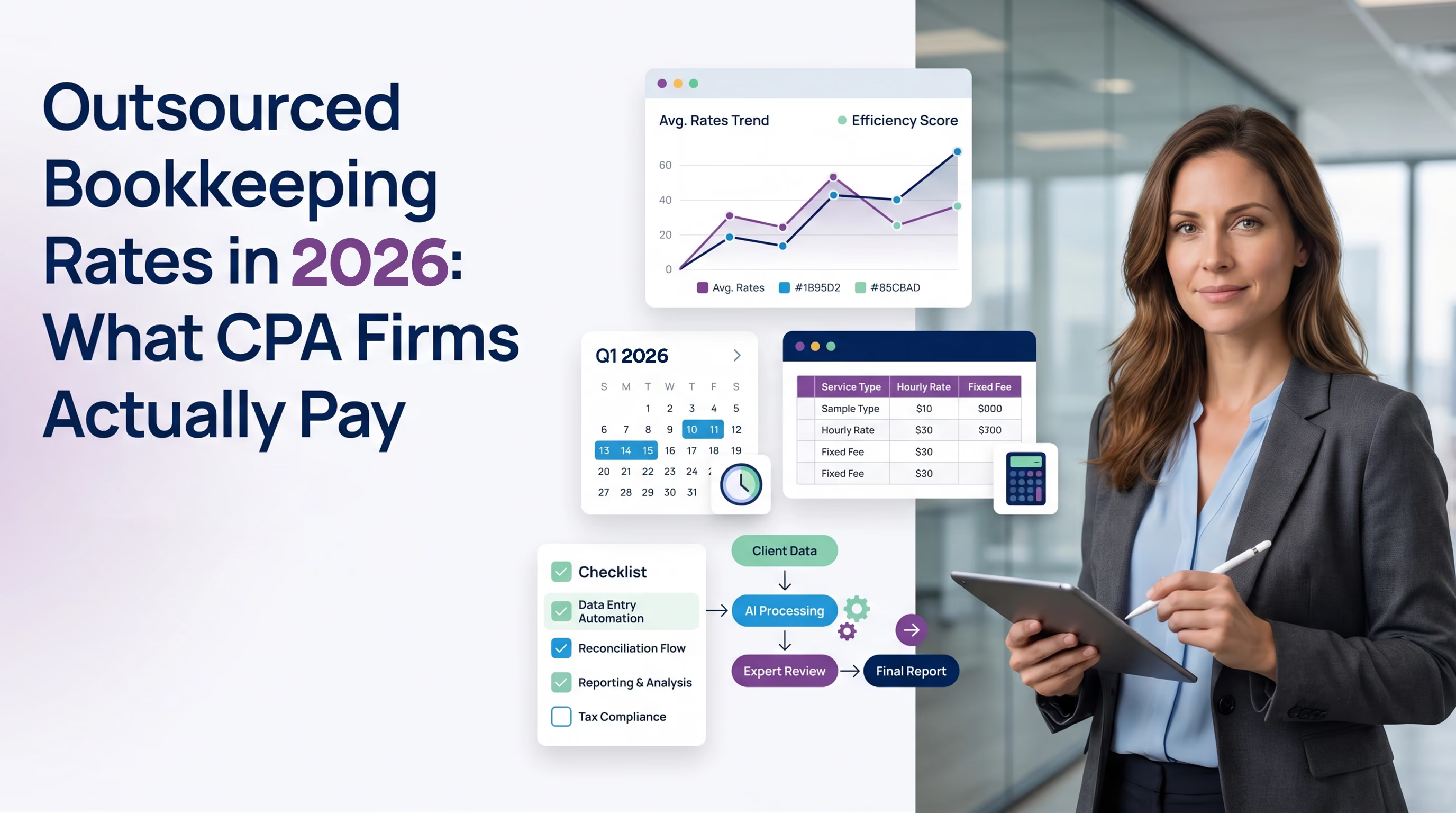
- Outsourced bookkeeping rates in 2026 sit on a wide range, because “bookkeeping” can mean anything from bank reconciliations to AP, AR, payroll support, and close.
- This guide breaks down real pricing models, offshore bookkeeping rates per month, and the true outsourced bookkeeping vs hiring cost.
- It also includes practical per-client pricing ranges, FTE equivalents, and a clean way to quote without underpricing.
Why outsourced bookkeeping pricing feels inconsistent
Most firms look up “how much does outsourced bookkeeping cost” and get a huge spread.
That spread is real. It comes from scope. It also comes from quality level, tooling, and how clean the client’s books are when work starts.
If you do not define the work, you cannot compare rates. You also cannot protect margin.
So let’s define it in operational terms. Then we can talk pricing without guessing.
Outsourced bookkeeping cost ranges
For most small to mid-sized business clients served through CPA firms, a realistic monthly range looks like this.
The exact number depends on transactions, accounts, sales channels, payroll frequency, and how tight the close needs to be.
Typical outsourced bookkeeping rates per month (USD).
- Basic bookkeeping: $500 to $1,500 per month
- Full-service bookkeeping (AP, AR support, payroll coordination): $1,500 to $3,500 per month
- Controller-supported close (review, accruals, reporting cadence): $3,500 to $7,500 per month
These bands align with what you see across current market guides and CPA advisory content. They also match what operations teams see when they normalize scope.
The only pricing question that matters: what level of “done” do you deliver?
Bookkeeping outsourcing pricing breaks when the firm and the provider define “done” differently.
Do you mean “transactions posted” or “month closed and ready for tax and advisory”? Those are not the same deliverable.
Here is a clean way to define levels for quoting and packaging.
Level 1: Transactional bookkeeping (foundation work)
This level usually includes the following.
- Bank and credit card reconciliations
- Rules-based categorization and cleanup
- Basic month-end checks
- Simple financial statements
This is where many “low monthly fee” packages live. It also carries the highest rework risk if you skip controls.
Level 2: Operational bookkeeping (client-ready monthly close)
This level usually adds the work clients actually feel.
- AP and AR support, or at least coordination
- Clearing accounts management
- Accrual support and basic schedules
- Month-end close checklist and due dates
- Variance checks and exception follow-ups
This level is where CPA firms reduce partner interruptions. It also supports clean handoffs to tax teams.
Level 3: Controller-supported bookkeeping (review-driven close)
This level adds structured review and a tighter cadence.
- Controller-level review notes and sign-off
- Month-end reporting package consistency
- KPI packs or department views
- Policy enforcement on coding and documentation
This level drives higher rates. It also drives lower partner review time when it runs well.
Pricing models CPA firms use in 2026 (and where each one wins)
There are three models you will see most often in a CPA firm or CAS practice.
Each model can work. Each model can also break. It depends on client mix and how disciplined your scope control is.
1) Hourly pricing
Hourly billing feels safe when scope is messy. It also trains clients to argue about time, not outcomes.
Hourly ranges commonly fall in these bands.
- Offshore: often $10 to $25 per hour
- US-based: often $40 to $75 per hour
- Specialized or high-touch: can run higher depending on industry and review depth
Hourly works best for cleanup, projects, and unknowns. It works worst for routine monthly work.
2) Fixed monthly fee (bundle pricing)
This is the most common per-client bookkeeping pricing model in mature CAS practices.
It creates predictable revenue. It also forces you to define scope and enforce a change-order process.
Fixed fee works when you standardize workflows and control inputs. It breaks when every client “does it their way.”
3) Capacity-based pricing (FTE or pod-based)
This model ties cost to capacity, not transactions.
It fits firms that want a dedicated outsourced bookkeeper or a shared team. It also fits firms that manage staffing like an operations function.
This is where “outsourced bookkeeper FTE cost” becomes a better lens than per-transaction estimates.
Offshore bookkeeping rates per month: what firms usually see
Offshore pricing typically lands in lower hourly bands than US-based staffing.
But the monthly number depends on whether you buy shared capacity, dedicated capacity, or a managed team with QA and workflow controls.
Here is a practical way to think about offshore bookkeeping rates per month in 2026.
Offshore shared support (part-time coverage)
This is common for firms that want help with reconciliations, coding, and routine close tasks.
- Typical range: $400 to $1,500 per month per client equivalent, depending on volume and scope
- Best for standardized clients with stable monthly cadence
Offshore dedicated capacity (fractional to full FTE)
This is closer to staffing than per-client service. It works well when you have steady internal demand.
- 0.5 FTE equivalent: often $1,500 to $3,000 per month
- 1.0 FTE equivalent: often $3,000 to $6,500 per month
The number moves with experience level, management layer, and tooling maturity.
India bookkeeping outsourcing price vs Philippines bookkeeping outsourcing cost
Firms often ask whether India or the Philippines is “cheaper.”
The better question is whether the team can follow your SOPs, hit close dates, and document work so review time drops. That is where total cost lives.
Still, you will see some market patterns.
India bookkeeping outsourcing price (common market pattern)
India often shows deep accounting talent pools and strong process execution in outsourced models.
- Hourly bands often show up around $10 to $25 per hour for bookkeeping support tiers
- Monthly bands vary based on whether the provider includes QA, team leads, and workflow management
Philippines bookkeeping outsourcing cost (common market pattern)
The Philippines often shows strong English fluency and service culture, with rates that vary widely by provider structure.
- Hourly rates commonly land in a similar offshore band, often slightly higher for certain roles
- Monthly pricing depends heavily on whether you buy a “seat” model or managed output
Do not select by country alone. Select by operating model.
Bookkeeping outsourcing cost per client: a usable 2026 benchmark table
Most CPA firm leaders need a quick way to sanity-check a quote.
This table gives starting ranges. You still need to adjust for complexity, industry, and cleanup needs.
If your firm sees heavy cleanup, add a one-time onboarding and remediation fee.
If you skip that fee, your monthly margin will pay for it anyway.
Outsourced bookkeeper FTE cost: the comparison most firms ignore
Leaders often compare outsourcing to an hourly contractor.
But operationally, you usually replace capacity. That means the right comparison is fully loaded FTE cost versus outsourced capacity cost.
Here is what “fully loaded” usually includes for an in-house hire.
- Base pay
- Payroll taxes
- Benefits
- Recruiting fees
- Training time
- Software and equipment
- Management time and rework time
- Turnover risk and ramp time
A simple FTE comparison table (illustrative)
Numbers vary by market, but the structure holds.
The hidden driver is partner and manager time. If outsourcing reduces review cycles, it can win even at higher sticker price.
Outsourced bookkeeping vs hiring cost: the operational break-even point
When does outsourcing beat hiring.
It usually happens when one of these is true.
- Your work volume is uneven across the month or year.
- Your partners keep doing review because workpapers are inconsistent.
- Your firm cannot hire fast enough without lowering standards.
- Your client mix needs flexible staffing across industries and apps.
Hiring can win when workflow is stable, roles are clear, and you can keep utilization high without burning people out.
Outsourcing can win when you need elasticity and fast capacity without hiring risk.
What drives bookkeeping outsourcing pricing up or down
If you want predictable margins, you need to price the drivers.
These are the drivers that matter most in real close workflows.
1) Transaction count is not enough
Two clients with 400 transactions can feel completely different.
One has clean bank feeds. The other has undeposited funds issues, owner draws, and random memos.
Price for the mess, not just the count.
2) Close cadence and expectations
Weekly bookkeeping costs more than monthly.
Five-day close costs more than “sometime by the 20th.”
If the client wants speed, you need tighter controls. That means more touches.
3) Systems and sales channels
Stripe plus Shopify plus PayPal plus Amazon equals more reconciliation work.
Job costing, inventory, and multi-entity adds review and schedule discipline.
You should either price those as add-ons or put them in higher tiers.
4) Client responsiveness
This is the silent killer.
If the client delays answers, your team context-switches. That drives cost, even if transaction volume stays flat.
Build a “client responsibility” clause into scope. Then enforce it with a change process.
A practical per-client pricing model (that protects your firm)
If you manage outsourced bookkeeping inside a CPA firm, you need a model your team can apply consistently.
Here is a structure that works in real operations.
Step 1: Set a base tier by volume and complexity
Pick a tier that matches the client’s normal month.
Do not use the best month. Do not use the worst month. Use the normal month.
Step 2: Add close requirements as a separate lever
Examples you can price as levers.
- 5-business-day close
- Weekly cash reporting
- Board pack formatting
- Class or location reporting
- Accrual schedules and rollforwards
Step 3: Add systems as add-ons
Examples.
- Additional bank accounts beyond two
- Each additional processor or sales channel
- Payroll coordination beyond one provider
- Inventory support
- Multi-entity consolidations
Step 4: Price onboarding separately
Onboarding includes cleanup, mapping, rules, and documentation.
If you bury onboarding in the monthly fee, you train the practice to accept low margins during the most painful phase.
What “good outsourcing” looks like operationally (and why it changes cost)
Outsourcing succeeds when you treat it like operations, not labor.
That means you define the workflow, enforce SOPs, and create visibility. Then you measure output quality and cycle time.
A structured outsourcing partner can act as an extension of your accounting ops function.
In practice, that structure usually includes:
- Process discipline. Clear SOPs for bank recs, AP coding rules, and month-end close checklists.
- Automation-first workflows. Rules, templates, and standardized workpapers reduce touches and reduce error rates.
- Visibility and control. Status reporting by client, aging of open items, and clean handoffs for review.
- Reduced partner review burden. Better documentation and fewer surprises shorten review loops.
- Scalable growth without hiring risk. You add capacity without committing to headcount before demand stabilizes.
This is the model Etisson supports when firms need reliable bookkeeping execution with qualified US/UK-trained professionals, tight SOP adherence, and operational reporting that keeps partners out of the weeds.
The point is not “cheaper labor.” The point is a cleaner close and fewer review cycles.
Common pricing traps CPA firms run into
These show up in almost every practice that scales bookkeeping quickly.
Trap 1: Quoting a flat fee with no input controls
If the client can send anything, anytime, in any format, your cost will drift up.
You need boundaries. You also need a monthly “what we need by when” checklist.
Trap 2: Treating cleanup as “part of monthly”
Cleanup work rarely stays contained.
If you do not isolate cleanup, you will keep paying for it in every close.
Trap 3: Buying offshore hours without a workflow owner
Hours do not manage themselves.
If nobody owns training, QA, and issue routing, your partner ends up owning it by default.
That is the most expensive outcome.
A simple decision table: which pricing model should you choose?
Use this as a fast internal filter.
You can also combine models. Many firms do hourly onboarding, then fixed monthly once the workflow stabilizes.
FAQ: outsourced bookkeeping rates and costs
How much does outsourced bookkeeping cost?
Most businesses pay $500 to $3,500 per month for outsourced bookkeeping in 2026, depending on transaction volume and scope. Controller-supported close and reporting can run $3,500 to $7,500+ per month.
What are typical offshore bookkeeping rates per month?
Offshore bookkeeping rates per month commonly range from $1,500 to $3,000 for about 0.5 FTE and $3,000 to $6,500 for about 1.0 FTE, depending on experience level and management structure. Shared per-client support can land lower for basic scopes.
What is a typical India bookkeeping outsourcing price?
India bookkeeping outsourcing price often falls around $10 to $25 per hour for bookkeeping support tiers. Monthly pricing varies by whether you buy shared hours or dedicated capacity with QA and team leads included.
What is a typical Philippines bookkeeping outsourcing cost?
Philippines bookkeeping outsourcing cost often sits in a comparable offshore band, with pricing driven more by role seniority and service model than geography. Managed service teams typically cost more than seat-based staffing.
What is the bookkeeping outsourcing cost per client for a CPA firm?
For many CPA firms, bookkeeping outsourcing cost per client ranges from $500 to $1,800 per month for simpler clients. More complex clients with multiple systems or job costing often run $1,500 to $5,000+ per month.
How do I compare outsourced bookkeeping vs hiring cost?
Compare fully loaded cost, not salary alone. Fully loaded hiring cost includes taxes, benefits, recruiting, training, software, management time, and turnover risk. Outsourcing often wins when it reduces partner review time and scales capacity without hiring risk.
What is the outsourced bookkeeper FTE cost?
Outsourced bookkeeper FTE cost commonly lands around $3,000 to $6,500 per month offshore, depending on skill and oversight layers. US-based equivalents often cost significantly more once fully loaded expenses are included.
What is the best per-client bookkeeping pricing model for 2026?
For stable clients, a fixed monthly fee with clear scope, close deadlines, and add-ons for systems usually works best. For messy or new clients, use hourly onboarding and shift to fixed pricing after stabilization.
Conclusion
Outsourced bookkeeping rates only make sense after you define the deliverable.
If you price “bookkeeping” as a vague activity, you will underquote, overwork your team, and push review back to partners.
If you price by operational outcomes, clear close cadence, and controlled inputs, you can scale without breaking quality.
That is what makes outsourced bookkeeping a capacity solution, not a constant fire drill.
.avif)