.avif)

Blog Summary / Key Takeaways
• Accounting staff augmentation means adding trained professionals to your team on a flexible basis under your direct management. It is not outsourcing. You control the daily work.
• Staff augmentation differs from outsourcing in that you manage the professional directly. Higher process control, higher integration, more management overhead in month one.
• The four most common first augmentation roles are bookkeeper, tax associate, senior accountant, and first-level reviewer.
• Offshore augmented professionals cost $1,200 to $3,800 per month. A seasonal tax associate engagement runs $6,000 to $10,000 total versus $16,000 to $22,400 for a US seasonal hire.
• Five situations where augmentation beats hiring: seasonal surges, new client segments, turnover gap coverage, new service line evaluation, and geographic talent constraints.
• Three risks to manage: integration friction, management overhead, and knowledge transfer on rotation. All are manageable with structured onboarding and documented workflows.
• Etisson's dedicated model operates as true staff augmentation. Your professional works under your direction, inside your systems, on your clients.
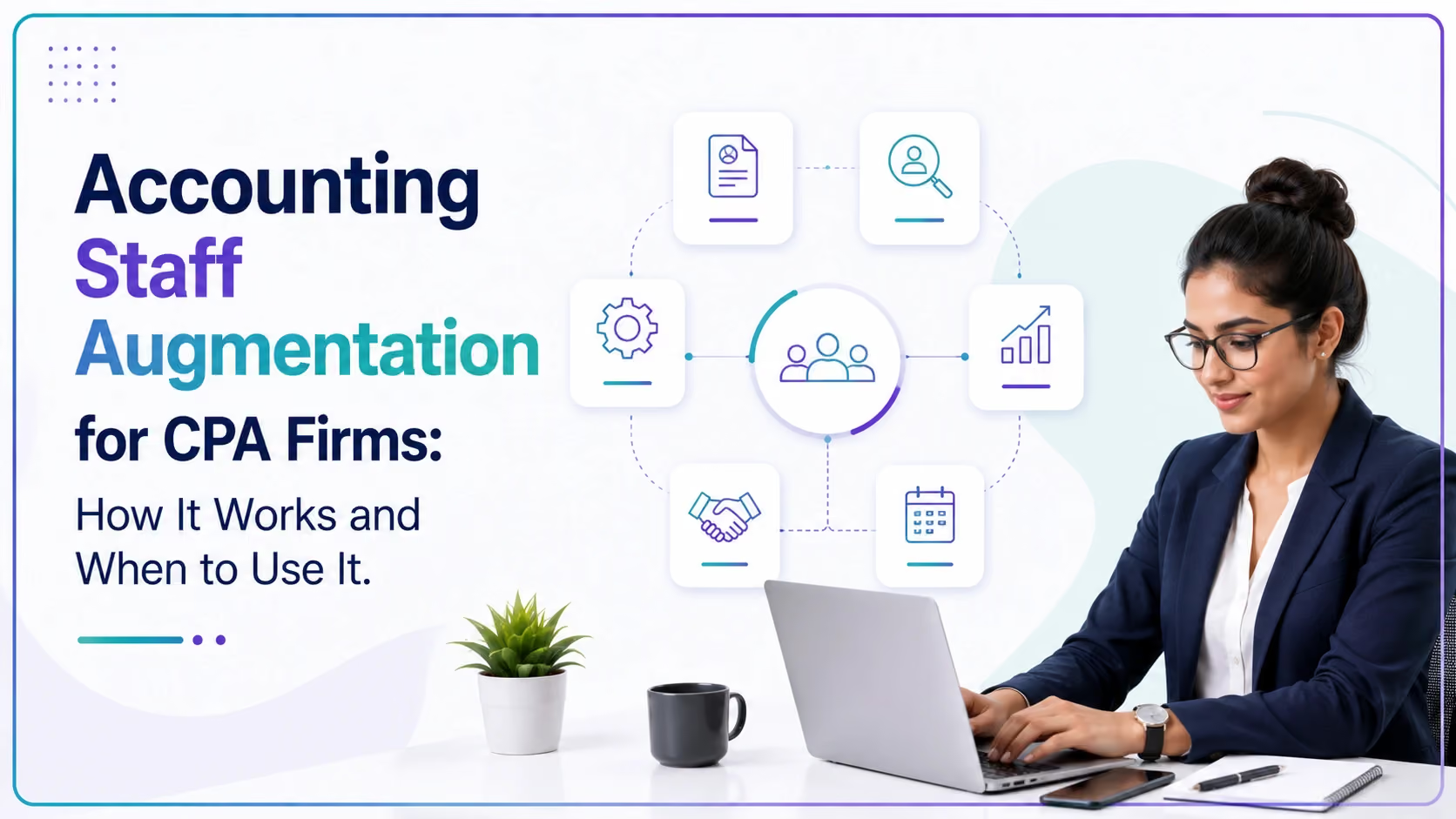
Accounting Staff Augmentation for CPA Firms: How It Works and When to Use It
Your firm has more work than your team can handle right now.
You do not want to hire a full-time employee for what might be a temporary surge. You do not want to hand off entire service lines to an outsourcing vendor and lose process control. You want to add one or two trained professionals to your team for a defined period, under your direction, working exactly the way your firm works.
That is accounting staff augmentation. And for CPA firms navigating seasonal surges, new client segments, or turnover gaps, it is often the most efficient answer.
This post explains exactly what accounting staff augmentation is, how it differs from traditional outsourcing, what it costs, and when it is the right call.
What Is Accounting Staff Augmentation?
Accounting staff augmentation means adding trained accounting professionals to your existing team on a flexible basis. They work under your direct supervision, inside your systems, following your processes and quality standards. The difference from a full-time hire is that the engagement can be scoped by duration, by role, or by volume without a permanent headcount commitment.
For CPA firms, staff augmentation typically means one of three things. Adding a bookkeeper or tax associate during peak periods. Adding a senior accountant to absorb a new client segment that your internal team cannot take on. Or adding a controller-level professional to handle a service line your firm is building but does not yet have dedicated capacity for.
The professionals come trained and ready to work. The provider handles payroll, benefits, and HR administration. You direct the daily work. You define the standards. You review the output.
How Is Staff Augmentation Different From Outsourcing?
This is the question most CPA firm owners ask first because the terms are often used interchangeably. The distinction is meaningful in practice.
In a traditional outsourcing arrangement, you hand off a defined set of tasks to a third party. They manage the work, the workflow, and the output. You review what comes back. Your process control is limited.
In a staff augmentation model, the professional integrates into your team. You manage their daily work directly. They follow your processes, your tools, and your quality standards. The provider is a staffing and HR layer, not a service delivery layer.
For CPA firms that want full control over how work is done and how it is reviewed, staff augmentation is the closer fit. For firms that want to hand off an entire function and review the output, traditional outsourcing is more appropriate. Many firms use both depending on the service type and the complexity of the client work involved.
What Roles Do CPA Firms Augment First?
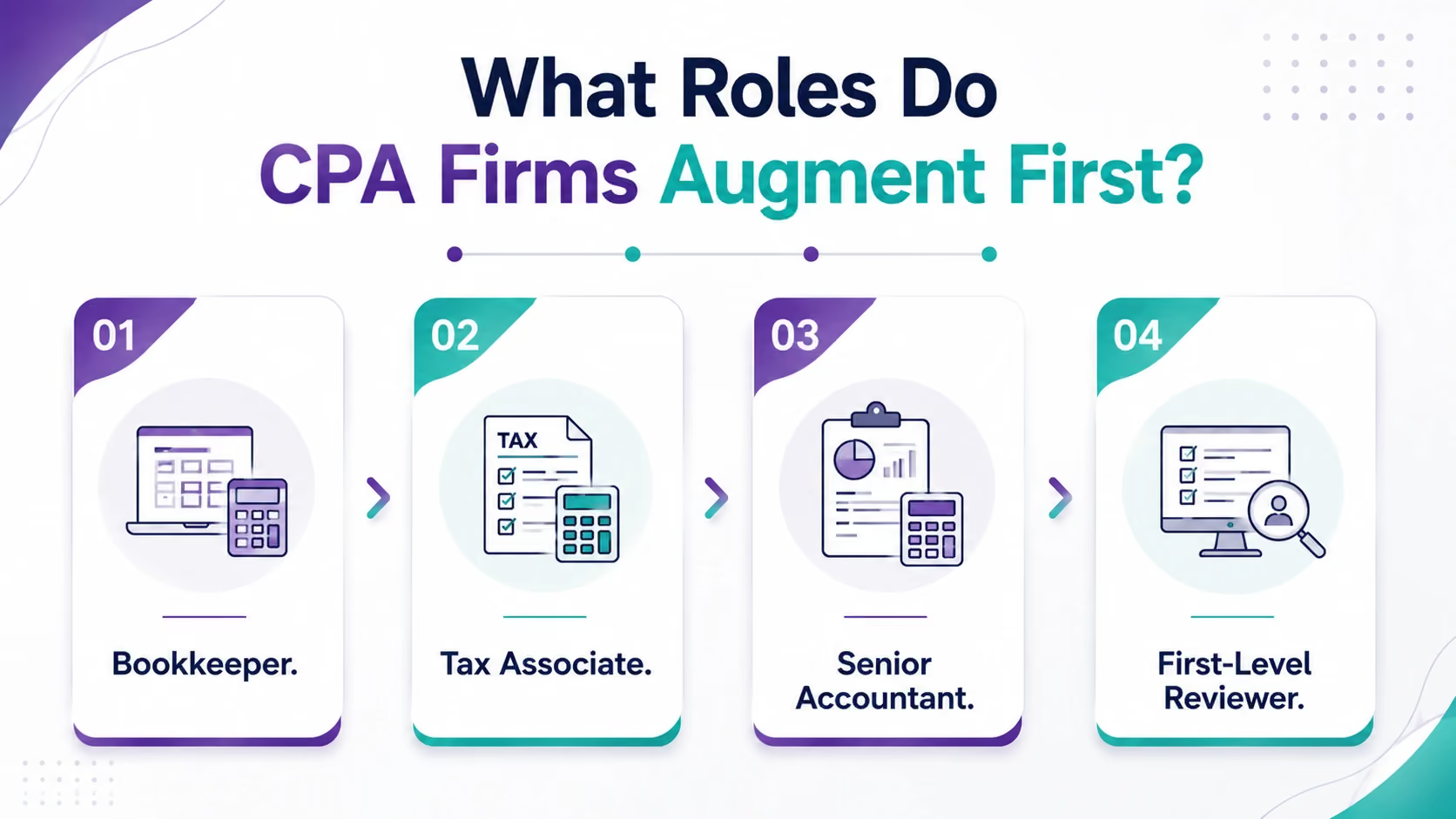
The most common augmentation roles in CPA firms fall into four categories.
Bookkeeper.
The highest volume and most common first augmentation. Handles transaction coding, bank feeds, reconciliations, and month-end close prep for assigned clients. This is the role most firms start with because it is well-defined, documentable, and high-impact on partner capacity.
Tax Associate.
Common during tax season. Handles 1040, 1065, 1120S preparation under your firm's review process. Seasonal augmentation is the standard model for this role. Most firms engage a tax associate from January through April and do not need them year-round.
Senior Accountant.
Added when a firm takes on a new client segment requiring controller-level work: accruals, prepaids, depreciation, financial statement prep, and budget-versus-actuals analysis. Usually a year-round augmentation role when the client segment is stable.
First-Level Reviewer.
Less common but growing in adoption. Some firms augment a reviewer who sits between the bookkeeper output and the partner review. This layer speeds up the close cycle significantly and allows partners to spend review time on higher-complexity items rather than routine reconciliation checks.
What Does Accounting Staff Augmentation Cost?
Cost depends on role level, engagement duration, and provider. Here is a realistic breakdown for offshore augmented professionals, which is where most CPA firms find the best cost-to-quality ratio.
For seasonal augmentation covering January through April only, total cost for a tax associate runs $6,000 to $10,000 for the engagement period. Compare that to a US seasonal hire at $16,000 to $22,400 in wages alone, before recruiting cost, onboarding time, and the probability that many seasonal hires do not return the following year.
The cost advantage is real and consistent. But the more important metric for most firm owners is time-to-productivity. A well-structured augmented professional is working independently within two to three weeks. A US hire takes three to six months to find and another four to eight weeks to reach full productivity.
When Does Staff Augmentation Make More Sense Than Hiring?
Five specific situations where augmentation consistently outperforms a permanent hire.
Seasonal volume spikes.
Tax season is the clearest example. You need additional capacity from January through April. You do not need three additional headcount for the other 38 weeks. Augmentation gives you the capacity without the overhead.
New client segments you are not yet staffed for.
You take on your first three monthly controller-services clients. You need a senior accountant with controller experience. Augmenting that role while the new segment proves out its margin is lower risk than hiring a full-time professional into a service line that may still be finding its footing.
Staff turnover gap coverage.
A senior accountant gives notice. Their clients cannot wait three to six months for a replacement hire to reach productivity. An augmented professional bridges the gap while you hire for the permanent role. This keeps client relationships intact and prevents the revenue disruption that often follows unexpected departures.
Evaluating a new service line before committing.
Before you build out a controller services or advisory practice, you want to know if the demand is real and the margin is sustainable. Running the service line with an augmented professional for 6 to 12 months gives you real data before you commit to a permanent hire or a structural team change.
Geographic talent constraints.
Your firm is in a market where qualified accounting professionals are genuinely difficult to find at a price your firm can support. Augmentation removes the geographic constraint entirely. Your clients get the work quality they need. Your firm gets the capacity it needs without competing for local talent against larger firms with bigger compensation budgets.
What Are the Risks and How Do You Manage Them?
.avif)
Three risks are specific to staff augmentation versus traditional outsourcing.
Risk 1: Integration friction.
Because the augmented professional works inside your team under your direct management, integration matters more than in a task-based outsourcing model. Spend real time on onboarding. Introduce them to your tools, your client files, your naming conventions, and your communication style. Treat it like a new hire onboarding, not a vendor setup call. The professionals who integrate fastest are the ones whose managers treated the onboarding as a real investment.
Risk 2: Management overhead.
You are managing this person's daily work directly. That takes time, especially in the first 30 days. Build that management overhead into your expectations before you start. A well-documented workflow system reduces this overhead significantly after the initial period. Most firms report that management time drops to one to two hours per week after the first month.
Risk 3: Knowledge transfer if the engagement ends.
If the augmented professional rotates out, client knowledge goes with them. Mitigate this by requiring all work to be documented in your project management system throughout the engagement. Every client file should have documented history, notes, and recurring issue flags that are accessible to the next professional from day one.
What to Look for in an Accounting Staff Augmentation Provider
Not every offshore provider operates a true staff augmentation model. Here is what to verify.
Dedicated model.
Your augmented professional should work exclusively for your firm. Shared professionals who handle multiple client firms simultaneously cannot give your clients the continuity and learning that makes augmentation valuable.
Direct management structure.
Confirm that you direct the professional's daily work. If the provider's model routes all task assignments through their own project management layer, that is traditional outsourcing, not augmentation.
Tool compatibility.
The professional must be trained on the tools your firm uses. QBO, Xero, Karbon, Drake, ProConnect. Confirm this before engagement, not after.
Flexible engagement terms.
True staff augmentation should be adjustable. Seasonal scope, year-round scope, scope changes between seasons. A provider that locks you into rigid annual contracts for what is supposed to be a flexible model is not really offering augmentation.
A Real Scenario: Seasonal Staff Augmentation During Tax Season
A six-person CPA firm in the Mid-Atlantic had two internal tax associates who could handle their regular client load through tax season. But the firm had taken on 35 new 1040 clients after a local firm closed unexpectedly. Their two associates had no capacity to absorb the new clients without working unsustainable hours.
They augmented two Etisson tax associates starting January 10. Both were onboarded within 48 hours. Both were inside the firm's Drake environment by January 12, working directly under the firm's senior associate who reviewed their output daily for the first three weeks.
Over 14 weeks, the two augmented professionals completed 33 of the 35 new 1040 returns. Two unusually complex returns with multiple state filings stayed with the firm's internal senior. Total review time on the 33 outsourced returns averaged 18 minutes per return.
After April 15, one of the two augmented tax associates transitioned into a year-round bookkeeper role for the firm. The other engagement concluded with April as planned. Total cost for the seasonal engagement was $14,200. Revenue from the 35 new clients was approximately $52,000.
The firm kept one augmented professional year-round, adjusted the scope to bookkeeping, and avoided hiring a full-time US staff member for a role that the augmented professional now fills at 65% lower cost.
How Etisson's Model Fits the Staff Augmentation Approach
Etisson operates a dedicated professional model that functions as true staff augmentation for CPA firms. Your assigned professional works exclusively for your firm, under your direction, inside your systems. Etisson handles payroll, HR, compliance, and professional development. You direct the daily work and set the standards.
Engagements are available seasonally or year-round. Scope adjustments are flexible between seasons. The 40-hour free pilot lets you evaluate the professional in your actual workflow before making a commitment.
FAQs
What is accounting staff augmentation?
Staff augmentation means adding trained accounting professionals to your existing team on a flexible basis. They work under your direct management, inside your systems, following your processes.
How is accounting staff augmentation different from outsourcing?
In outsourcing, the provider manages the work. In staff augmentation, you manage the professional directly. Augmentation gives you full process control. Outsourcing reduces management overhead.
What roles do CPA firms augment most often?
Bookkeepers, tax associates, senior accountants, and first-level reviewers are the four most common augmentation roles for CPA firms.
How much does accounting staff augmentation cost?
Offshore augmented professionals cost $1,200 to $3,800 per month depending on role level. Seasonal tax prep engagements run $6,000 to $10,000 total for a 4-month season.
When is staff augmentation better than hiring?
Seasonal surges, new client segments, turnover gaps, new service line evaluation, and geographic talent shortages are the five situations where augmentation consistently outperforms a permanent hire.
How quickly can an augmented professional start?
Etisson completes onboarding in 48 hours from agreement. Independent productivity on client files typically takes two to three weeks depending on file complexity and how complete your process documentation is.
Does Etisson support seasonal staff augmentation?
Yes. Etisson supports both seasonal and year-round engagements. Scope can be adjusted between seasons. The 40-hour free pilot applies to both models.
Need extra capacity for tax season or a new client segment?
Book a 15-minute call with Etisson: https://meetings.hubspot.com/nick2204
Conclusion
Accounting staff augmentation isn't just a way to fill short-term staffing gaps. It's a strategic way for CPA firms to stay flexible, grow confidently, and maintain control over their client work. Whether you're preparing for tax season, expanding into new services, or dealing with unexpected capacity challenges, the right augmentation model helps you scale without the long-term commitment of hiring. By partnering with a provider that offers dedicated professionals who work as an extension of your team, you can improve productivity, protect service quality, and focus on growing your firm with confidence.