.avif)

Blog Summary
- Bookkeeping cleanup services fix messy or behind books so financials become usable for tax, lending, and management reporting.
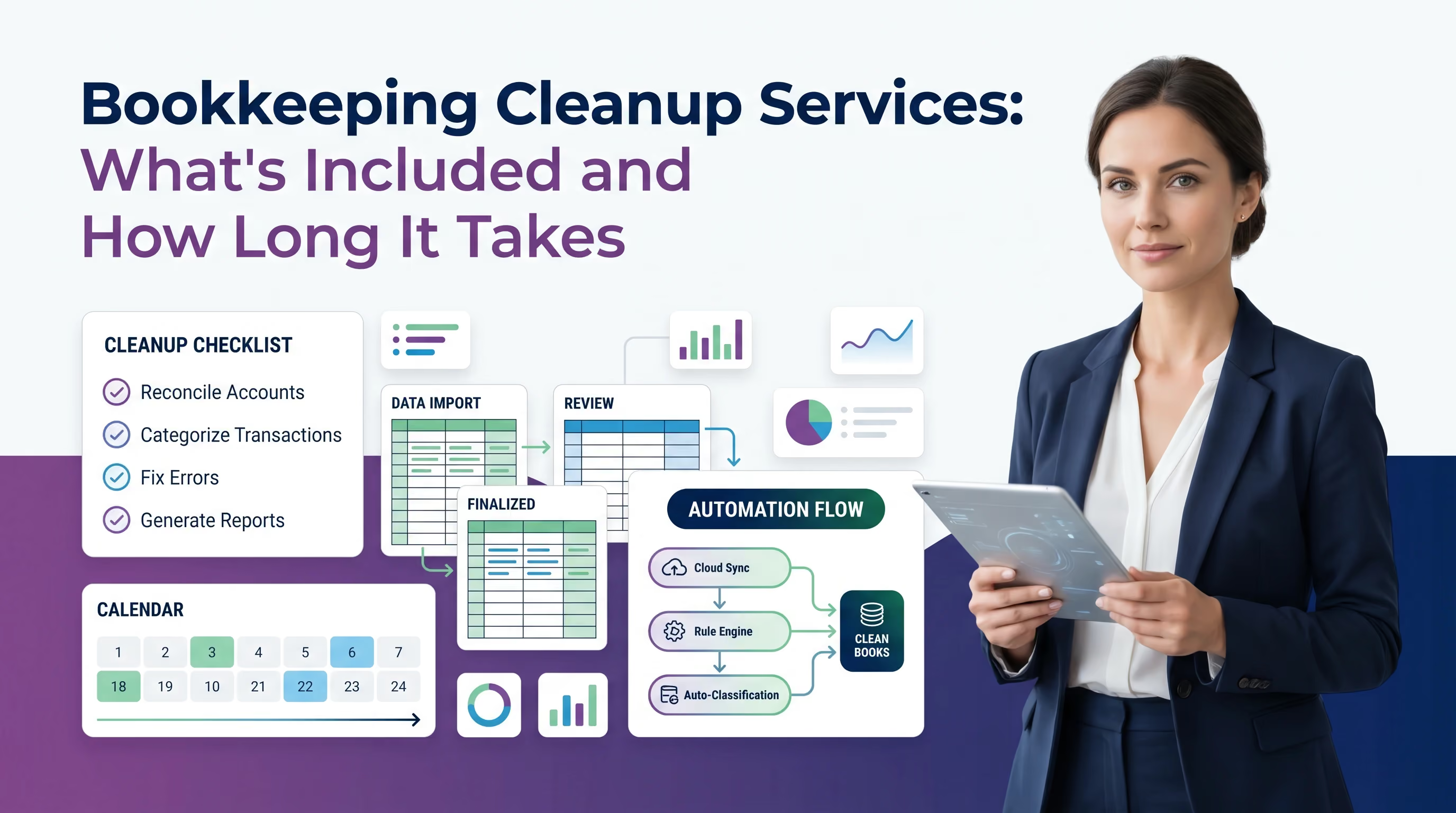
- This guide breaks down what is included in bookkeeping cleanup, the cleanup bookkeeping service scope, and a realistic bookkeeping cleanup timeline.
- You will also see how long bookkeeping cleanup takes in real scenarios.
- Plus, you will get a CPA-firm view of accounting cleanup services, including controls, review expectations, and handoff to ongoing monthly close.
What “bookkeeping cleanup services” actually mean
A bookkeeping cleanup is a defined project. It brings a set of historical months from “not reliable” to “reconciled and review-ready.”
It is not the same as ongoing bookkeeping. It is also not a full audit. It is closer to a structured catch-up plus correction, with documentation strong enough to support tax work.
Most firms start cleanup when one of these happens. The client needs a tax return. The lender wants clean financials. Or the controller cannot explain basic balance sheet movements.
When a cleanup becomes unavoidable
You can often “operate” with messy books for months. Then one day you cannot. The questions get sharper and the deadlines get real.
Here are common triggers I see in firms and in-house teams. Any two of these usually mean cleanup work, not normal monthly bookkeeping.
- Bank and credit card accounts have not been reconciled in months
- Undeposited funds does not clear and keeps growing
- A/R and A/P aging do not tie to reality
- Payroll liabilities look wrong or negative
- Sales tax payable does not match filed returns
- Loan balances do not match statements
- Ask My Accountant holds thousands with no support
- Equity shows strange entries or large prior-period adjustments
If you feel the partner review turning into forensic work, that is the signal. Cleanup needs a project plan and a scope boundary.
What is included in bookkeeping cleanup
Most bookkeeping cleanup services include the same core building blocks. The difference is the order, the depth, and the documentation.
At a minimum, a professional cleanup should include these deliverables. These apply whether the file sits in QuickBooks Online, Xero, or a similar SMB GL.
1) Intake and diagnostic review
This is the “what are we dealing with” phase. The team confirms the accounting basis, reporting periods, and which modules matter.
Typical diagnostic outputs include: open reconciliations, exception lists, and a risk note on areas that can break tax prep.
2) Source document gathering and gap list
No cleanup succeeds without complete inputs. The team builds a missing-items list early and keeps it tight.
Expect requests for: bank statements, credit card statements, loan statements, merchant reports, payroll reports, and prior filed returns when relevant.
3) Transaction catch-up and coding normalization
Cleanup often includes importing or syncing transactions, then standardizing categorization. It also includes fixing inconsistent mapping to the chart of accounts.
This is where you remove “misc expense” sprawl. You also enforce naming rules for vendors, customers, and classes or locations if used.
4) Reconciliations for all cash-like accounts
Cash drives everything. If cash is wrong, every report is wrong. Cleanup should reconcile every bank account and credit card, month by month, in chronological order.
Do not skip months. Do not reconcile “net.” Month-by-month reconciliation is the only way to identify and isolate prior-period errors.
5) Balance sheet cleanup
Most balance sheet problems fall into a short list: unreconciled clearing accounts, orphaned AR or AP sub-ledger items, wrong loan balances, negative liability accounts, and equity misclassifications.
A solid cleanup resolves these systematically, not case by case.
6) Adjusting journal entries with support
Cleanup generates JEs. Good cleanup generates JEs with memos, support documents, and dates that make sense. Every entry should have a reason that a reviewer can follow without asking questions.
7) Final review package
The output should include: reconciliations, a list of unresolved items with dollar amounts, variance notes on material P&L movements, and a summary memo. That is what reduces partner review time to a final check, not a forensic investigation.
Bookkeeping cleanup scope: where most projects go wrong
Cleanup projects fail for three operational reasons. Not because the bookkeeper is incompetent. Because scope was undefined.
Here are the scope gaps that cause the most damage.
No defined “done” criteria
Cleanup without a finish line runs forever. You need a written scope that says: these periods, these accounts, this reporting standard. When those are met, cleanup is complete.
No materiality threshold
Chasing every $12 rounding error in a $2M file is the wrong use of time. Define materiality at the start. Document items below it. Move on.
No cutoff on document requests
If you let clients send documents whenever, you never close a month. Set a document cutoff. Request everything once. Log what is missing and estimate where necessary.
No lock after cleanup
Unlocked periods invite accidental edits. Once a month is clean and reviewed, lock it. If your system allows period lock, use it. If not, document the close date and communicate clearly.
Bookkeeping cleanup vs. catch-up vs. ongoing: the operational difference
These three are often confused. Here is a plain-language distinction.
| Service type | What it is | When you need it | Output |
|---|---|---|---|
| Catch-up bookkeeping | Completing missing months | Books are behind, periods not started | Month-by-month financials with recs |
| Bookkeeping cleanup | Fixing messy or wrong periods | Periods exist but are unreliable | Corrected books with adjusted JEs and recs |
| Ongoing bookkeeping | Keeping books current monthly | After catch-up or cleanup is done | Monthly close package with recs |
Most firms need catch-up and cleanup together, then transition to ongoing. The order matters.
What good QuickBooks cleanup services look like
QuickBooks Online is the most common environment for SMB cleanup work. Here is what solid QBO cleanup looks like operationally.
Duplicate removal
Bank feeds and imports create duplicates. A professional cleanup identifies and removes them without corrupting the reconciliation history. This requires reviewing import logs, not just running a duplicate check.
Bank rule audit and reset
Bad bank rules create persistent miscoding. Cleanup should review all active rules. Disable or delete rules that are wrong. Then re-categorize affected transactions from the rule’s creation date forward.
Undeposited funds resolution
Undeposited Funds in QBO is a clearing account. It should net to zero or close to it. Cleanup projects often find thousands sitting here for years. Resolving it requires matching deposits to the original sales receipt or invoice payments.
Accounts Receivable and Accounts Payable cleanup
AR and AP sub-ledgers must tie to the GL. Cleanup should identify old open items, confirm what is collectible, and write off or reclassify the rest with proper documentation.
Payroll liability cleanup
Payroll liabilities should reconcile to filed returns and remittance confirmations. Negative balances almost always indicate a workflow error, usually payments posted directly to the bank instead of through QBO’s payroll flow.
Bookkeeping cleanup services pricing: what drives the cost
Most providers price cleanup by hours, by period, or as a fixed project. Each has trade-offs.
For a detailed breakdown of typical ranges, see this catch-up bookkeeping pricing guide.
Here are the real cost drivers regardless of pricing model.
- Number of months in scope
- Number of bank and credit card accounts
- Payroll complexity and number of runs per period
- Loan count and interest schedule availability
- AR and AP sub-ledger condition and volume
- Source document availability and organization
- Whether a COA restructure is needed
When a provider gives you a flat quote, ask what assumptions they made. Most underquotes come from underestimating missing statements or a messy payroll history.
The 5-step cleanup framework that holds up in CPA firms
If you are running cleanup inside a firm, you need a consistent workflow. Heroics do not scale. Use this five-step framework.
Step 1. Define scope and establish the “done” standard
Before touching the file, confirm: which entities, which periods, which accounts, and what reporting output is expected. Write it down.
Step 2. Build the document request list
List every statement and report you need. Send the request once. Give the client a deadline. Log what arrives and what is still missing.
Step 3. Run reconciliations in sequence
Start with the earliest open month. Reconcile bank first. Then cards. Then clearing. Do not move to the next month until the current one ties.
Step 4. Adjust, correct, and document
Post JEs. Fix COA issues. Resolve sub-ledger discrepancies. Every change gets a memo. Every unusual entry gets support.
Step 5. Deliver and lock
Deliver the final review package. Get sign-off. Lock the period. Transition to ongoing close with a clear cadence.
This is the difference between cleanup as a project and cleanup as a habit. The habit always breaks eventually. The project has an end date and a handoff.
How Etisson supports bookkeeping cleanup for CPA firms
Take the Undeposited Funds example from earlier in this guide. A clearing account with years of unmatched deposits does not get fixed by looking at it harder. It gets fixed by matching every deposit back to its source, one bank statement at a time, in chronological order.
That is the kind of work Etisson's cleanup teams are built around: mechanical, sequential, and easy to audit afterward. Each reconciled month gets a support file and a short note on what moved and why, so the next reviewer is not starting from zero.
Cleanup work also has a natural end point, and Etisson treats it that way. Once materiality thresholds are met and the balance sheet ties out, the same accountant transitions the client into ongoing monthly close, using the same chart mapping and the same reconciliation cadence built during cleanup. There is no second onboarding and no re-explaining the file to someone new.
FAQ:
What is bookkeeping cleanup?
Bookkeeping cleanup is the process of correcting historical accounting periods that are inaccurate, incomplete, or unreliable. It includes reconciliations, adjusting entries, sub-ledger corrections, and documentation, producing financials that support tax filings and lender reporting.
What is included in a bookkeeping cleanup service?
A complete bookkeeping cleanup includes intake and diagnosis, document collection, transaction correction, bank and credit card reconciliations by month, balance sheet cleanup, adjusting journal entries with support, and a final review package.
How long does bookkeeping cleanup take?
Duration depends on backlog depth, account complexity, and document availability. Light cleanup on 3 to 6 months typically takes 2 to 4 weeks. Complex multi-entity or multi-year cleanup can take 6 to 14 weeks.
What is the difference between bookkeeping cleanup and catch-up?
Catch-up fills in missing periods. Cleanup corrects periods that already exist but contain errors or incomplete data. Many engagements require both.
How do I know if I need bookkeeping cleanup?
Signs include unreconciled bank accounts, unexplained balance sheet balances, large adjusting entries at year end, payroll liabilities that do not match filed returns, and AR or AP sub-ledgers that do not tie to the GL.
Can bookkeeping cleanup be done remotely?
Yes. Most cleanup work happens inside cloud accounting software. Remote access through QBO, Xero, or similar platforms is standard. Document collection happens through secure file sharing.
What does bookkeeping cleanup cost?
Cost depends on scope, periods, and account complexity. Most projects are scoped after a brief intake conversation. Flat-fee pricing is common for defined-scope projects.
Conclusion
Bookkeeping cleanup is not about making the numbers look good. It is about making them defensible.
Define the scope. Set a document cutoff. Reconcile in order. Document every adjustment. Deliver a package your reviewers can use and substantiate the balance sheet.
If you do that, the cleanup finishes on schedule. More importantly, the firm gets financials that are reviewable, defensible, and ready for the next step.
Related reading: how catch-up bookkeeping works, our account reconciliation services guide, Etisson home, and more CPA firm accounting guides.