.avif)

Blog Summary / Key Takeaways
- Clearly defines both models with real-world analogies
- 4 scenarios where dedicated wins (ongoing bookkeeping, close work, tax prep, review)
- 4 scenarios where project-based wins (catch-up, migrations, one-time diagnostics, overflow)
- Hidden cost of knowledge reset with rotating project staff explained
- Pricing comparison table for all Etisson roles vs. project-based scoping
- Firm-size decision framework: which model to use at <15, 15–40, 40–80, 80+ entities
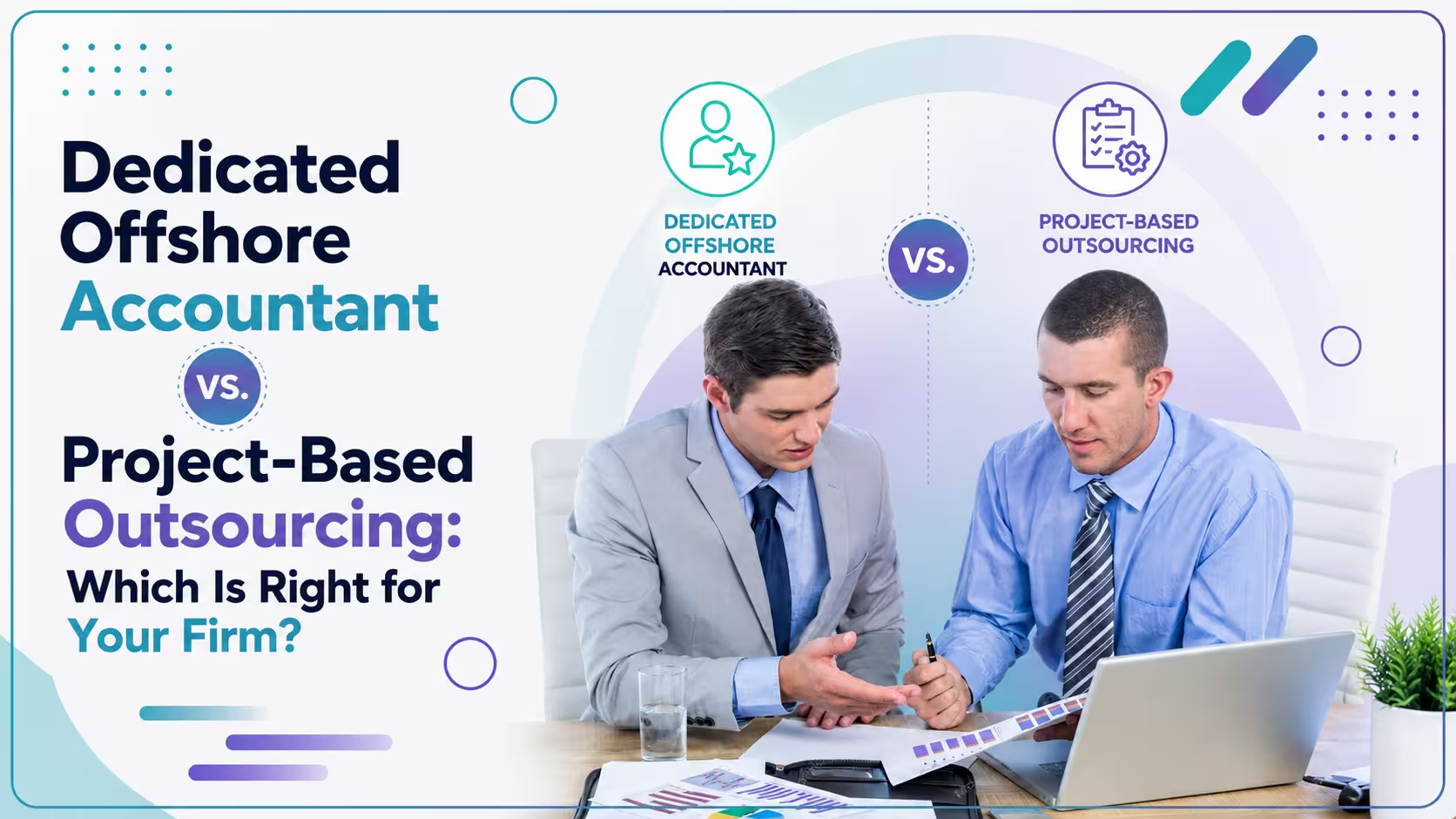
Every CPA firm eventually faces the same choice: bring on a dedicated offshore accountant who becomes an extension of your team, or use project-based outsourcing to cover specific tasks as they arise. Both models work. Neither is universally superior. And choosing the wrong one for your firm's current stage is one of the most common and most expensive mistakes in accounting outsourcing.
Most firms start this search simply wanting to hire offshore accountant support, then have to decide between two very different delivery models.
This guide breaks down the differences with specificity cost structure, control model, quality implications, and the types of firms each model suits best.
1. The Two Models - Defined
Dedicated Offshore Accountant
A dedicated professional is assigned exclusively to your firm. They work on your clients, follow your workflows, use your software, and report through your management structure. The relationship is ongoing the offshore accountant builds institutional knowledge of your clients over time, just as an in-house hire would.
Analogy: A remote employee who works only for you, without the overhead of employment.
Project-Based Outsourcing
You contract a provider for a defined scope of work a tax season overflow package, a client's catch-up backlog, or a software migration. The project has a start and end date. When it's done, the engagement ends. You may or may not work with the same individuals if you return.
Analogy: A contractor hired for a renovation project, not a full-time staff member.
2. Where Dedicated Wins
- Ongoing bookkeeping and reconciliation: Clients benefit from consistency the same person handling their accounts month over month, building familiarity with their chart of accounts, vendors, and unusual transactions.
- Monthly close and workpaper preparation: Close work requires contextual knowledge knowing which accounts behave oddly, which clients have complex payroll, where errors typically appear. A dedicated accountant develops this over time; a project-based resource starts from scratch each month.
- Review and controller-level work: High-judgment work like financial statement review, accruals, and actuals-vs-budget analysis requires someone who understands the business context. Dedicated models support this; project-based models don't.
- Tax return preparation for recurring clients: Once an offshore tax associate understands a client's situation, preparation gets faster and more accurate each year. Project-based tax prep loses this efficiency.
3. Where Project-Based Wins
- Catch-up and clean-up work: When you inherit a client with 12 months of disorganized books, a focused project-based team can work through the backlog intensively without disrupting your ongoing capacity.
- Software migrations: QuickBooks to Xero migrations are defined, finite projects. Project-based scoping with clear deliverables and a completion milestone makes more sense than a monthly retainer.
- One-time diagnostic work: If you need a full review of a new client's historical books to assess risk, a project-based engagement scoped for that purpose works well.
- Tax season overflow: If your firm handles more returns than your team can manage in April, adding project-based capacity for 8–12 weeks is more efficient than a year-round dedicated associate.
🚀 Not sure which model fits your firm right now? Talk to an Etisson expert — no commitment required.
→ Start your 40-hour free pilot at etisson.com
4. The Hidden Cost of Switching Models
One risk that most firms underestimate is the knowledge reset cost of project-based engagements. Every time a new person handles a client's books, there is a ramp-up period reviewing history, understanding the chart of accounts, flagging unusual items that a long-term accountant would recognize immediately.
For firms with 20+ client entities, this hidden cost measured in reviewer hours, error rates, and turnaround time can exceed the apparent cost savings of cheaper project-based pricing.
The dedicated model eliminates this reset cost. Your offshore accountant becomes more efficient, not less, as the engagement continues.
5. Pricing Comparison
| Role | US In-House (Annual) | Etisson Offshore (Monthly) |
|---|---|---|
| Dedicated Bookkeeper | $2,200/month | Unlimited entities within agreed scope |
| Dedicated Senior Accountant | $2,500/month | Close, review, reporting |
| Dedicated Reviewer | $3,000/month | Quality control, workpaper review |
| Dedicated Tax Associate | $3,000/month | 1040/1120/1065 preparation |
| Project-Based (catch-up) | Scoped per engagement | Per-entity or hourly |
| Project-Based (migration) | Scoped per project | One-time deliverable |
For firms with consistent monthly volume, the dedicated model produces a lower cost-per-entity than project rates within 2–3 months.
6. Which Model Matches Your Firm's Stage?
| Role | US In-House (Annual) | Etisson Offshore (Monthly) |
|---|---|---|
| <15 client entities | Project-based | Use for overflow and one-off projects; dedicated model overhead not yet justified |
| 15–40 entities | Dedicated bookkeeper | One dedicated bookkeeper handles volume; build institutional knowledge |
| 40–80 entities | Dedicated bookkeeper + senior | Add review layer; move close work offshore |
| 80+ entities | Dedicated team (book + senior + reviewer) | Full offshore production team; partners focus on advisory |
7. How Etisson Structures Both
Etisson's primary model is dedicated FTE but they also support project-based engagements for catch-up work, migrations, and seasonal overflow. The transition between models is frictionless: many firms start with a project-based catch-up engagement and convert to a dedicated model once the books are clean and the workflow is documented.
Etisson's 40-hour free pilot is the lowest-risk evaluation available test the dedicated model on real client work before committing to a monthly engagement.
FAQs
What is a dedicated offshore accountant?
A dedicated offshore accountant is a professional assigned exclusively to your CPA firm not shared with other clients of the provider. They work on your clients' books, follow your workflows, and build institutional knowledge over time, similar to a remote employee without the employment overhead.
Is project-based outsourcing cheaper than dedicated?
Per-hour, often yes. But for ongoing volume, dedicated models are more cost-effective because they eliminate the knowledge reset cost of rotating staff and reduce reviewer time on output.
Can I switch from project-based to dedicated mid-year?
Yes. Most firms start with a project-based catch-up engagement, then transition to a dedicated model once their books are clean. Etisson supports this transition without a gap in service.
How many clients can one dedicated offshore bookkeeper handle?
Typically 10–20 client entities, depending on complexity. Simple cash-basis bookkeeping allows more entities; multi-entity accrual clients with payroll require fewer.
What if I only need help during tax season?
Project-based or seasonal capacity is available. However, consider whether the knowledge reset cost of project-based tax prep outweighs the cost of a year-round dedicated tax associate for returning clients, it often does.
Does a dedicated offshore accountant understand US tax law?
Yes. Etisson's tax associates are specifically trained in US federal and state tax law, IRS procedures, and GAAP-compliant bookkeeping standards.
Can project-based work convert to an ongoing relationship?
Yes, and this is common. A firm that starts with a catch-up project often discovers the quality and workflow fit, and transitions to a dedicated model. Etisson facilitates this transition smoothly.
What level of management does a dedicated model require?
Etisson's model is designed to minimize management overhead. Weekly update emails, a client work tracker, and a structured escalation process mean most dedicated relationships require 1–2 hours of partner oversight per week.
Conclusion
The choice between a dedicated offshore accountant and project-based outsourcing is ultimately a question of volume, consistency, and growth stage. For most CPA firms managing 15+ active client entities, the dedicated model delivers better quality, lower long-term cost, and more scalable capacity than rotating project teams.
Project-based outsourcing remains valuable for what it was designed for: defined, finite work with a clear deliverable. Use it for catch-up, migrations, and seasonal overflow and use the dedicated model for everything ongoing.