

.avif)

Blog Summary / Key Takeaways
- What a depreciation schedule is and why it matters
- The main depreciation methods and when each applies
- How to build a depreciation schedule step by step
- Where depreciation errors consistently show up in client books
- How CPA firms handle depreciation tracking at scale
Introduction
It starts with one piece of equipment purchased in March 2022.
The client logged it as an expense. Nobody caught it. Three years later, the asset is not on the depreciation schedule, has never generated a depreciation charge, and the books have been overstating expenses and understating assets since the day it was bought.
This is not an unusual story. Fixed asset management is one of the most neglected areas in small and mid-size business bookkeeping and it falls on CPA firms to catch it.
The depreciation schedule is the tool that keeps it from happening. When it is built correctly and maintained consistently, it ensures every asset is tracked, every depreciation charge is accurate, and the balance sheet reflects what the client actually owns.
This guide covers how to build one, maintain it, and what goes wrong when it is not managed properly.
What Is a Depreciation Schedule?
A depreciation schedule is a table that tracks every depreciable asset a business owns, along with the annual or monthly depreciation charge for each one. It shows the asset's original cost, the depreciation method, the useful life, accumulated depreciation to date, and the remaining book value.
Every entry in the depreciation schedule generates a corresponding journal entry a debit to depreciation expense and a credit to accumulated depreciation that flows through the income statement and balance sheet each period.
A complete depreciation schedule includes:
According to IRS Publication 946, most tangible business assets must be depreciated over their useful life rather than expensed immediately with specific rules on methods, useful lives, and special elections like Section 179 and bonus depreciation.
Why Does Depreciation Matter for CPA Firms?
Depreciation affects two of the three core financial statements simultaneously the income statement (through depreciation expense) and the balance sheet (through accumulated depreciation and net book value). Getting it wrong distorts both.
For CPA firms, the consequences are practical:
- Understated depreciation means overstated net income. The client's profit looks higher than it actually is. Tax liability may be understated.
- Overstated depreciation means understated net income. The client's profit looks worse than it actually is. Lenders and investors get a distorted picture.
- Missing assets mean the balance sheet doesn't reflect what the business actually owns. This matters enormously for lending, valuation, and due diligence.
- Wrong useful life or method creates cumulative errors that compound year over year until someone does a full fixed asset audit.
For audit-ready clients and those with bank covenants, depreciation accuracy is not optional. AICPA standards require that fixed assets be carried at cost less accumulated depreciation and any impairment which means the depreciation schedule must be accurate and current.
Who Is Responsible for Managing the Depreciation Schedule?
In a well-structured CPA firm, depreciation schedule management sits with the senior accountant or controller level not the bookkeeper. The bookkeeper posts the monthly depreciation journal entry. The senior accountant maintains the schedule itself, reviews asset additions and disposals, and ensures the methods and useful lives are correctly applied.
Division of responsibility:
The most common structural error CPA firms make: leaving depreciation schedule maintenance to the bookkeeper with no senior review. Assets get added incorrectly, useful lives get guessed, and methods get applied inconsistently until the next review finds a three-year backlog of errors.
When Is a Depreciation Schedule Updated?
A depreciation schedule should be updated every time a new asset is acquired, an existing asset is disposed of, and at minimum once per month when the depreciation journal entry is posted.
Update triggers:
Monthly: Post depreciation journal entry for all active assets. Reconcile accumulated depreciation balance in the GL to the schedule total.
When an asset is purchased: Add the asset immediately with correct cost basis, method, and useful life. Do not wait for year-end. Assets purchased mid-year need partial-year depreciation calculated correctly.
When an asset is sold or retired: Remove the asset from the schedule, record the gain or loss on disposal, and eliminate the accumulated depreciation. An asset sitting on the schedule after it has been sold is a common source of balance sheet overstatement.
At year-end: Review the full schedule for Section 179 elections, bonus depreciation decisions, and any assets that have reached the end of their useful life. Tax depreciation (MACRS) and book depreciation often differ the schedule may need two columns: one for GAAP, one for tax.
What Depreciation Methods Do CPA Firms Use?
The right depreciation method depends on the asset type, the client's industry, and whether you're calculating book depreciation (GAAP) or tax depreciation (IRS rules). Here are the four most common methods:
1. Straight-Line Depreciation
The simplest and most widely used method for GAAP book depreciation. Spreads the cost evenly over the asset's useful life.
Formula: (Cost − Salvage Value) ÷ Useful Life = Annual Depreciation
Example: A $25,000 piece of equipment with a $1,000 salvage value and 8-year useful life depreciates at $3,000 per year.
Best for: Furniture, fixtures, buildings, long-lived assets with consistent use.
2. MACRS (Modified Accelerated Cost Recovery System)
The IRS-required method for tax depreciation in the US. Assigns assets to specific property classes (3-year, 5-year, 7-year, etc.) and applies accelerated rates in early years.
Best for: All tax-basis depreciation for US clients. Always runs parallel to GAAP book depreciation.
3. Double-Declining Balance
Accelerates depreciation by applying twice the straight-line rate to the remaining book value each year. Front-loads the expense.
Formula: (2 ÷ Useful Life) × Beginning Book Value = Annual Depreciation
Best for: Assets that lose value quickly in early years vehicles, technology equipment.
4. Units of Production
Ties depreciation to actual usage rather than time. Useful when an asset's wear is directly tied to production volume.
Best for: Manufacturing equipment, vehicles with trackable mileage.
How to Build a Depreciation Schedule: Step by Step
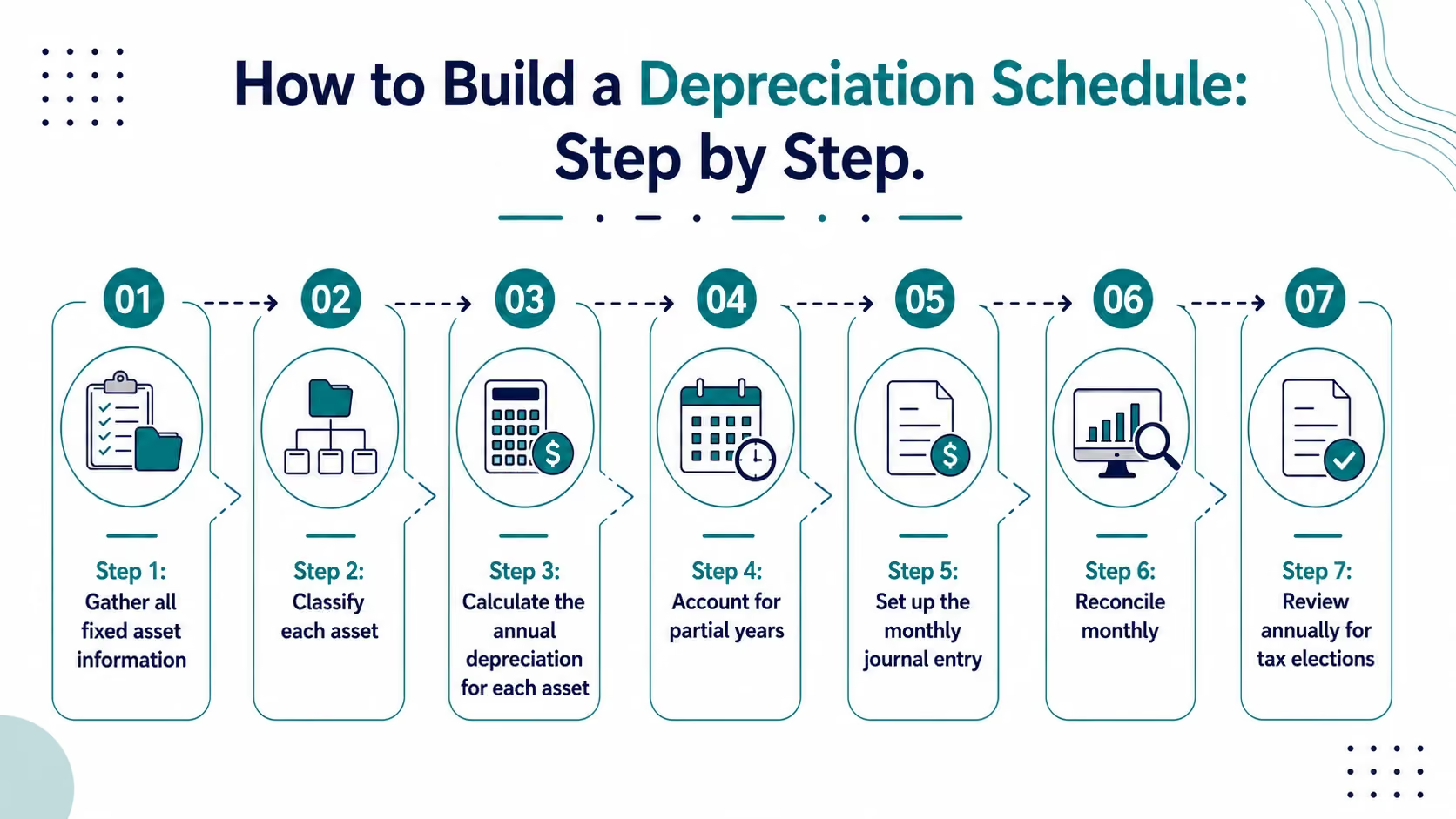
Step 1: Gather all fixed asset information Collect purchase invoices, asset registers, and prior-year tax returns for every depreciable asset the client owns. Include cost, purchase date, and any prior depreciation taken.
Step 2: Classify each asset Assign each asset to a category equipment, vehicles, furniture, leasehold improvements, buildings and determine the appropriate useful life and depreciation method under GAAP. Cross-reference with IRS property class for tax depreciation.
Step 3: Calculate the annual depreciation for each asset Apply the chosen method. For straight-line: (Cost − Salvage Value) ÷ Useful Life. For double-declining: (2 ÷ Useful Life) × Beginning Book Value. For MACRS: use the IRS rate tables from Publication 946.
Step 4: Account for partial years Assets purchased or disposed of mid-year need partial-year depreciation. Most firms use the half-year convention for MACRS. For book depreciation, calculate the exact number of months in service.
Step 5: Set up the monthly journal entry For each asset, the monthly depreciation entry is:
- Debit: Depreciation Expense
- Credit: Accumulated Depreciation [Asset Category]
Step 6: Reconcile monthly At the end of each month, reconcile the accumulated depreciation balance on the schedule against the accumulated depreciation accounts in the GL. They must match. Any discrepancy needs to be investigated before close.
Step 7: Review annually for tax elections At year-end, review Section 179 expensing elections and bonus depreciation decisions with the CPA or tax associate. These change the tax-basis depreciation significantly and may create a permanent book-to-tax difference.
Common Depreciation Errors in Client Books
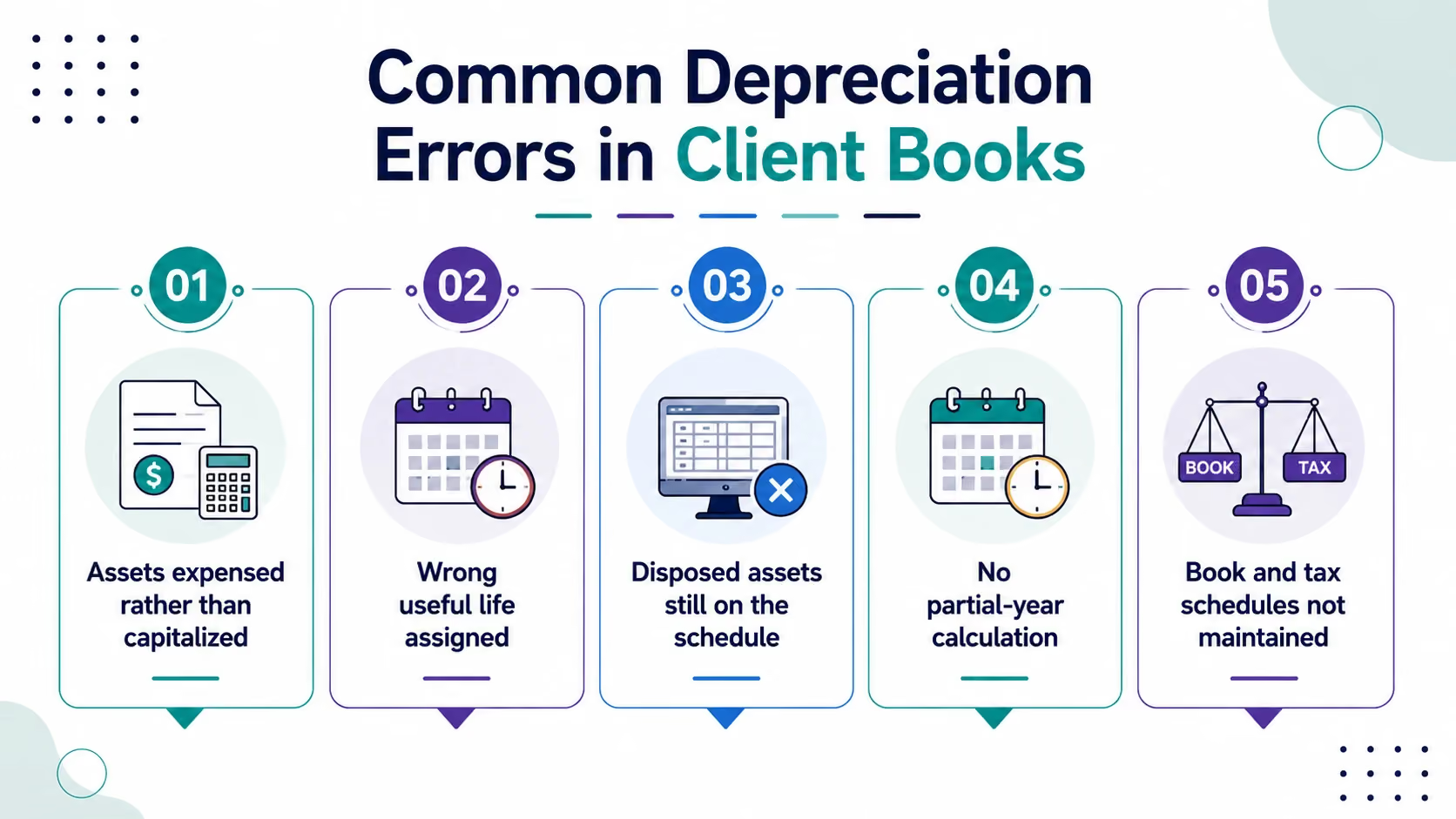
1. Assets expensed rather than capitalized A $15,000 piece of equipment is posted directly to an expense account instead of a fixed asset account. Never makes it onto the depreciation schedule. The income statement takes a one-time hit instead of spreading the cost over the asset's life.
2. Wrong useful life assigned A client's accountant guesses 5 years for an asset that the IRS classifies as 7-year property. The annual depreciation is wrong every year until someone catches it.
3. Disposed assets still on the schedule An asset was sold two years ago. The accumulated depreciation is still building. The balance sheet shows an asset the business no longer owns.
4. No partial-year calculation An asset purchased in September gets a full year of depreciation in year one. Overstates depreciation expense by 75% in the first year.
5. Book and tax schedules not maintained. GAAP depreciation and tax depreciation separately are treated as the same. The financial statements are wrong, the tax return is wrong, or both.
Real Scenario: How One Firm Found 11 Missed Assets Across a Single Client
A CPA firm in Georgia was managing a manufacturing client with around $2M in annual revenue. The client had purchased several pieces of equipment over a 4-year period some expensed directly, some added to the depreciation schedule, and some simply never recorded anywhere.
When the firm's senior accountant did a full fixed asset audit as part of a client advisory review, she found 11 assets totaling $187,000 in original cost that had never been added to the depreciation schedule. Some had been partially depreciated on prior tax returns but never added to the GAAP schedule. Others had been fully expensed in the year of purchase when they should have been capitalized.
The corrections required:
- Restatement of three years of financial statements
- Amended tax returns for two years
- Recalculation of accumulated depreciation across all 11 assets
- Adjustment of the client's net asset position which materially changed their debt-to-equity ratio under a bank covenant
Total time to remediate: 22 hours across the senior accountant and a CPA. The client relationship survived but the conversation about why this had happened for four years was not easy.
After the firm restructured their fixed asset process adding depreciation schedule review as a mandatory close step for all clients they brought on an Etisson senior accountant to handle depreciation schedule maintenance, monthly reconciliation, and close-ready workpapers across their manufacturing client base.
How Etisson Handles Depreciation for CPA Firm Clients
Etisson's senior accountants handle depreciation schedule management as part of their controller services engagement maintaining the fixed asset register, posting monthly depreciation entries, reconciling accumulated depreciation to the GL, and preparing workpapers for partner review.
What Etisson handles in the depreciation workflow:
- Building and maintaining the fixed asset register across all client accounts
- Calculating depreciation using the correct method for each asset class
- Posting monthly depreciation journal entries (debit depreciation expense, credit accumulated depreciation)
- Reconciling accumulated depreciation balances to the GL at each close
- Flagging new asset additions for useful life and method review
- Identifying disposed assets that need to be removed from the schedule
- Preparing year-end workpapers for tax review and audit support
The staffing model:
Etisson's senior accountants are dedicated to your firm not shared across 50 clients at once. They work in your accounting software stack (QBO, Xero, Sage Intacct, or NetSuite), follow your workflows, and produce close-ready workpapers that match your firm's standards.
At $2,500/month for a dedicated senior accountant vs. $65,000–$95,000/year for a US-based equivalent, the cost difference allows most firms to allocate senior-level attention to clients who previously only got bookkeeper-level coverage.
Use the Etisson ROI Calculator to see what the cost difference looks like for your firm specifically.
Book a free strategy call we'll walk through your current fixed asset and depreciation workflow and show you where Etisson fits.
FAQs
What is a depreciation schedule in simple terms?
A depreciation schedule is a table that tracks every depreciable asset a business owns, showing the original cost, depreciation method, annual depreciation charge, accumulated depreciation to date, and remaining book value. It ensures the correct depreciation expense flows through the income statement each period and the balance sheet reflects accurate asset values.
What depreciation methods are used in the US?
For book (GAAP) depreciation, the most common methods are straight-line, double-declining balance, and units of production. For tax depreciation, the IRS requires MACRS (Modified Accelerated Cost Recovery System) for most tangible property, with specific property class assignments and rate tables defined in IRS Publication 946.
How often should a depreciation schedule be updated?
The depreciation schedule should be updated immediately when a new asset is purchased or an existing asset is disposed of. Monthly, the depreciation journal entry should be posted and accumulated depreciation reconciled to the GL. At year-end, the full schedule should be reviewed for Section 179 elections, bonus depreciation, and assets that have reached the end of their useful life.
What is the difference between book depreciation and tax depreciation?
Book depreciation follows GAAP and uses methods like straight-line or double-declining balance to match the asset's cost to the periods it benefits. Tax depreciation follows IRS rules primarily MACRS which typically allows faster write-offs in early years. Most businesses maintain two separate depreciation calculations, which creates a temporary book-to-tax difference tracked on the tax return.
What happens when an asset is fully depreciated?
When an asset reaches the end of its useful life and its book value equals its salvage value (or zero), depreciation stops. The asset remains on the balance sheet at salvage value with its full accumulated depreciation balance until it is sold, retired, or disposed of. At that point, both the asset cost and accumulated depreciation are removed and any gain or loss on disposal is recorded.
What is Section 179 depreciation?
Section 179 allows businesses to immediately deduct the full cost of qualifying equipment and assets in the year of purchase, rather than depreciating over the asset's useful life. For 2026, the Section 179 deduction limit is $1,160,000. This creates a significant difference between book and tax depreciation in the year of purchase and is a common year-end tax planning decision for CPA firm clients.
How do CPA firms manage depreciation across multiple clients?
The most efficient CPA firms maintain a separate depreciation schedule for each client, updated monthly, with a designated senior accountant responsible for additions, disposals, and reconciliation. Firms managing high volumes of clients increasingly use dedicated offshore senior accountants through providers like Etisson to maintain depreciation schedules, post monthly entries, and prepare close-ready workpapers ensuring the work gets done consistently without consuming senior partner time.
Conclusion
A depreciation schedule is not a complex document. It is a table with a defined set of columns and rules that apply consistently to every asset a business owns.
What makes it hard is not the concept it is the maintenance. Assets get purchased and never added. Assets get sold and never removed. Methods get applied inconsistently. Tax and book schedules get confused. And because depreciation is not a cash transaction, the errors sit quietly in the balance sheet until someone looks for them.
The CPA firms that manage this well treat the depreciation schedule as a live document updated every time an asset event occurs, reconciled every month, and reviewed at year-end by someone with the authority to make judgment calls on method and useful life.
That discipline is what keeps the balance sheet clean and the income statement accurate. And it is exactly the kind of structured, recurring work that a dedicated offshore senior accountant handles well consistently, every month, without it falling to the bottom of the priority list.

.avif)