.avif)
.avif)

Blog Summary / Key Takeaways
- Outsourced bookkeeping costs $1,200 to $3,200 per month for a dedicated offshore FTE in 2026.
- Dedicated FTE pricing is more predictable and better value for growth than hourly or per-client models.
- A fully loaded US bookkeeper costs $73,000 to $106,000 per year. The offshore equivalent costs $14,400 to $38,400.
- Hidden costs that affect true ROI: onboarding time, rework, provider turnover, and rate escalation clauses.
- ROI compounds from month three onward as freed internal capacity converts to higher-value work.
- Ask every provider for staff retention rate, security certifications, onboarding timeline, and contract escalation terms.
You are ready to stop losing sleep over your next hire.
You just want to know what it costs.
This post gives you actual numbers. Not ranges so wide they are useless. Actual cost structures, what drives them, what gets hidden, and what to look for when comparing providers honestly.
How Much Does Outsourced Bookkeeping Cost for CPA Firms in 2026?
Outsourced bookkeeping for CPA firms typically costs $1,200 to $3,200 per month for a dedicated offshore professional, depending on role level and provider. For a US-based outsourced bookkeeper, expect $3,500 to $7,000 per month for comparable output.
That range exists because providers use different models. Some charge hourly. Some charge by client. Most charge a flat monthly rate for a dedicated professional. The model you choose matters as much as the number you negotiate.
What Pricing Models Do Outsourced Bookkeeping Providers Use?
Three models dominate the market. Understanding which one you are buying is the most important step before you compare prices across providers.
Hourly rate. You pay per hour of work completed. This sounds flexible but gets expensive fast during heavy periods. Average hourly rates for offshore bookkeeping range from $12 to $25 per hour. For 160 hours per month, that is $1,920 to $4,000. The flexibility is real but the unpredictability is too.
Per-client or per-entity. Some providers charge a fee per bookkeeping client per month. This is common in tech-enabled bookkeeping platforms. Rates typically run $150 to $600 per client per month depending on volume and complexity. Straightforward for a small number of clients, expensive as your client base grows.
Dedicated FTE model. You pay a flat monthly fee for a professional who works full time exclusively for your firm. This is what structured offshore staffing providers like Etisson offer. It produces the most predictable cost, the strongest continuity, and the fastest compounding returns as the professional learns your clients.
For most CPA firms with five or more bookkeeping clients, the dedicated FTE model delivers the best cost per output over a 12-month period.
What Drives the Cost Difference Between Providers?
Five factors explain most of the price variation you will see in the market.
Location of the professional. India, the Philippines, and Eastern Europe are the most common offshore locations. India and the Philippines are typically the most cost-efficient. Eastern European providers tend to run 20 to 30% higher for similar roles due to local wage market differences.
Role level. A staff bookkeeper handling transaction coding and reconciliations costs less than a senior accountant handling controller-level close tasks. When comparing providers, make sure you are comparing equivalent roles, not just equivalent titles.
Security and compliance infrastructure. SOC 2 and ISO 27001 certifications cost money to maintain and audit. Providers without these certifications often charge less. They are also not appropriate partners for firms handling sensitive client financial data under FTC Safeguards Rule obligations.
Onboarding and support model. Some providers charge a one-time onboarding fee of $500 to $1,500. Others include it. Ask explicitly. That cost affects your true month-one spend significantly.
Engagement length and flexibility. Month-to-month engagements often cost 10 to 15% more than annual commitments. If you are confident in the model, a 12-month commitment usually reduces your monthly rate meaningfully.
How Does Offshore Bookkeeping Cost Compare to a US Hire?
This is the comparison that changes most firms' decisions. The total cost of a US bookkeeper is consistently underestimated because most owners calculate salary but not the full loaded cost.
The offshore dedicated professional costs roughly 35 to 45% of the low end of a fully loaded US hire. At mid-range, the savings are closer to 55%.
That gap is why 100+ US CPA firms have engaged Etisson. Not because offshore is fashionable, but because the math is clear and consistent.
What Hidden Costs Do CPA Firms Miss When Evaluating Providers?
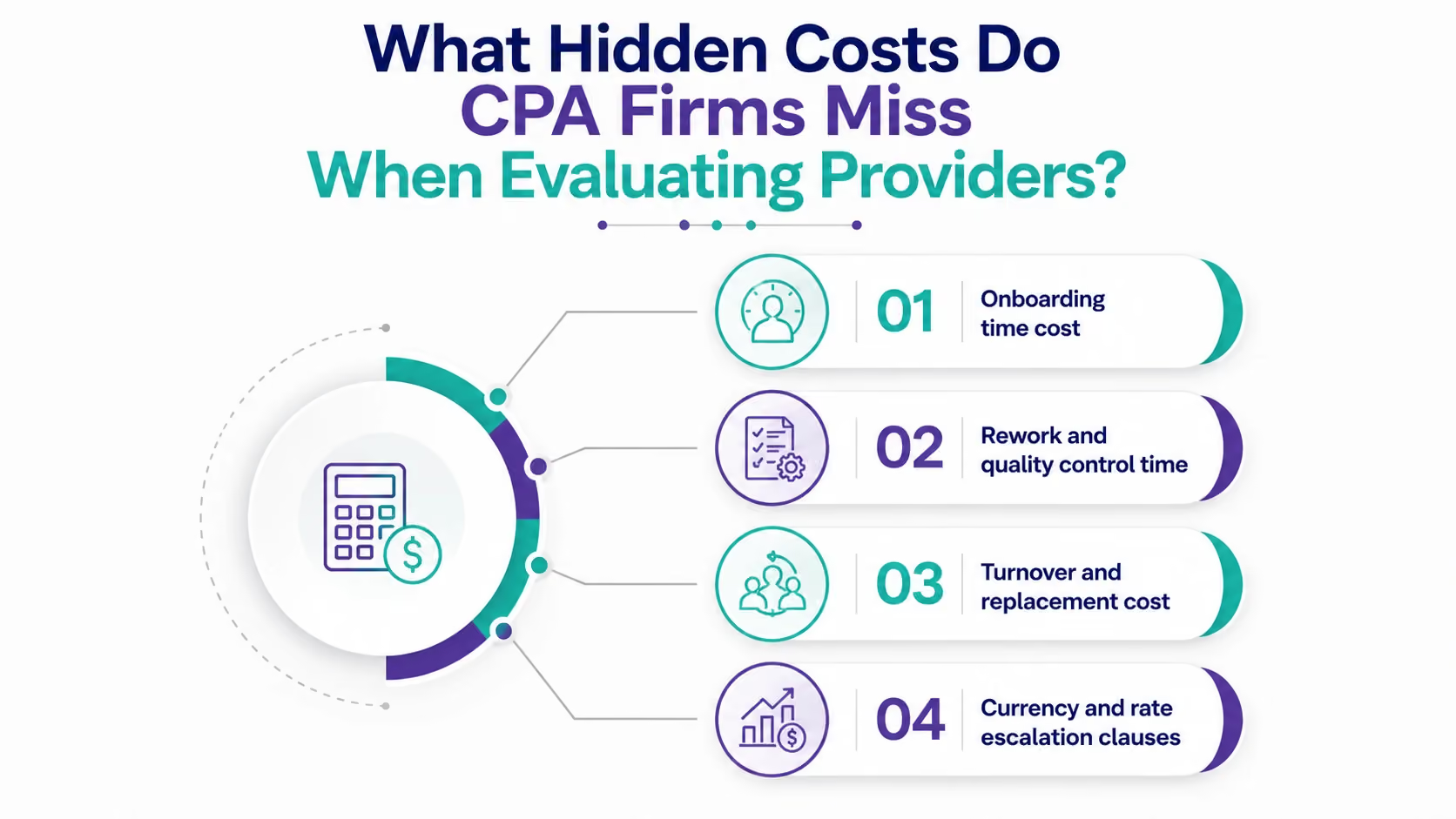
Price comparisons between providers often miss four costs that show up later and affect your true ROI significantly.
Onboarding time cost. Even the best offshore professional takes two to four weeks to learn your specific client files. During that ramp-up, your internal staff is spending real time on training and supervision. That time has a dollar value. Ask providers how they structure onboarding to minimize your team's time investment in it.
Rework and quality control time. If your provider has a weak quality assurance layer, your internal reviewers catch more errors. More errors mean more review time. More review time means less time for advisory work. Compare quality control processes, not just price.
Turnover and replacement cost. If your offshore provider has 40% annual staff attrition, you will redo the onboarding process every 9 to 12 months. That is real money in your team's time, plus the three to four week productivity gap during each transition. A provider's retention rate is one of the most important numbers you can ask for.
Currency and rate escalation clauses. Some providers invoice in US dollars but include annual rate escalation language tied to currency movements or inflation indices. Read the contract carefully. Understand exactly what your rate looks like in year two and year three.
What Does ROI Look Like From Month One to Month Six?
Most firms evaluating outsourced bookkeeping focus on month-one cost. The better lens is the six-month arc.
Month one. Onboarding cost is highest. The offshore professional is learning your files. Your internal reviewer is spending more time than usual catching up to speed. Net cost impact is roughly flat versus your current model.
Month two. The professional reaches independent working speed on their assigned clients. Review time drops. You are now getting the output benefit at the monthly rate cost.
Month three. The professional handles their clients reliably. Your internal staff who were doing that work have recovered hours. Those hours are now available for review, advisory, or onboarding new clients. This is where the ROI begins to compound.
Month four to six. The freed internal capacity converts to new client revenue, higher advisory billing, or reduced partner production hours. Most firms that track this number report a 2 to 3x return on the monthly cost of the outsourced professional within six months.
The firms that see the strongest returns are the ones that intentionally redirect the freed hours toward higher-value work rather than absorbing them back into the same production workload.
A Real Example: What One 8-Person CPA Firm Paid and Saved
A CPA firm with eight staff, primarily doing monthly bookkeeping and tax prep for small businesses, had been trying to hire a fourth bookkeeper for five months. Two offers were declined. The third candidate ghosted after accepting.
They calculated their true annual cost for that hire at $89,000, including salary, benefits, and the recruiting fee they had already paid once to a staffing agency.
They engaged Etisson at $2,100 per month ($25,200 annually) for a dedicated bookkeeper. That professional now handles 14 monthly bookkeeping clients independently. The managing partner does a weekly review that takes about 90 minutes.
The firm's bookkeeping cost per client dropped by 58%. The managing partner recovered four hours per week she had been spending in production.
She is now using that time for quarterly business reviews with her top 12 advisory clients. That service, which she had not been able to offer consistently before, has already driven two service upgrades from monthly bookkeeping to full accounting advisory packages.
How Etisson Prices Its Bookkeeping Support
Etisson uses the dedicated FTE model. You pay a flat monthly fee for a professional who works full time exclusively for your firm. No hourly surprises. No per-client escalation as you grow.
The 40-hour free pilot means you evaluate real work output before making a financial commitment. If the work does not meet your standard in the pilot period, you walk away with no obligation.
FAQs
How much does outsourced bookkeeping cost for CPA firms?
In 2026, a dedicated offshore bookkeeper costs $1,200 to $3,200 per month. US-based outsourced bookkeepers run $3,500 to $7,000 per month for equivalent work.
What is the cheapest way to outsource bookkeeping?
Dedicated offshore FTE models offer the lowest per-hour equivalent cost with the highest continuity. Hourly models often cost more at scale because of variable demand and ramp-up time.
Is outsourced bookkeeping worth it for small CPA firms?
Yes. Even for a three to five person firm, one offshore bookkeeper frees internal staff for review and advisory work, which increases revenue per staff member without adding headcount.
How does offshore bookkeeping compare to hiring in-house?
A fully loaded US bookkeeper costs $73,000 to $106,000 per year. An offshore dedicated professional costs $14,400 to $38,400. The quality of output is comparable when the provider has strong training and quality control.
What is a dedicated FTE model?
A dedicated FTE means a flat monthly fee for a professional who works exclusively for your firm, not shared across other clients. This is the standard model for professional offshore bookkeeping providers.
How do I compare outsourced bookkeeping providers fairly?
Compare total cost including hidden costs, security certifications, staff retention rate, onboarding process, and tools compatibility. The monthly rate alone is not a sufficient comparison.
Does Etisson charge an onboarding fee?
No. Etisson includes onboarding in the engagement. The 40-hour free pilot covers the initial setup and first work output so you can evaluate quality before committing.
Know what you need and ready to see actual numbers for your firm?
Book a 15-minute call with Etisson we will walk you through pricing for your specific workflow and client volume.
.avif)
.avif)