.avif)

Blog Summary / Key Takeaways
- Offshore accounting means dedicated professionals in another country working inside your systems on your clients.
- Cost savings of 40 to 50% versus a US hire are consistent and well-documented.
- Production work including bookkeeping, reconciliations, close prep, and tax preparation can all be handled offshore.
- Quality control requires explicit review processes. The offshore model makes gaps visible, it does not create them.
- Require SOC 2 and ISO 27001 certificates from any provider handling your client data.
- Ask for staff retention rate, training curriculum, and replacement process before signing.
- Start with a pilot before making a long-term commitment.
Your LinkedIn feed is full of people debating offshore accounting.
Half of them say it transformed their firm. The other half say it was a disaster.
The difference almost always comes down to one thing: how the model was set up, not where the staff was located.
This guide breaks down exactly what offshore accounting looks like for CPA firms. What you delegate. What you control. What it actually costs. And what to verify before you commit to any provider.
What Is Offshore Accounting for CPA Firms?
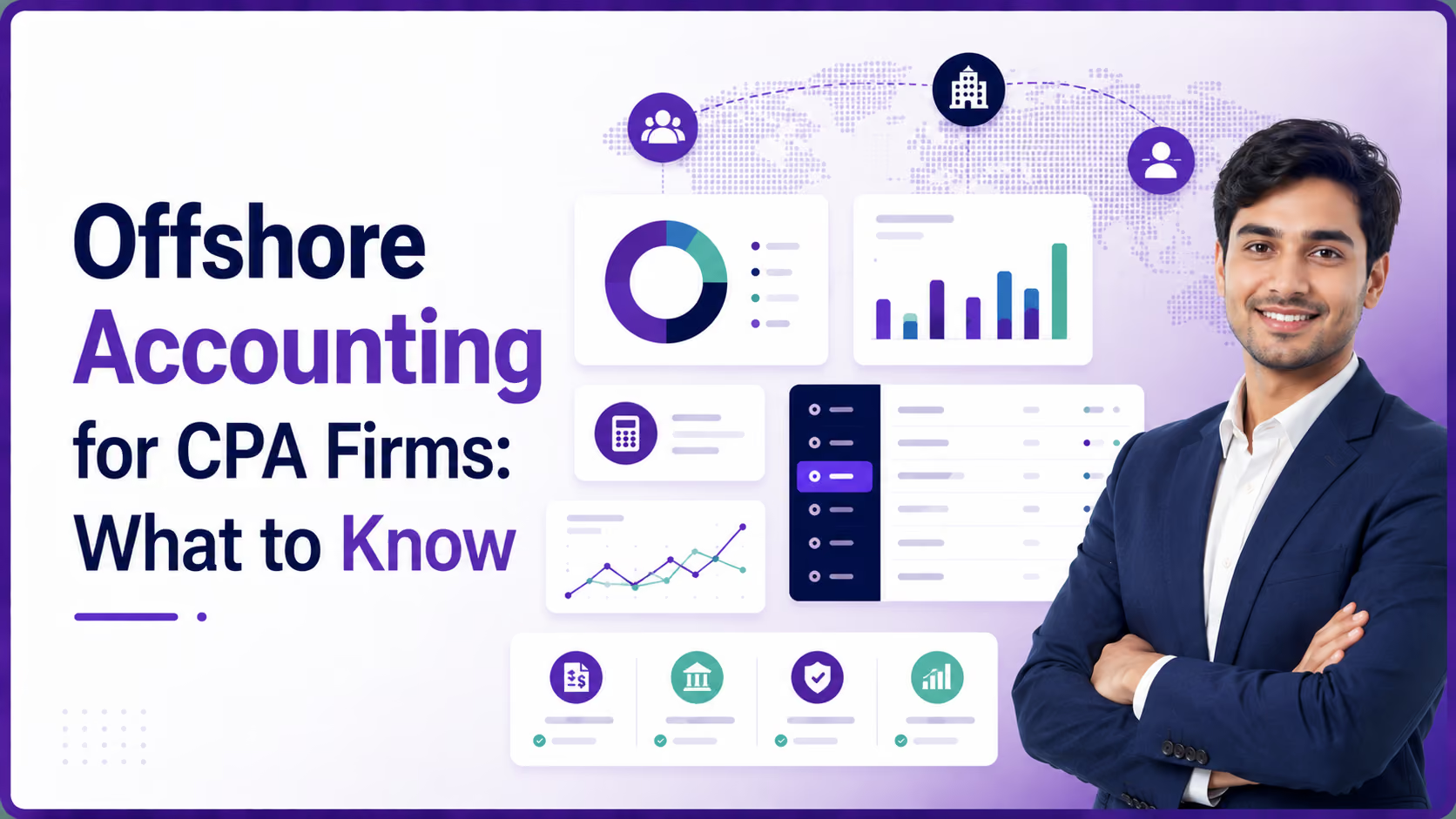
Offshore accounting means hiring accounting professionals located in another country to handle defined work for your firm. They work inside your systems, on your clients, under your oversight. You review the output. They handle production.
For US CPA firms, offshore professionals most often work from India, the Philippines, or Eastern Europe. They are trained in US GAAP, familiar with common US tax software, and operate on workflows you define.
The key word is dedicated. In a proper offshore model, the professional works exclusively for your firm. They are not shared across 12 other clients. They are not a call center. They are not a processing center that returns files with no real-time communication. They are an extension of your team who happens to be in a different time zone.
That distinction separates the offshore arrangements that work from the ones that do not.
Why Do CPA Firms Choose Offshore Over Domestic Outsourcing?
Cost is the starting point. A domestic outsourced bookkeeper in the US still costs $25 to $45 per hour. An offshore dedicated professional typically costs 35 to 50% of a fully loaded US hire.
But cost is not the only reason. Three other factors matter more than most firm owners expect.
Availability. The US accounting talent market is undersupplied. The Bureau of Labor Statistics projects continued pressure on the accountant workforce as retirements outpace new entrants. Offshore markets, particularly India, produce hundreds of thousands of accounting graduates annually with strong English proficiency and US workflow training.
Scalability. Adding one local hire takes three to four months from posting to productivity. Adding an offshore professional with a structured provider can take one to two weeks. That speed matters when you have a new client onboarding or a seasonal surge coming.
Continuity. Domestic staff turnover in smaller CPA firms is high. Offshore professionals in a structured employment model tend to have lower attrition because the role represents strong career earnings relative to their local market. A professional who stays two or three years with your firm builds real institutional knowledge about your clients. That is worth more than the monthly rate savings.
What Accounting Work Can Be Handled Offshore?
Nearly all production-level accounting work can be handled offshore. The work that stays onshore is typically client-facing and judgment-heavy.
For a side-by-side look at the tradeoffs, see this offshore vs onshore accounting staff comparison.
| Work Type | Offshore | Onshore |
|---|---|---|
| Daily bookkeeping | Yes | |
| Bank reconciliations | Yes | |
| Month-end close prep | Yes | |
| Tax return prep (1040, 1065, 1120) | Yes | |
| Accruals and prepaids | Yes | |
| Depreciation schedules | Yes | |
| Workpaper preparation | Yes | |
| Financial statement review | Partial | Final review stays onshore |
| Client communication | Yes | |
| Strategic advisory | Yes | |
| Partner sign-off | Yes |
The boundary is defined by your review process. Anything that goes through an internal reviewer before reaching the client can be produced offshore. Anything that requires partner judgment or direct client relationship management stays internal.
A good rule of thumb: if the task has a defined output format and a checkable standard, it can be produced offshore. If the output requires professional judgment that cannot be codified in a checklist, it stays with your team.
What Does Offshore Accounting Cost in 2026?
Pricing varies based on role level, provider, and engagement model. Here is an honest breakdown of current market rates.
| Role | US Fully Loaded Cost/Year | Offshore Dedicated Cost/Year | Savings |
|---|---|---|---|
| Staff Bookkeeper | $75,000 to $95,000 | $28,000 to $38,000 | 40% to 50% |
| Senior Accountant | $95,000 to $120,000 | $38,000 to $50,000 | 40% to 55% |
| Tax Associate | $85,000 to $110,000 | $32,000 to $42,000 | 40% to 50% |
| Controller (part-time support) | $50,000 to $80,000 equivalent | $20,000 to $35,000 | 45% to 60% |
These are total engagement costs including provider overhead, not just salary. The savings versus a US hire are real and consistent across the market. Etisson clients report approximately 40% cost reduction compared to their previous fully loaded US hire cost.
The cheapest provider is not always the best value. Onboarding speed, quality control processes, and staff retention rate affect your total cost more than the monthly rate does. A provider charging $200 less per month with 50% annual staff attrition costs more over 12 months than a provider charging $200 more with 90% retention.
How Do You Maintain Quality Control With an Offshore Team?
This is the question firm owners ask most often, and the answer is simpler than most expect.
Quality control does not change when you go offshore. It gets more explicit.
You already should be reviewing work before it reaches clients. That review process is what catches errors regardless of where the work was produced. The offshore transition does not add new failure modes. It makes you formalize what was previously informal.
What good quality control looks like in practice:
A daily task log or shared project board. Karbon, Asana, or even a simple shared spreadsheet works. Every task has a status, a due date, and a clear deliverable. No ambiguity about what is being worked on.
A defined review checklist per deliverable type. Bank reconciliation review checklist. Month-end close checklist. Tax return prep checklist. These take one or two hours to build and save hours every month.
A clear escalation path. When the offshore professional is unsure about a transaction, a coding decision, or a client-specific quirk, they need to know exactly who to ask and how. An unclear escalation path leads to guesses. Guesses lead to errors.
A weekly sync for the first 90 days. Thirty minutes per week to review work, give feedback, and flag anything unusual. After 90 days, most firms move to monthly check-ins.
The firms that struggle with offshore accounting quality almost always had undocumented review processes before they outsourced. The offshore model did not create the problem. It revealed one that was already there.
How to Evaluate an Offshore Accounting Provider Before You Sign

Most providers look similar in a sales conversation. Here is what to actually verify.
Ask for security certificates, not security claims. SOC 2 Type II and ISO 27001 are the two relevant standards. Any provider that handles US client financial data should hold at least one. Ask for the actual certificate. If they send a marketing PDF instead of a compliance document, that tells you something.
Ask about their training curriculum. What US-specific training do their professionals receive before being placed? Which IRS forms do they cover? Which accounting software platforms? What is the difference in preparation between a staff-level and senior-level placement?
Ask for their staff retention rate. A number below 80% annual retention is a warning sign. Anything above 90% suggests a well-run operation with professionals who want to stay. This single number tells you more about ongoing engagement quality than any case study.
Ask what happens when your assigned professional leaves. Every provider will eventually experience this. The question is how fast they can replace the professional and how they manage the transition. A provider with no clear answer to this question has not thought through the operational reality.
Ask about the pilot or trial option. Any provider confident in their work product should be willing to let you evaluate it before a long-term commitment. Etisson's 40-hour free pilot is structured exactly for this. You assign real client work. You review the output. You decide whether to continue.
What Are the Real Risks of Offshore Accounting (and How Do Firms Mitigate Them)?
.png)
Four risks come up consistently. Each is manageable with the right setup.
Risk 1: Data security. Your offshore partner handles sensitive client financial data. Require SOC 2 Type II and ISO 27001 certifications. The FTC Safeguards Rule requires your firm to ensure any third party handling client financial data meets the same safeguard standards your firm does.
Risk 2: Communication gaps. Time zone differences create coordination friction. The fix is a defined daily handoff process with a shared task board, not real-time availability. Most well-structured offshore engagements run smoothly on asynchronous communication with one scheduled sync per week.
Risk 3: Staff turnover at the provider. High attrition means repeated onboarding costs for your firm. Ask directly for the retention rate before signing. Build a replacement process expectation into your contract.
Risk 4: Mismatch on US accounting standards. Some offshore professionals have strong general accounting skills but limited US-specific training. Verify that your provider trains explicitly on US GAAP, IRS forms, and the software platforms your firm uses. Do not assume.
A Real Scenario: What Offshore Accounting Looked Like for One Firm
A 12-person CPA firm in the Midwest was running two seniors and three staff accountants at full capacity during tax season and 60% utilization the rest of the year. The partners were paying for capacity they could not always use, while still turning away monthly accounting clients during the busy period.
They added two Etisson professionals: one bookkeeper and one senior accountant. The bookkeeper took over 18 monthly bookkeeping clients. The senior accountant handled quarterly close for six mid-size business clients.
Their US senior who had been doing that production work shifted to first-level review and took on three new advisory clients. Within six months, the firm grew revenue by 22% with no additional US hires.
The offshore team learned the firm's process in three weeks. After 90 days, the partners described the review load as about what it was before, just on more clients.
How Etisson Structures Its Offshore Accounting Model
Etisson places dedicated professionals from India who are trained in US GAAP and familiar with the software platforms CPA firms run on: QBO, Xero, Drake, ProConnect, Karbon, and others.
Each professional works exclusively for your firm. They are not shared resources. They work on your files, in your systems, under your review process.
Onboarding takes 48 hours from agreement. The 40-hour free pilot lets you run a real work sample before committing to a long-term engagement.
Once you have hired an offshore accountant, having a week-by-week onboarding plan once you've hired one makes those first 48 hours and following weeks far less chaotic.
FAQs
What is offshore accounting for CPA firms?
Offshore accounting means hiring trained accounting professionals in another country to handle production work for your firm. They work in your systems under your oversight.
Is offshore accounting legal for US CPA firms?
Yes. CPA firms regularly use offshore staff for accounting production work. The licensed CPA retains responsibility for the final work product. Offshore staff handle production, not attestation.
How much can CPA firms save with offshore accounting?
Most firms save 35 to 50% compared to the fully loaded cost of a US hire. Etisson clients report approximately 40% savings on average.
What is the difference between offshore and outsourced accounting?
Offshore accounting is a type of outsourcing that specifically uses staff in another country. Outsourcing is the broader category and can be domestic or offshore.
What software do offshore accounting teams use?
Good offshore providers train their staff on the tools CPA firms actually use. Etisson professionals are trained on QuickBooks Online, Xero, Drake, ProConnect, and Karbon.
How do I ensure data security with an offshore provider?
Require SOC 2 Type II or ISO 27001 certification and ask for the actual compliance documents. The FTC Safeguards Rule requires your firm to vet any third party handling client financial information.
How long does it take to onboard an offshore accounting professional?
Etisson completes onboarding in 48 hours. The client-specific learning curve takes two to four weeks depending on file complexity.
Conclusion
Offshore accounting can give CPA firms access to skilled talent, greater flexibility, and significant cost savings without sacrificing quality. The firms that see the best results are the ones that treat offshore professionals as an extension of their team, supported by clear processes, strong review controls, and the right technology. When implemented thoughtfully, offshore accounting is not just a staffing solution—it's a scalable operating model that helps firms grow capacity, improve margins, and focus more time on client advisory and strategic work.
Want to see what an offshore professional looks like working inside your firm?
Start your 40-hour free pilot with Etisson and evaluate the work before you commit to anything.