
.avif)

Blog Summary / Key Takeaways
- Tax season creates a predictable capacity crunch for CPA firms.
- Demand spikes sharply for a few months and then drops, making full-time hiring inefficient.
- Outsourcing tax return preparation allows firms to scale capacity during peak season without overstaffing during the rest of the year.
- Key considerations include data security, review workflows, and how closely the outsourced team integrates with the firm's existing software and review process.
Tax season doesn't create a staffing problem so much as a staffing spike: the same firm that runs comfortably on its core team in June needs two to three times the preparation capacity between February and April, then needs almost none of it in May. Outsourced tax preparation exists specifically to absorb that spike without permanent headcount. The step most firms get wrong isn't the workflow. It's skipping the IRS-required client consent disclosure under Section 7216 before any return data leaves the firm.
The rest of this guide covers how to manage the volume spike itself, what compliance requires, and how to vet a provider properly.
What Does the Tax-Season Volume Spike Actually Look Like?
For most firms, return volume during the ten to twelve weeks around the March and April deadlines runs two to three times the monthly average for the rest of the year, concentrated further by extension-season pushes in September and October.
That shape, a short, sharp peak rather than steady year-round growth, is exactly why full-time hiring is a poor match for the problem. A firm that staffs up to comfortably cover the March peak carries that excess capacity for the other eight months, while a firm that staffs to its average headcount is understaffed for the ten weeks that matter most for revenue and client retention.
Outsourced tax preparation is built around that mismatch. It adds preparation capacity that scales up sharply in Q1, tapers through the spring extension push, and scales back down without a firm carrying idle headcount the rest of the year.
Where Does the Spike Actually Break a Firm's Capacity First?
The volume spike rarely breaks a firm evenly. It breaks whichever stage of the workflow has the least slack, and that's usually one of three points:
- First-pass preparation. Data entry and initial draft preparation is where volume hits hardest, since every return has to pass through this stage regardless of complexity.
- Multi-state and multi-entity returns. Returns touching several states or multiple related entities take disproportionately longer to prepare correctly, and a handful of these can consume as much staff time as dozens of simple 1040s.
- Reviewer bandwidth in the final three weeks. Even when preparation keeps pace, review capacity is usually the last bottleneck before a deadline, since every outsourced or in-house return still needs a licensed preparer's sign-off.
Knowing which of these three is actually constraining your firm determines what to outsource first. A firm bottlenecked on first-pass volume should route simple, high-volume return types offshore early. A firm bottlenecked on multi-state complexity needs a provider with specific experience in that area, not just general capacity. A firm bottlenecked on reviewer bandwidth needs to fix the review workflow before adding more outsourced volume, since more draft returns arriving faster doesn't help if reviewers are already the constraint.
What Does the IRS Require Before You Outsource a Client's Tax Return?
The IRS requires written client consent before a firm discloses a client's tax return information to a preparer outside the firm, including an offshore provider, under Internal Revenue Code Section 7216.
This is the single most important compliance step in tax prep outsourcing, and it's the one most often overlooked by firms new to it, especially firms that adopt outsourcing mid-season under time pressure and skip steps to move faster.
Here's what firms need to have in place, ideally weeks before the volume spike hits rather than during it:
- A written consent form that specifically discloses the outsourcing arrangement, including that data may go to a preparer located outside the United States, if applicable.
- Client sign-off before any data transfer. The consent needs to happen before the return information is shared, not after.
- Retention of signed consents. Firms need to keep these on file, since they may be requested during a review.
- A pre-approved consent process for existing clients before the season starts, so that once volume hits, there's no mid-season scramble to chase down signatures while returns are already due.
The AICPA has published guidance specifically addressing the implications of outsourcing tax return preparation, noting that firms must obtain client consent under Treasury regulations before disclosing tax return information to a third party, whether domestic or offshore.
Skipping this step isn't a minor paperwork gap. It's a compliance failure that exposes the firm to real regulatory risk, and it's far more likely to happen when a firm is already underwater in March and reaching for outsourcing as an emergency valve rather than a planned surge resource.
Who Should Handle Outsourced Tax Prep Domestic Contractors or Offshore Staff?
Offshore staff typically offer the most cost-effective, scalable option for firms building outsourcing into a repeatable seasonal surge model, while domestic contractors work better for firms needing a one-time, short-term overflow fix.
The right choice usually comes down to whether the spike is a one-time event or a recurring, predictable pattern. A firm outsourcing occasionally to cover a single rough season can use domestic contractors. A firm that knows the same Q1 spike will hit every year gets more value from an offshore team that returns season after season, already trained on the firm's workflow.
How Should a Firm Triage Volume When Everything Is Due at Once?
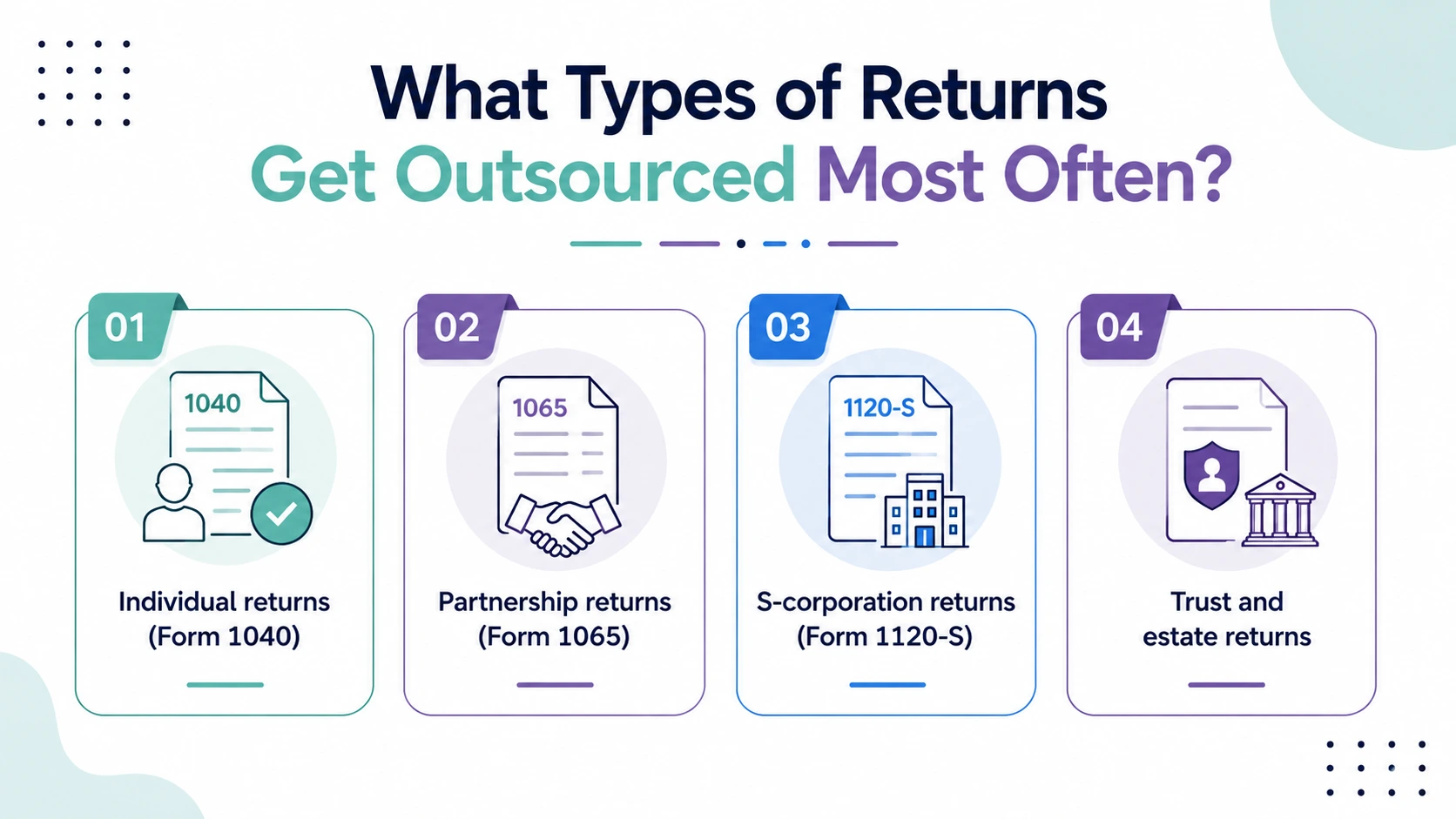
The firms that handle peak season smoothly triage returns into tiers before the spike hits, rather than working everything first-in-first-out as it arrives.
A workable triage model, in the order firms typically build it:
- Tier 1: simple, high-volume returns. Straightforward individual 1040s with W-2 income and standard deductions. Route these offshore first, since they're the highest-volume, lowest-judgment work and free up in-house staff fastest.
- Tier 2: standard business returns. Partnership and S-corporation returns without unusual complexity. Good candidates for outsourcing once a firm has run at least one season on Tier 1 work.
- Tier 3: multi-state and multi-entity returns. These need either in-house handling or a provider with specific, proven experience in multi-jurisdiction work, since errors here are costlier and harder to catch in review.
- Tier 4: complex, high-touch, or extension-bound returns. Trusts, estates, and situations requiring significant client-specific judgment generally stay in-house, then get pushed to the extension deadline if March capacity is tight rather than rushed.
Deciding this tiering before the season starts, not during it, is what separates firms that handle the spike calmly from firms that are still deciding what to outsource in the middle of March.
Where Do Firms Run Into Problems Managing the Season's Volume?
Most problems trace back to unclear workflow handoffs under time pressure, not the quality of the outsourced work itself.
Real scenario: A mid-size firm began outsourcing 1040 preparation for the first time, sending a batch of returns to an offshore team without a clearly defined review checklist for their in-house reviewers, in the middle of an already-busy March.
The offshore team prepared the returns competently, but used a slightly different convention for organizing supporting documentation than the firm's in-house staff were used to. Reviewers, already stretched thin during peak weeks and expecting the usual internal format, missed a handful of small errors buried in the unfamiliar layout.
None of the errors were serious. All were caught before filing. But the review process took longer than expected during the firm's busiest stretch, and partners started questioning whether outsourcing was actually saving time.
The firm's fix wasn't to pull back from outsourcing. It was to standardize the documentation format and build a specific review checklist for outsourced returns before the next season started, so the review layer didn't have to be built under deadline pressure. Once that was in place, review time dropped back to expected levels even during peak weeks.
For a broader look at how the outsourced tax prep workflow itself works end to end, see this guide on tax return preparation outsourcing
The lesson: managing the seasonal spike isn't just about adding hands. It requires building the review and handoff structure before the volume hits, the same way a firm would plan seasonal capacity for any resource, whether that capacity sits down the hall or offshore.
How Should Extension Season Change the Approach?
The work doesn't stop at the April deadline. Extended returns create a second, smaller spike in September and October, and firms that treat extension season as an afterthought often end up managing it with a burned-out team.
A few adjustments firms make specifically for the extension window:
- Keep a smaller slice of outsourced capacity active through the fall rather than winding the arrangement down completely after April, since ramping back up from zero in August costs more time than maintaining a reduced baseline.
- Route the most complex extended returns to the same outsourced staff who handled them in Q1, when a provider allows it, since continuity avoids re-explaining client-specific context.
- Use the lower-volume extension months to fix whatever workflow friction showed up during the spring peak, since there's more slack to test process changes than there is in March.
Firms that plan for both spikes, rather than just the April one, get more consistent value out of an outsourcing arrangement year over year.
How Do Costs Compare Between In-House Seasonal Staff and Outsourced Tax Prep?
Outsourced tax prep typically costs less per return than hiring and training seasonal in-house staff, once recruiting costs and turnover are factored in, and the gap widens further once you account for the idle capacity a seasonal hire represents for the other nine months of the year.
The gap is usually largest for firms that struggle most with seasonal hiring, since the true cost of a seasonal hire includes recruiting time, training, and the risk they don't return next year, on top of the fact that they're only useful for the ten weeks a firm actually needs them.
How Should a Firm Vet an Outsourced Tax Preparation Provider for Seasonal Surge?
Vet a provider specifically on how well they scale during peak weeks, not just their steady-state capacity, since a provider that performs well in a slow month but can't flex in March isn't solving the problem you actually have.
Key questions to ask any provider:
- How much additional capacity can the provider add with two weeks' notice during peak season, and how does that compare to their off-season capacity?
- How is client data secured in transit and at rest?
- What training do preparers receive on current US tax law, including multi-state work if that's part of your volume?
- Can the provider support the Section 7216 consent process, or does that responsibility sit entirely with your firm?
- Does the same team return for extension season, or does the firm need to re-onboard a new group in the fall?
A provider that can't answer the surge-capacity question clearly, or that treats data security as an afterthought, is a risk regardless of how competitive their pricing looks in the off-season.
How Etisson Can Help
Etisson provides offshore tax preparation and accounting staff trained specifically to work within US CPA firm workflows, including scaling up for the Q1 volume spike and staying available through extension season, along with the documentation standards and review handoffs that prevent the friction described in the scenario above.
If your firm is evaluating how to handle tax season's volume spike for the first time, Etisson's staffing model is built around flexible seasonal capacity and clear workflow structure, so your firm can scale up for peak weeks without absorbing unnecessary compliance risk or carrying idle headcount the rest of the year.
For firms wanting a structured way to manage the review checklist for outsourced returns, Xenett's practice management tools help formalize that process so nothing gets missed between preparation and filing, even during the busiest weeks.
Quick Reference: Outsourcing Readiness Checklist
FAQs
What is tax preparation outsourcing?
It's the practice of having a third party, often offshore, prepare all or part of a client's tax return, while a licensed preparer at the hiring firm reviews and signs off before filing. During tax season specifically, it functions as a way to absorb the sharp seasonal volume spike without permanent headcount.
Is it legal to outsource tax return preparation?
Yes, but the IRS requires written client consent under Section 7216 before any tax return information is disclosed to a preparer outside the firm.
Do clients need to be told if their return is outsourced?
Yes. Firms must obtain signed consent that specifically discloses the outsourcing arrangement before sharing any return data.
How much extra capacity can outsourcing realistically add during peak weeks?
It depends on the provider and how far in advance the arrangement is set up, but firms that plan ahead of the season, rather than reaching for outsourcing mid-crunch, typically get the most flexible surge capacity when they need it most.
Is offshore tax preparation cheaper than hiring seasonal staff?
Usually, once recruiting, training, and turnover costs for seasonal hires are factored in, and once you account for the fact that a seasonal hire is only useful for the ten to twelve weeks of the actual spike.
Who is responsible if an outsourced return has an error?
The firm's licensed preparer, who reviews and signs the return, holds professional responsibility, regardless of who prepared the initial draft or how busy the season was.
How do I choose a provider that can actually handle my firm's volume spike?
Ask specifically about surge capacity and how quickly they can scale during peak weeks, not just their general data security and tax law training, since a provider with strong steady-state capabilities can still fail to flex when your firm needs it most.
Conclusion
Tax season's volume spike is predictable in shape even when the exact numbers vary year to year: a sharp, ten-to-twelve-week peak, a smaller extension-season echo in the fall, and long stretches of lower demand in between. Outsourced tax preparation, done well, gives firms a way to size capacity to that actual shape rather than either overstaffing year-round or scrambling every March.
Managing the spike isn't a shortcut around tax season staffing problems. It's a structured way to add capacity exactly where and when the volume hits, provided the compliance step, the triage plan, and the review workflow are all built before the season starts rather than during it.
Want to see how Etisson's offshore tax preparation staffing could fit your firm's next tax season surge? Book a 15-minute demo, and we'll map it against your current workflow.