.avif)

Blog Summary / Key Takeaways
- Offshore accounting = assign execution (bookkeeping, tax prep, close work) to overseas staff; firm keeps client relationships, review, and final sign-off
- Scope levels: bookkeeping → senior accountant → tax associate → controller services → catch-up/cleanup
- India vs Philippines: India better for process-heavy work (bookkeeping, tax prep); Philippines better for direct client communication and US time zone overlap
- 3 common mistakes: shared staff pool, treating it as cheap temp labor, no documented process before handoff
- Case study: 6-person Ohio firm added 12 new bookkeeping clients in month 3 after bringing on 2 Etisson bookkeepers - $44K/year vs. $150–160K for equivalent US hires
- Works when treated as a permanent operating model, not a staffing fix
The talent problem is not going away. Offshore accounting is how serious firms are solving it.
US accounting firms face a staffing math problem that doesn't resolve on its own.
The AICPA reports a sustained shortage of accounting graduates entering the profession. Experienced staff are expensive and leave for better offers. Recruiting a replacement takes three to six months. Meanwhile, your close calendar does not pause.
Offshore accounting is not a Band-Aid. For the firms running it correctly, it is a permanent operating model dedicated staff, documented processes, consistent output, every month.
This guide explains what offshore accounting actually includes for a US CPA firm, how engagements are structured, and what to look for when evaluating providers.
What is offshore accounting?
Offshore accounting is when a US firm assigns accounting tasks like bookkeeping, tax prep, close work, controller services to a team based in another country.
The firm retains full control of the client relationship, the review process, and the final deliverables. The offshore team handles execution.
"Offshore" does not mean "unsupervised." The best offshore accounting setups run inside the firm's own SOPs, close calendars, and review standards.
What does offshore accounting include for CPA firms?
The scope depends on the engagement model. Here is what structured offshore accounting covers at each level.
Most CPA firms start with bookkeeping and month-end close. They expand into tax prep once they see the workflow running cleanly.
India vs. Philippines: which offshore location is right for your firm?
Both are common choices for US CPA firms. They are not interchangeable.
India-based teams work well for process-heavy, documentation-heavy work: bookkeeping, tax prep, reconciliations.
Philippines-based teams work well when direct client communication is part of the scope.
Etisson is India-based. Our staff are CA-qualified or equivalent, trained on US accounting standards, and experienced with US-facing CPA firm workflows.
How offshore accounting engagements actually run
Week 1: Onboarding
Your dedicated offshore accountant is assigned, given access to your systems, and trained on your process your chart of accounts rules, your close checklist, your workpaper format, your review standards.
The goal is to be executing real work by end of week one. Not shadowing. Not watching demos. Actual client files.
Weeks 2–4: First close
The first full close is the calibration period. Expect some flags, some questions, some format adjustments.
This is normal. It is how the offshore accountant learns your standards.
By month two, the output should be consistent enough that your reviewer stops fixing formatting and starts doing actual review.
Month 2 onward: Standard execution
Same close process, same workpaper format, same flag thresholds every month.
Your offshore accountant knows your clients. They recognize patterns, flag anomalies, and escalate judgment calls before they become problems.
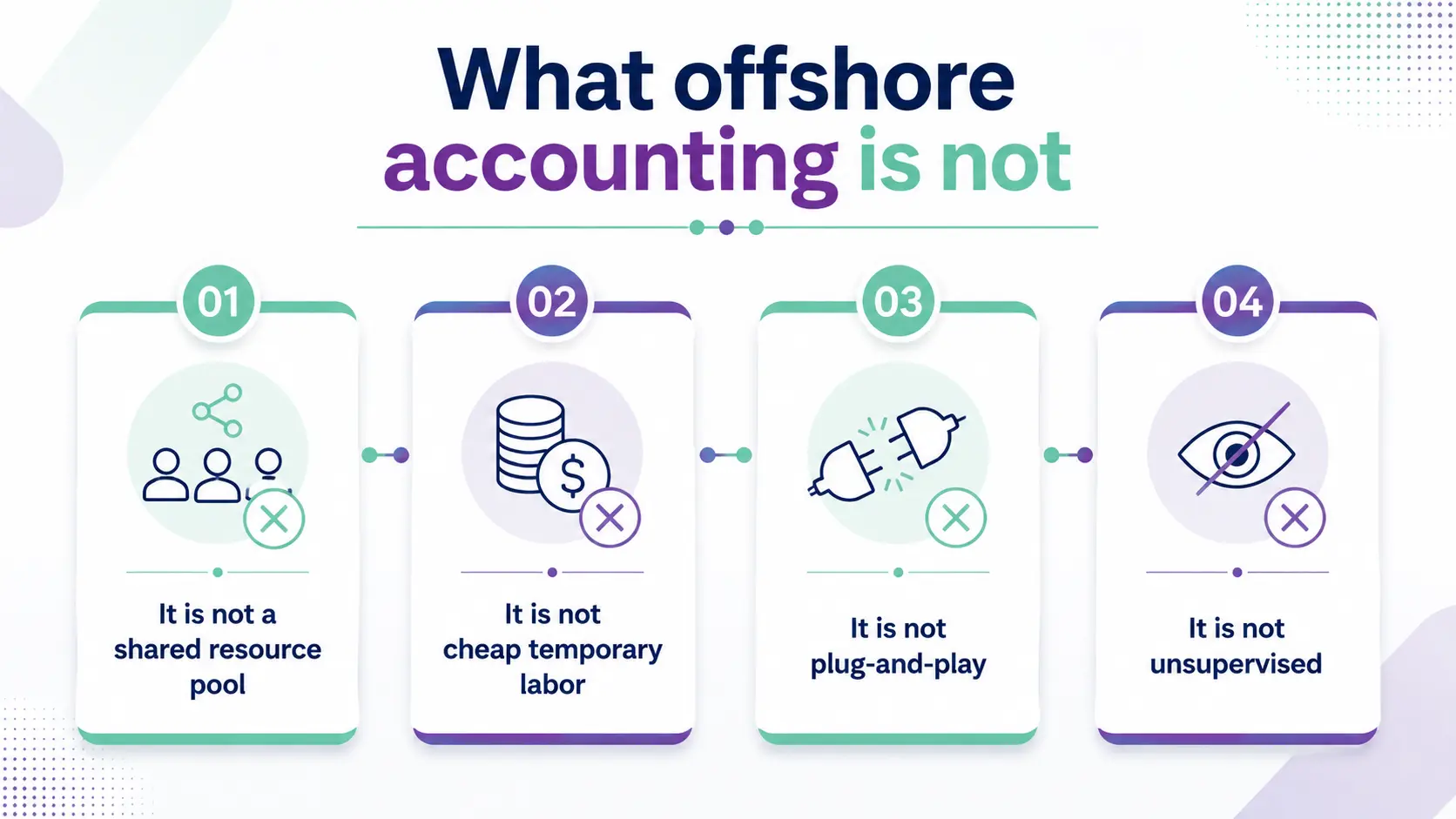
What offshore accounting is not
A lot of firms burn their first offshore engagement because they had the wrong expectations.
It is not a shared resource pool. If your provider rotates staff across clients, you lose context every time. Insist on dedicated staff - one accountant assigned to your firm.
It is not cheap temporary labor. Treating offshore staff like a lower-cost temp creates exactly the accountability vacuum that leads to errors.
It is not plug-and-play. Your process needs to be documented before offshore can execute it well. If your close depends on institutional knowledge that lives in one senior partner's head, offshore will not fix that.
It is not unsupervised. The firm still reviews the work. The offshore team eliminates execution time. It does not eliminate your review responsibility.
Real scenario: a 6-person firm doubles bookkeeping capacity without a new hire
A CPA firm in Ohio, six people, two partners was at capacity with 35 monthly bookkeeping clients.
They had stopped taking new bookkeeping work because they had nowhere to put it. Two staff accountants were spending 60% of their time on transaction-level work they were overqualified to do.
They brought on two dedicated offshore bookkeepers through Etisson.
Month one: slow- calibration period, some format corrections, close came in two days late. Month two: clean all 35 clients delivered on time, workpapers review-ready. Month three: the firm took on 12 new bookkeeping clients.
The two staff accountants moved to review, client communication, and advisory prep. The partners got out of the close entirely.
Cost of the two offshore bookkeepers: approximately $44,000 per year combined. Equivalent cost of two US bookkeeper hires: approximately $150,000–$160,000 combined.
How to evaluate offshore accounting providers
Use this checklist when comparing providers.
Even firms that use a checklist like this one still get burned, and it is worth reading about the real failure patterns firms run into when vetting an offshore CPA provider before signing a contract.
How Etisson handles offshore accounting for US CPA firms
Etisson places dedicated offshore accounting professionals bookkeepers, senior accountants, tax associates, and controllers inside US CPA firms.
All staff complete 35+ learning modules on US accounting standards, software tools, and workflow discipline before placement.
We support bookkeeping, close and finalization, tax and compliance, and controller services.
Onboarding: 48 hours. Pilot: 40 hours free, no contract. 100+ US CPA firms running this model today.
FAQs
What is offshore accounting?
Offshore accounting means a US firm assigns bookkeeping, tax prep, or close work to accounting professionals based in another country typically India or the Philippines while retaining ownership of the client relationship and the final review.
Is offshore accounting legal for US CPA firms?
Yes. CPA firms can legally use offshore staff for accounting and tax work. The firm retains full liability and review responsibility. Most state CPA boards permit this under the firm's existing license. Check AICPA outsourcing guidance or your state board for specifics.
How much does offshore accounting cost?
Most firms save 40–60% compared to equivalent US hires when salary, benefits, payroll taxes, and overhead are factored in. Etisson engagements run at approximately 40% of US equivalent cost.
What is the difference between India and Philippines for offshore accounting?
India-based teams are stronger for process-heavy accounting work bookkeeping, tax prep, reconciliations. Philippines-based teams typically have better US time zone overlap and stronger direct communication skills. Choice depends on your workflow requirements.
How long does offshore accounting onboarding take?
With Etisson, the offshore accountant is set up and executing work within 48 hours. The first full month is a calibration period. By month two, most firms see consistent, review-ready output.
Can offshore accountants handle US tax returns?
Yes. Etisson tax associates are trained on Form 1040, 1120, 1120S, 1065, 1041, multi-state filings, 1099s, and FBAR. They prepare returns to a review-ready standard — organized workpapers, source documents attached, ready for partner sign-off.
What accounting software do offshore accountants use?
Etisson staff are trained on QuickBooks Online and Desktop, Xero, Drake, UltraTax, Lacerte, ProConnect, and other common US firm tools.
Conclusion
Offshore accounting works when you run it like operations, not like staffing
The firms that get consistent results from offshore accounting are not the ones who found the cheapest option.
They are the ones who documented their process, set clear standards, and treated offshore staff as a permanent part of the firm not a revolving door.
Book a 15-minute call to see how Etisson fits your firm's workflow. No pitch. No pressure. Just a direct conversation about whether this model makes sense for you