.avif)

Blog Summary / Key Takeaways
- Outsourcing bookkeeping = hand off execution (coding, reconciliations, close work), keep client relationships and final review in-house
- What to outsource: rule-based, SOP-able tasks; what to keep: judgment-dependent, client-facing, partner sign-off
- 4 keys to making it work: document your close process first, set a shared close calendar, define review-ready workpaper standards, pilot on 5–8 clients before scaling
- Cost comparison: US hire ~$95–105K true cost vs. offshore ~$36–45K - not a compromise, a different operating model
- Case study: 3-partner Austin firm added 6 new clients in 4 months after bringing on one dedicated Etisson bookkeeper
- CTA: 40-hour free pilot, no contract
You're not outsourcing because bookkeeping is hard. You're outsourcing because there isn't enough time to do it right.
Every firm owner knows the math.
You have 40 monthly bookkeeping clients. Your two senior bookkeepers spend the first 12 days of every month coding transactions, reconciling accounts, and chasing missing documents.
By the time they're done, there's no bandwidth left for cleanup work, new clients, or anything advisory.
Outsourcing bookkeeping is not about finding someone cheaper. It's about buying back capacity for the work that actually grows your firm.
This guide covers exactly how to do it what to hand off, what to keep in-house, and how to structure the engagement so it doesn't fall apart three months in.
What does outsourcing bookkeeping actually mean for a CPA firm?
Outsourcing bookkeeping means assigning transaction coding, reconciliations, and close work to an external team while your firm retains ownership of the client relationship and the final review.
You do not give up control. You give up the execution of repeatable, time-consuming tasks.
The output your outsourced team delivers should be review-ready workpapers organized, consistent, and complete enough that your reviewer can approve without significant rework.
If you're getting half-finished reconciliations or raw transaction exports, the engagement is not structured correctly.
What should you outsource and what should you keep in-house?
This is the question most guides skip.
Not everything belongs offshore. The work that belongs offshore is repeatable, well-documented, and does not require direct client judgment.
Hand off:
Keep in-house:
The rule of thumb: if you can write an SOP for it, you can outsource it. If the answer changes based on who the client is that day, keep it in-house.
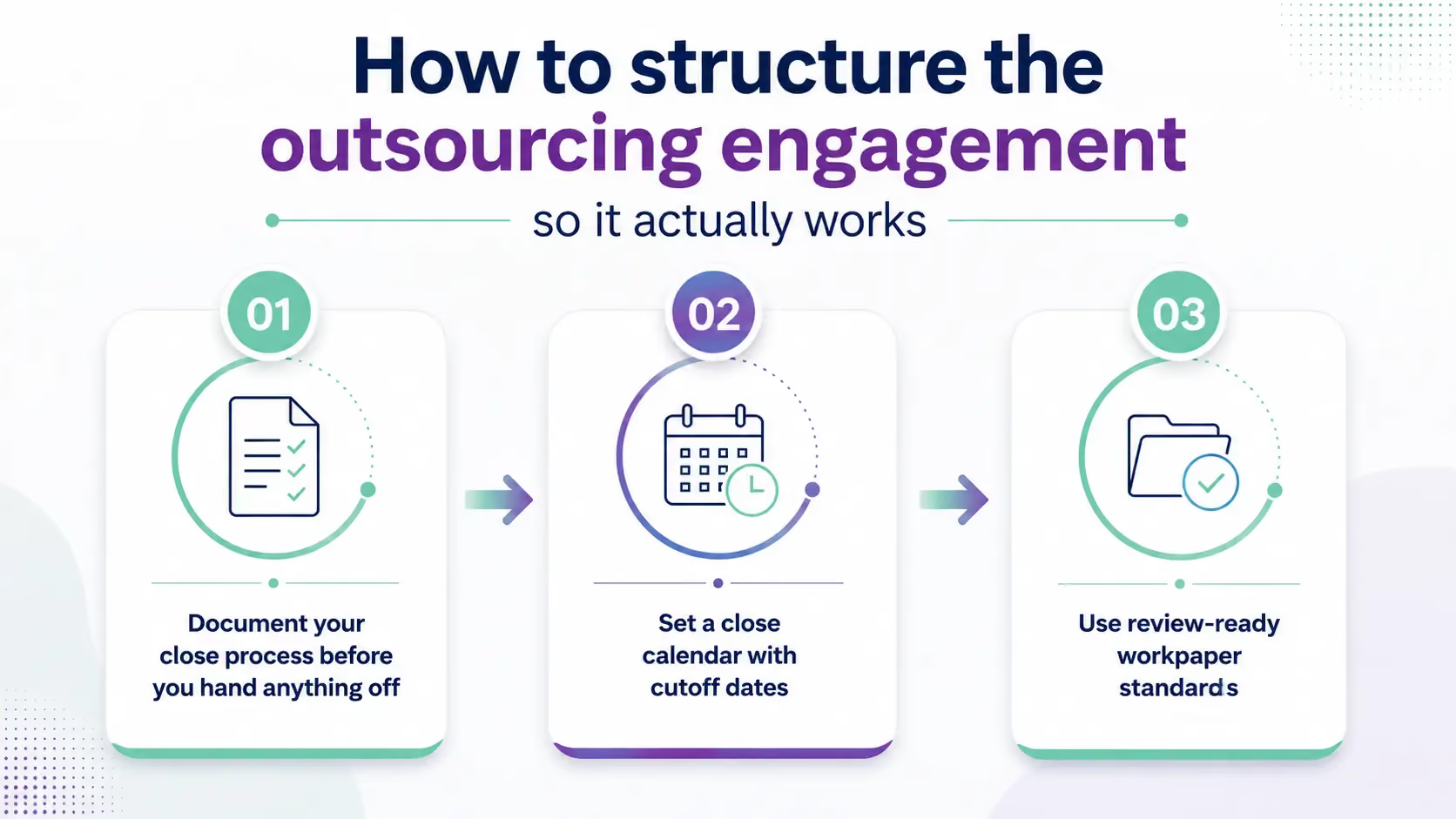
How to structure the outsourcing engagement so it actually works
Most outsourcing arrangements fail for operational reasons, not talent reasons.
The work structure breaks down. The handoff is unclear. The outsourced team waits on inputs. The firm gets back incomplete files and spends more time cleaning them up than they saved.
Here is the structure that prevents that.
Step 1: Document your close process before you hand anything off
Your outsourced bookkeeper will follow your process. If your process is not written down, they will make their own decisions and you won't like some of them.
Before onboarding offshore staff, document:
- Your chart of accounts mapping rules.
- Your reconciliation standards (what "done" means, what evidence is required).
- Your file naming and folder structure.
- Your variance thresholds (what gets flagged vs. what gets posted without escalation).
This takes time upfront. It saves ten times that time in corrections later.
Step 2: Set a close calendar with cutoff dates
Your outsourced team cannot close the books without inputs.
Define:
- Client document submission deadline.
- Internal posting deadline.
- Offshore team close delivery date.
- Partner review date.
Most delays happen because the firm never told the outsourced team when the books are due. A shared close calendar fixes this.
Step 3: Use review-ready workpaper standards
Tell your outsourced team exactly what a complete file looks like.
That means:
- Bank recs with support attached.
- Tie-out columns completed.
- Variance flags noted with a one-line explanation.
- A cover sheet summarizing what was done and what needs partner attention.
When you receive work that looks the same every month, review gets faster. When every file is formatted differently, you're doing cleanup instead of reviewing.
Step 4: Run a pilot before scaling
Do not hand off your 40 most complex clients on day one.
Start with five to eight clients similar complexity, standard close process. Run one full month. Identify what needs adjustment. Then scale.
Outsourcing bookkeeping vs. hiring in-house: a real comparison
This comparison assumes a mid-size CPA firm adding one bookkeeping headcount.
The math on a US hire looks straightforward until you add FICA, health insurance, 401k, PTO, and recruiting fees.
By the time you factor those in, a $70,000 salary is closer to $95,000–$105,000 in true cost.
Offshore staff at 40% of that cost is not a compromise. It is a different operating model that lets you serve more clients without proportional overhead growth.
Real scenario: a 3-partner firm in Texas adds capacity without adding headcount
A 3-partner CPA firm in Austin was handling 28 monthly bookkeeping clients.
Their one full-time bookkeeper was maxed out. Partners were reviewing raw files and fixing coding errors before they could even start the actual review.
They brought on one dedicated offshore bookkeeper through Etisson.
The first month was structured: the offshore bookkeeper was onboarded into QBO, trained on the firm's chart of accounts rules, and assigned 12 of the 28 clients — the cleanest ones.
By month two, all 28 clients were covered. Partner review time dropped because files came back organized.
By month four, the firm took on six new bookkeeping clients.
The in-house bookkeeper shifted to reviewing offshore output and handling client communication. The partners got out of the weeds.
What to ask before you hire an outsourced bookkeeping provider
Not every provider runs the same model.
How Etisson supports CPA firm bookkeeping
Etisson provides dedicated offshore bookkeepers and senior accountants for US CPA firms.
Staff are trained on US bookkeeping standards, common accounting software, and the close process discipline most firms need to stop cleaning up after their outsourced team.
Etisson supports bookkeeping engagements, catch-up and clean-up work, month-end close and finalization, and controller-level services.
Onboarding takes 48 hours. Most firms are running full client work by the end of week one.
100+ US CPA firms have made this transition.
FAQs
What is bookkeeping outsourcing for CPA firms?
Bookkeeping outsourcing for CPA firms means assigning transaction coding, reconciliations, and close work to an external offshore team while the firm keeps ownership of client relationships and final review.
What bookkeeping tasks can be outsourced?
Transaction coding, bank and credit card reconciliations, AR and AP posting, payroll entry, recurring accruals, financial statement prep, and workpaper assembly are all well-suited to outsourcing.
How much does outsourced bookkeeping cost for a CPA firm?
Costs vary by provider and scope. Dedicated offshore bookkeeping through a structured provider like Etisson runs roughly 40% of what an equivalent US hire costs — typically $36,000–$45,000 per year versus $75,000–$100,000 for in-house. See AICPA's 2024 staffing survey for current US accounting compensation benchmarks.
How do I maintain quality when outsourcing bookkeeping?
Use documented SOPs, require review-ready workpapers with consistent formatting, set variance thresholds, and run a monthly close calendar with clear deadlines. The structure you build determines the quality you get.
Is outsourced bookkeeping secure for client data?
Yes, when the provider uses secure systems. Verify that your provider uses encrypted file transfer, role-based access controls, and does not store client data in insecure environments. Ask for their data security policy before signing.
How long does it take to onboard an outsourced bookkeeper?
With Etisson, onboarding takes 48 hours. The bookkeeper is set up in your software, trained on your process, and executing work by end of week one.
What is the difference between outsourcing and offshoring bookkeeping?
Outsourcing refers to assigning work to an external party. Offshoring specifically means that external party is based in another country. Offshore outsourcing combines both you get external delivery and international cost economics. Most structured offshore bookkeeping providers like Etisson operate as both.
Conclusion
Start with pilot, not commitment.
The best way to evaluate outsourced bookkeeping is to run a real engagement on a small set of clients.
Not a demo. Not a proposal.
Actual work, on your files, delivered to your review standards.
Start your free 40-hour pilot with Etisson. No contract required. See the output before you decide.