.avif)

Blog Summary / Key Takeaways
- 80% of CPA partners believe growth requires headcount — this blog challenges that
- Introduces the 3-pillar model: offshore production + workflow optimization + tech enablement
- Details which work stays onshore vs. moves offshore
- Year-1 scaling roadmap broken into 5 phases (month 1 through month 12)
- Texas firm case study: 85 → 130 client entities, partner production time cut from 40% to 12%
- 8 FAQs covering firm size thresholds, data security, and software compatibility
80% of CPA firm partners say revenue growth requires adding headcountbut for most practices, every new hire compresses margin before it expands it. Recruiting takes 60–90 days. Onboarding takes 4–8 weeks. And if the hire doesn't work out, you're back to square one, with 3–4 months of lost capacity and $8,000–$15,000 in recruiting fees written off.
The firms scaling most effectively in 2026 are not hiring their way to growth. They are redesigning their operating models separating the work that requires a local, senior, relationship-oriented professional from the work that can be done efficiently by a skilled, dedicated offshore team.
This guide shows you exactly how to scale an accounting firm without proportionally increasing overhead and what it looks like in practice.
1. Why Traditional Scaling Is Breaking CPA Firms
The conventional growth model for accounting firms goes like this: win more clients → hire more staff → win more clients. Each step in that cycle adds fixed cost. When a client leaves or revenue dips seasonally, those fixed costs don't move. Margins compress.
The AICPA reported in 2024 that over 300 CPA firms closed or merged specifically because they couldn't sustain the overhead of their staffing model. The talent market made recruiting expensive. Retention made compensation uncompetitive. And margin pressure made investment in technology difficult.
The firms that survived and grew did something different. They decoupled headcount from capacity.
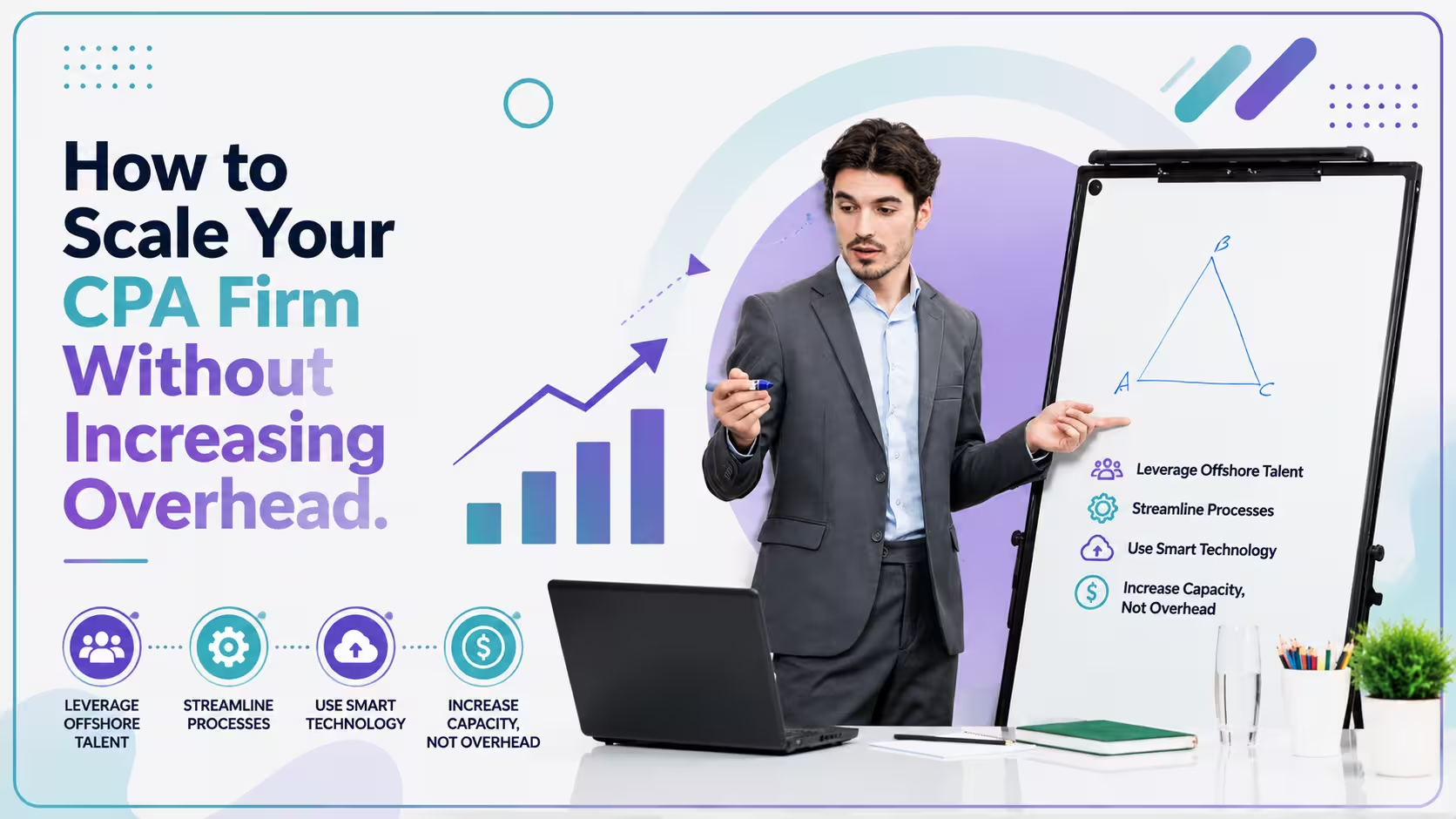
2. The Three-Pillar Model for Lean Scaling
Firms successfully scaling without overhead growth share a common framework:
- Pillar 1: Offshore production work (bookkeeping, reconciliations, tax prep, catch-up, migration)
- Pillar 2: Workflow optimization (standardized close processes, SOPs, client work trackers)
- Pillar 3: Tech enablement (cloud accounting, automated bank feeds, diagnostic reporting)
Each pillar reinforces the others. Offshore teams work most effectively when workflows are standardized. Standardized workflows are easier to automate with technology. And technology produces the data visibility that lets you manage offshore teams without micromanaging them.
3. Pillar 1: Offshore Production Work
The single highest-leverage decision a CPA firm can make is identifying which work requires local, senior, relationship-oriented staff and which work can be done more efficiently by a dedicated offshore team.
Work that stays onshore
- Client-facing advisory conversations
- Complex judgment calls on tax strategy
- Partner-level review and sign-off
- New client onboarding and relationship management
Work that moves offshore
- Daily bookkeeping and transaction recording
- Bank and credit card reconciliations
- Payroll entries and 1099 preparation
- Month-end and year-end close procedures
- Workpaper preparation
- Catch-up and clean-up work on inherited books
- Tax return preparation (1040, 1120, 1065)
- Software migration work
Etisson's dedicated offshore professionals are trained in all of the above. A bookkeeper at $2,200/month and a Senior Accountant at $2,500/month can handle the full production stack for 10–20 client entities each freeing your onshore team to manage relationships and deliver advisory.
🚀 Start your 40-hour free pilot. No commitment, no cost just real work on your clients' books.
→ Start your 40-hour free pilot at etisson.com
4. Pillar 2: Workflow Optimization
Offshore teams perform best when workflows are standardized. This is actually a forcing function: firms that adopt offshore support are required to document their processes and that documentation makes the entire firm more efficient, not just the offshore component.
Key workflow investments to make before or alongside offshore onboarding:
- Monthly close checklist: Define every step, who owns it, and the deadline. Etisson's Client Work Tracker shows bank feed status, payroll entry dates, and reconciliation progress in real-time.
- Workpaper templates: Standardized workpapers reduce review time by 30–40%. Etisson provides audit-ready workpaper documentation as standard.
- Communication cadence: Weekly update emails from your offshore team, covering what was completed, what's in progress, and what's needed from the client. This replaces status-chasing.
- Exception escalation process: Define what your offshore team escalates immediately vs. resolves independently.
5. Pillar 3: Tech Enablement
Technology is not the solution it's the infrastructure. The firms getting the most from their tech stack in 2026 are using it to:
- Automate bank feed imports and transaction categorization
- Run diagnostic reports that flag bookkeeping errors before the monthly close
- Track client work status across all entities in one dashboard
- Communicate securely with offshore teams without email chains
Etisson's offshore professionals are trained across all major platforms: QuickBooks, Xero, Sage Intacct, NetSuite, Bill.com, Dext, ADP, Gusto, Paychex, and Rippling.
6. Real Firm Example
A 4-partner CPA firm in Texas was managing 85 client entities with 6 full-time in-house staff. Total loaded payroll: $520,000/year. Partners were spending 40% of their time on production work.
Over 6 months, they moved 70% of production work to a dedicated Etisson team (2 bookkeepers + 1 senior accountant + 1 reviewer). Total offshore cost: $9,700/month ($116,400/year).
- Saving: $403,600/year in direct labor costs
- Partner production time: Reduced from 40% to 12%
- Client entities managed: Grew from 85 to 130 without adding onshore staff
- Close cycle: Shortened from 14 days to 8 days on average
7. What Scaling Without Overhead Looks Like in Year 1
| Timeline | Milestone | What Happens |
|---|---|---|
| Month 1–2 | Pilot + onboarding | Test with 40-hr free pilot, then onboard 1 dedicated bookkeeper |
| Month 3–4 | Production handoff | Move reconciliations, bank feeds, payroll entries offshore |
| Month 5–6 | Workflow standardization | Document SOPs, implement weekly update cadence |
| Month 7–9 | Capacity expansion | Add Senior Accountant for close and finalization work |
| Month 10–12 | Advisory focus | Partners fully shifted to advisory; production fully offshore |
FAQs
Can a small CPA firm scale without hiring?
Yes. Firms with as few as 15 client entities can effectively use a single dedicated offshore bookkeeper to expand capacity without adding to payroll, enabling growth that would otherwise require a local hire.
What is the biggest mistake CPA firms make when scaling?
Hiring reactively. Adding a full-time in-house employee to solve a short-term capacity problem creates a fixed cost that outlasts the problem. Offshore staffing scales up and down with demand.
How does offshore accounting support advisory growth?
By removing production work from partners and senior staff, offshore accounting frees those people for higher-value advisory conversations — which is where client retention and referrals are won.
How long does it take to see results from offshore accounting?
Most firms see measurable results within 60–90 days: faster close cycles, reduced partner hours in production, and lower labor cost per client entity managed.
Do I need to change my software to use offshore accounting?
No. Etisson's team is trained on all major platforms like QuickBooks, Xero, NetSuite, Sage Intacct so you keep your existing stack and your offshore team adapts.
How do I maintain quality control with an offshore team?
Through structured review processes, workpaper standards, and Etisson's four-eye review protocol. Your senior reviewer signs off before any deliverable reaches the client.
Is offshore accounting safe for my clients' data?
Yes. Because Pillar 2 of the three-pillar model requires standardized workflows and documented SOPs, every offshore engagement runs through Etisson's four-eye review protocol and NDA-backed confidentiality agreements — the same controls that let the Texas firm in this guide move 70% of production offshore without a single client data incident.
What's the minimum firm size for offshore accounting to make sense?
Based on the Year-1 roadmap above, firms with 15+ client entities get the clearest return: that's roughly the caseload where a single dedicated bookkeeper (Month 1–2 of the roadmap) pays for itself. The Texas firm in this guide started the same way, at 85 entities, before scaling to 130.
Conclusion
Scaling a CPA firm without increasing overhead is not a future possibility it's a present reality for hundreds of US accounting firms that have adopted offshore production models. The math is clear, the case studies are real, and the technology infrastructure to make it work is already in place.
The question is not whether offshore accounting works. It's whether your firm is ready to redesign its operating model to take advantage of it. The 40-hour free pilot from Etisson is designed to answer that question with real work not a sales pitch.
.avif)