.avif)

Blog Summary / Key Takeaways
- What a bookkeeper actually does task by task
- How the bookkeeper role differs from an accountant or controller
- What software bookkeepers use in US CPA firms
- Where bookkeeping work typically breaks down at scale
- How CPA firms are staffing the bookkeeper role offshore in 2026
Introduction
Ask ten CPA firm owners what a bookkeeper does and you'll get ten different answers.
Some will say data entry. Some will say reconciliations. Some will say "everything we don't have time for." And all three are partially right which is exactly the problem.
When the bookkeeper role isn't clearly defined, it becomes a catch-all. The bookkeeper ends up doing whatever falls through the cracks. That's not a staffing strategy. That's a recipe for inconsistent output, rework, and a team member who's always behind.
This guide breaks down exactly what a bookkeeper does task by task and how CPA firms can structure the role properly, whether they're hiring locally or building an offshore team.
What Is a Bookkeeper?
A bookkeeper is an accounting professional who records, organizes, and maintains a business's financial transactions on a day-to-day basis. Their job is to keep the books accurate and current so that accountants, controllers, and firm owners can rely on the underlying data.
Bookkeepers work at the transaction level. They are not responsible for strategic financial decisions, tax filing, or audit opinions those sit with senior accountants and CPAs. But without accurate bookkeeping, none of those higher-level functions work correctly.
According to the Bureau of Labor Statistics, there are over 1.5 million bookkeeping, accounting, and auditing clerks employed in the US. The median annual wage for bookkeepers sits around $47,000 but fully-loaded costs for a US-based bookkeeper in a CPA firm typically run $60,000–$85,000 when you add FICA, health insurance, PTO, and recruiting overhead.
Why Does Bookkeeping Matter for CPA Firms?
Clean books are the foundation of everything a CPA firm delivers. Every tax return, every financial statement, every audit, every advisory conversation starts with the underlying transaction data that a bookkeeper maintains.
When bookkeeping is done well, the rest of the firm's workflow runs smoothly. Partners spend their time on review and client advisory not correcting categorization errors or chasing missing transactions.
When bookkeeping is inconsistent, the opposite happens:
- Month-end close takes twice as long
- Senior accountants waste hours fixing entry-level errors
- Financial statements go out late or with corrections
- Clients lose confidence in the firm's output
Based on data from 100+ CPA firms working with Etisson, firms with a dedicated, structured bookkeeping function see an average 25% reduction in partner time spent on non-advisory work. That time goes back into client relationships and higher-value services.
Who Should Be Doing the Bookkeeping in Your Firm?
Bookkeeping should be done by someone with solid accounting fundamentals but it does not require a CPA license. The role sits below the accountant and controller levels, and it should stay there.
The separation of duties principle matters here. The person entering transactions should not be the same person reviewing and signing off on them. In a well-structured CPA firm:
- The bookkeeper handles data entry, categorization, and initial reconciliation
- A senior accountant or reviewer checks their work
- A partner or manager signs off before anything goes to the client
When Do Bookkeeping Tasks Happen in a Firm's Workflow?
Bookkeeping is not just a month-end activity. It happens every day and the daily consistency is what makes the month-end close manageable.
Daily tasks: Transaction entry, bank feed review, categorization, AP/AR updates
Weekly tasks: Payroll entries, vendor payments, accounts receivable follow-ups, bank feed reconciliation
Monthly tasks: Full bank and credit card reconciliation, month-end journal entries, balance sheet tie-outs, close preparation
Quarterly / annually: Sales tax filing support, 1099 preparation, year-end cleanup, audit support workpapers
Firms that treat bookkeeping as a monthly task rather than a daily one spend the last week of every month in catch-up mode. The close drags. Errors compound. Partners get pulled in.
The most efficient CPA firms build daily bookkeeping cadences for every client. That cadence is what Etisson's dedicated bookkeepers are built to maintain same person, same client, every day.
What Does a Bookkeeper Do Task by Task?
Here is a complete breakdown of what a bookkeeper handles inside a CPA firm client engagement:
Transaction Recording
Recording every financial transaction in the accounting system sales, purchases, payments received, expenses paid. The bookkeeper ensures every entry is in the right account, coded correctly, and dated accurately.
Bank and Credit Card Reconciliation
Matching the client's bank and credit card statements against the transactions in QBO or Xero. Every discrepancy missing transactions, duplicates, timing differences is identified and resolved before the month closes.
Accounts Payable Management
Processing vendor invoices, scheduling payments, and maintaining accurate aging reports. The bookkeeper ensures bills are paid on time and coded to the correct expense accounts.
Accounts Receivable Management
Recording customer invoices, tracking outstanding balances, and following up on overdue accounts. Clean AR means the client always knows what they're owed and by whom.
Payroll Entry
Recording payroll journal entries after each pay run gross wages, tax withholdings, net pay, employer contributions. The bookkeeper imports or manually enters payroll data from systems like ADP, Gusto, or Paychex and reconciles it against the payroll reports.
Bank Feed Management
Reviewing and categorizing imported bank feed transactions. Setting up rules for recurring vendors. Catching transactions that imported incorrectly or with wrong dates.
Month-End Close Support
Preparing the books for the month-end close ensuring all transactions are entered, all reconciliations are complete, and the books are clean enough for the senior accountant to begin their review.
Full task breakdown:
Bookkeeper vs. Accountant vs. Controller: What's the Difference?
This is the question every CPA firm owner asks when building their team and getting it wrong leads to either overpaying for tasks that don't require a CPA, or underpaying and getting work that needs to be redone.
The clearest way to think about it: bookkeepers record what happened. Accountants explain what it means. Controllers decide what to do about it.
What Software Do Bookkeepers Use in CPA Firms?
The bookkeeper's software stack in a US CPA firm varies by client but the most common platforms are:
Accounting platforms:
- QuickBooks Online (most widely used across US CPA firms)
- Xero (growing adoption, especially in CA and tech-forward firms)
- Sage Intacct (mid-market and larger clients)
- NetSuite (enterprise clients)
Document capture and AP automation:
- Dext (receipt and invoice capture)
- Bill.com (AP processing and payments)
- Expensify (expense reporting)
Payroll integration:
- ADP, Gusto, Paychex, Rippling (payroll data imported into the accounting system)
Review and quality control:
- Xenett (AI-powered GL review and close checklist)
Etisson's bookkeepers are trained and proficient across all of these platforms before they're placed with a firm. There's no ramp-up period spent learning software they arrive ready to work in whatever stack your clients use.
Common Bookkeeping Mistakes That Cost CPA Firms Time
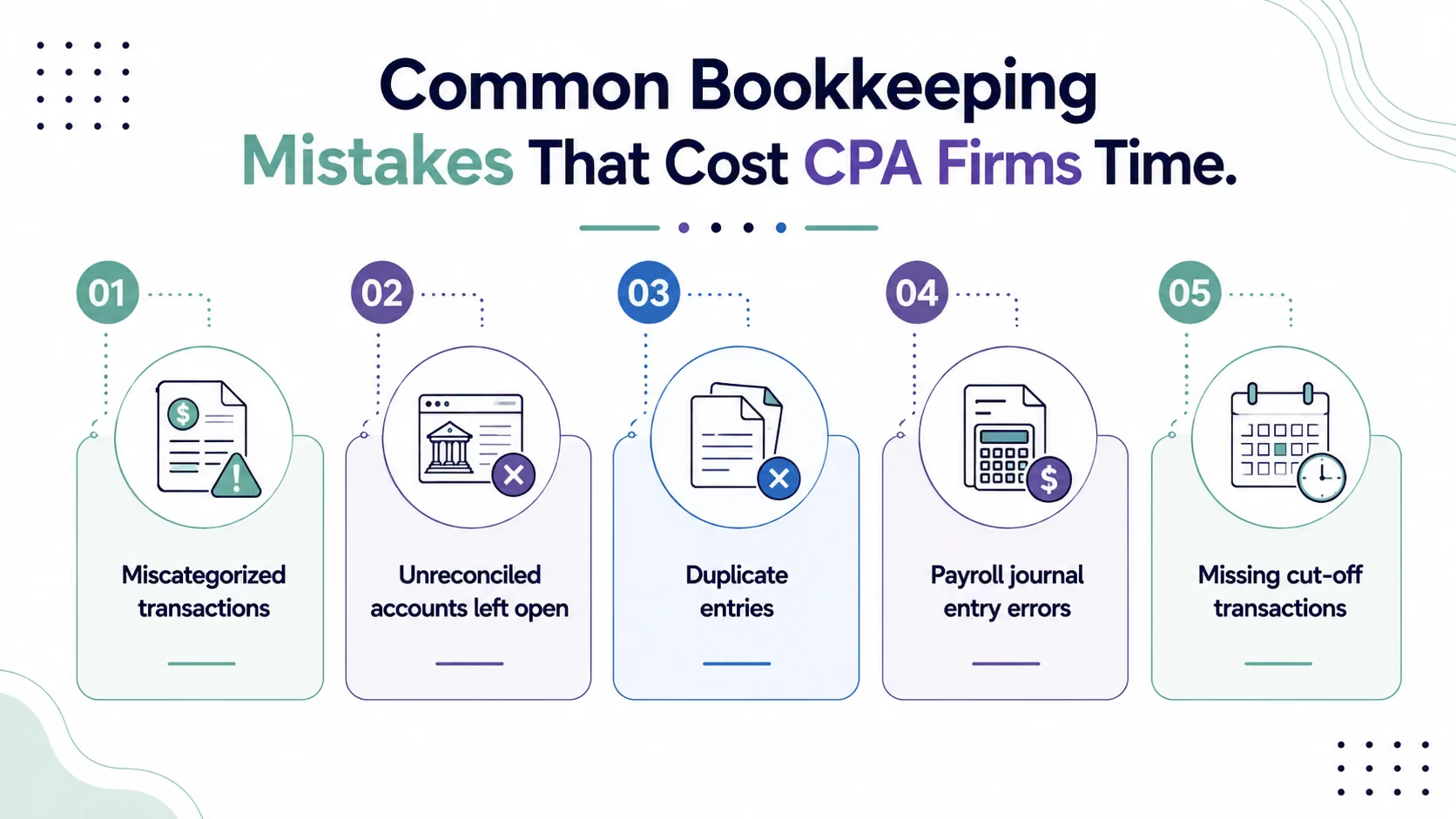
Even experienced bookkeepers make errors usually under volume and deadline pressure. Here are the five that show up most often:
1. Miscategorized transactions Expenses posted to the wrong account meals coded as office supplies, for example, or software subscriptions going into equipment. Catches by a reviewer catch these, but they take time to find and fix.
2. Unreconciled accounts left open A bank reconciliation that's 90% done and then left. The unresolved items carry forward month over month, compounding into a backlog that takes hours to unwind.
3. Duplicate entries A transaction entered manually and then also imported via bank feed. Happens frequently when clients have mixed workflows some transactions entered by the client, some by the bookkeeper.
4. Payroll journal entry errors Gross pay, net pay, and employer taxes not tying correctly to payroll reports. One miskey creates a balance sheet discrepancy that can take a senior accountant an hour to trace.
5. Missing cut-off transactions Transactions from the last few days of the month that arrive after the close has started. If the bookkeeper doesn't have a clear process for catching late items, they get pushed to the next period which distorts the monthly financials.
Real Scenario: How a 6-Person Firm Reclaimed 20 Hours a Month
A 6-person CPA firm in Michigan was managing 28 clients a mix of small businesses and professional services firms. Their bookkeeping was split across two part-time staff members, both of whom also handled administrative tasks, client communication, and basic tax prep support during busy season.
The problem: Bookkeeping was never the priority. It got done in between everything else. By the time month-end arrived, three or four clients were always behind. The firm's one senior accountant was spending 8–10 hours per month cleaning up bookkeeping errors before she could start any actual accounting work.
What they did: The firm brought on a dedicated offshore bookkeeper through Etisson at $2,200/month. The bookkeeper took over the daily bookkeeping workflow for all 28 clients bank feed review, reconciliations, AP entry, payroll journal entries.
The result:
- The senior accountant's prep-work cleanup dropped from 8–10 hours to under 2 hours per month
- Month-end close started on time for the first time in over a year
- The firm took on four additional clients in the next quarter without adding headcount
- Total monthly savings vs. hiring a second part-time local bookkeeper: over $1,800/month
The firm used the recovered capacity to move two clients into advisory engagements work that had been on the roadmap for 18 months but never had the bandwidth to happen.
How Etisson Provides Dedicated Offshore Bookkeepers for CPA Firms
Etisson places dedicated offshore bookkeepers inside CPA firms one bookkeeper, committed to your firm, working your hours, in your systems.
This is not a shared-resource model. Your bookkeeper works for your firm alone. They follow your workflows, use your software stack, and report to your team they just operate from Etisson's offshore facility.
What an Etisson bookkeeper handles:
- Daily transaction recording across all client accounts
- Bank and credit card reconciliation
- AP and AR management
- Payroll journal entry and reconciliation
- Bank feed review and categorization
- Month-end close preparation
- Reporting support for the senior accountant review
How the onboarding works:
Step 1: Etisson runs a 20-point Pulse Diagnostic across your client files catching unreconciled accounts, coding gaps, and backlog issues upfront so scope is set on evidence, not assumptions.
Step 2: Your dedicated bookkeeper is matched to your firm based on software proficiency and client industry mix.
Step 3: Onboarding in 48 hours. Your bookkeeper learns your workflows, your clients, and your close process in the first week.
Step 4: Weekly update email and operational call you stay fully informed without chasing status updates.
The numbers:
Use the Etisson ROI Calculator to see exactly what the cost difference looks like for your firm's specific situation.
See how other CPA firms have structured their bookkeeping teams in the Etisson case studies.
Book a free strategy call we'll map out which roles make sense for your firm and give you a custom quote based on your actual client base.
FAQs
What does a bookkeeper do on a daily basis?
On a daily basis, a bookkeeper reviews bank feed transactions, categorizes and codes incoming entries, processes vendor invoices, updates accounts receivable records, and ensures all transactions are entered correctly. The daily cadence is what keeps month-end manageable firms that skip daily bookkeeping spend the last week of every month in catch-up mode.
What is the difference between a bookkeeper and an accountant?
A bookkeeper records financial transactions and maintains accurate books. An accountant interprets those records, prepares financial statements, handles tax filing, and provides strategic financial advice. Bookkeepers work at the transaction level. Accountants work at the reporting and analysis level. In a CPA firm, bookkeepers prepare the work that accountants review and sign off on.
Do bookkeepers need a CPA license?
No. Bookkeepers do not need a CPA license. The role requires strong accounting fundamentals and proficiency with accounting software, but it does not require the professional certification that CPAs hold. Some bookkeepers hold a QuickBooks ProAdvisor certification or a bookkeeping certificate, but neither is required.
How much does a bookkeeper cost?
A US-based bookkeeper costs $47,000–$65,000 in base salary, plus 35–45% in employer overhead (FICA, health insurance, 401k, PTO, recruiting). Total fully-loaded cost typically runs $60,000–$85,000 per year or $5,000–$7,000+ per month. An Etisson dedicated offshore bookkeeper starts at $2,200/month with no additional overhead, recruiting cost, or compliance liability.
What software does a bookkeeper use?
In US CPA firms, bookkeepers primarily work in QuickBooks Online and Xero. They also use document capture tools like Dext, AP platforms like Bill.com, expense tools like Expensify, and payroll platforms like ADP, Gusto, and Paychex. Etisson bookkeepers are proficient across all major platforms used in US accounting firms before they start with your firm.
What is the difference between a bookkeeper and a virtual bookkeeper?
A virtual bookkeeper performs the same tasks as an in-office bookkeeper but works remotely either as a freelancer or through a staffing provider. The quality difference comes from whether the virtual bookkeeper is dedicated to your firm or shared across many clients. Etisson's bookkeepers are dedicated they work for your firm alone, 40 hours per week, on your schedule.
How do CPA firms use offshore bookkeepers?
CPA firms use offshore bookkeepers to handle the daily transaction work bank feeds, reconciliations, AP/AR, payroll entries at a significantly lower cost than local hires. The offshore bookkeeper works within the firm's existing software stack and workflow, reports to the firm's senior accountant or manager, and follows the same close process as any in-house staff member. According to data from 100+ CPA firms using Etisson, firms with dedicated offshore bookkeepers see a 25% average reduction in partner time spent on non-advisory tasks.
Conclusion
A bookkeeper is not just the person who does the data entry. When the role is properly structured, a bookkeeper is the foundation that makes everything else in a CPA firm faster, cleaner, and more reliable.
The difference between a firm that closes on time every month and one that's always in catch-up mode usually comes down to one thing: whether the daily bookkeeping is getting done consistently, by someone whose only job is to do it well.
For most growing CPA firms, the constraint isn't finding a good bookkeeper it's the cost and unpredictability of hiring one locally. US bookkeepers are expensive, take months to recruit, and leave when a better offer comes along.
That's the problem Etisson was built to solve. A dedicated offshore bookkeeper, trained on your systems, committed to your firm, at a fraction of the local cost available in 48 hours.
The firms doing this well aren't cutting corners. They're making a smarter staffing decision.
.avif)