.avif)

Blog Summary / Key Takeaways
- Capacity planning replaces gut feel with actual time-tracking data.
- Firms often turn away clients based on inaccurate capacity estimates.
- Senior staff time spent on transactional work is a common source of wasted capacity.
- Reassess capacity quarterly and before major client acquisition pushes.
- Offshore staffing can free up senior capacity for higher-value work.
- A time-tracking based model is more accurate than headcount ratios alone.
Introduction
You turn down a new client in January because your team is already at capacity, and it stings, because that client was a strong fit.
By March, you realize the team actually had room. The capacity estimate was wrong, and you left revenue on the table.
This happens at many firms without a clear capacity planning process, relying instead on gut feel about how busy the team member is.
A structured capacity planning approach removes the guesswork and gives you a real answer before you have to make the call.
This post walks through a practical framework, along with a firm that changed its process after turning away too many clients.
What Is Capacity Management?
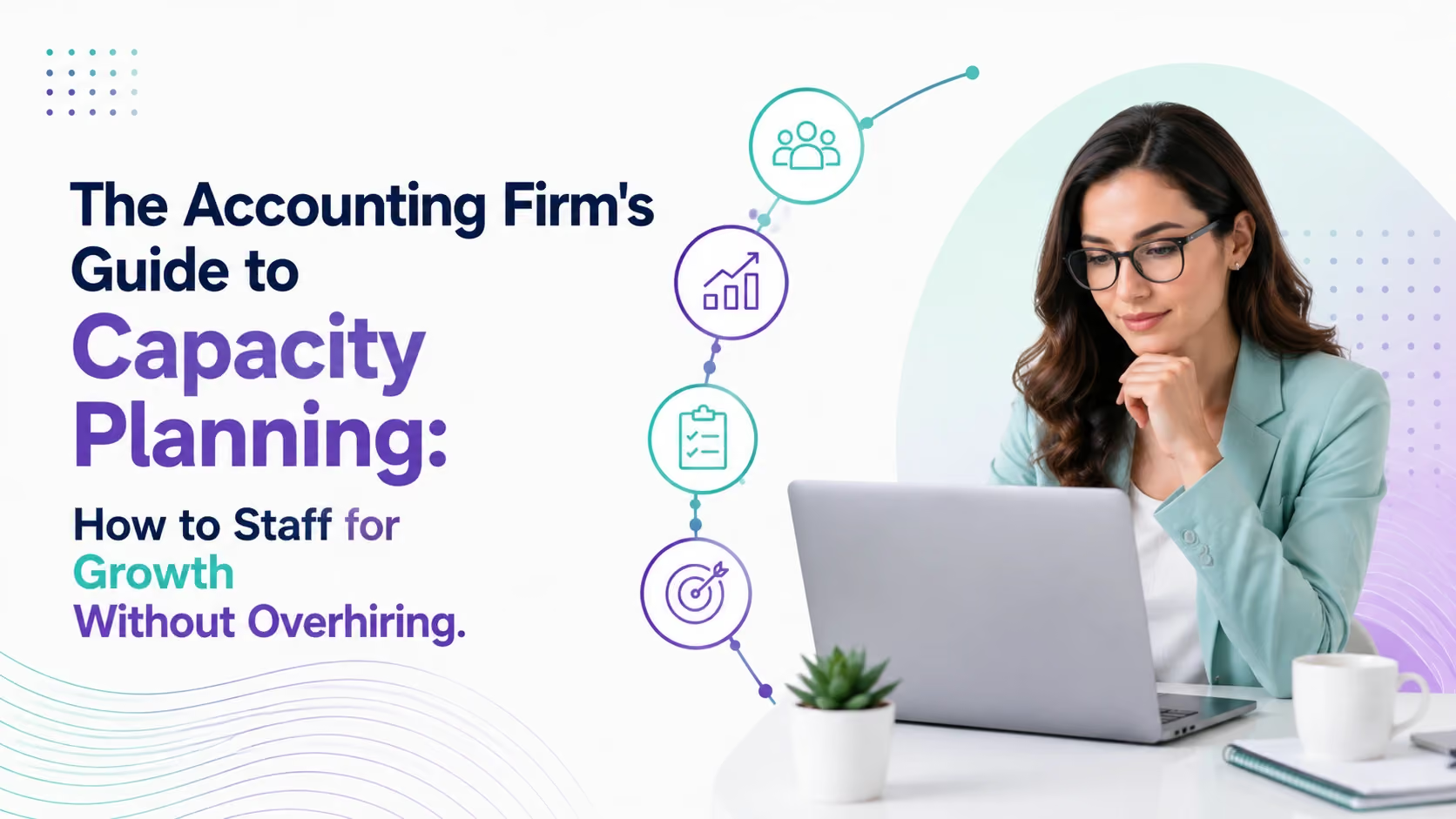
Capacity planning is the process of matching staff hours available against workload required, both current capacity and projected demand.
It answers a specific question: can the team take on this new client without sacrificing quality or working unsustainable hours.
Done well, it turns a subjective gut check into a number-based decision that is easier to defend and repeat.
The idea is simple, but many firms never formalize it, which is exactly why capacity decisions default to whoever feels overworked at the moment.
Why Is Capacity Management a Top Priority for Accounting Firms?
Most firms do not track actual billable hours spent per client closely enough to know true capacity versus perceived capacity.
Workload also fluctuates with busy season, making a single capacity number misleading without accounting for tax season demand.
Without a system, capacity decisions default to whoever is loudest about being busy, rather than real time data.
Ensures Timely Deliverables and Client Satisfaction
When capacity is tracked accurately, deadlines are far less likely to slip, since the firm knows in advance whether it has the ability to take on new work.
This directly protects client satisfaction, since missed deadlines are one of the fastest ways to damage a client relationship.
Clients rarely complain about a firm being too careful with capacity. They do complain, loudly, when a deliverable is late because staff were stretched across too many engagements.
Prevents Employee Overload and Underutilization
Some team members carry a heavy load of non billable work and admin work while others have room for more clients, and without visibility, this imbalance goes unnoticed.
A senior accountant spending hours on transactional tasks instead of advisory work is a common example of this same imbalance.
Left unaddressed, this creates a strange dynamic where the firm feels short-staffed and overstaffed at the same time, just in different places.
Reduces Turnover and Hiring Costs
Employees who consistently feel overworked are more likely to leave, which drives up hiring costs and training time for every new hire brought in to replace them.
A proactive approach to capacity planning helps a firm stay ahead of burnout before it turns into turnover.
Replacing an experienced employee costs far more than the salary line suggests, once lost productivity and client relationship disruption are factored in.
Balances Current and Future Demand
Capacity planning is not just about today's workload. It also accounts for upcoming work already in the pipeline, so the firm can create capacity ahead of demand rather than reacting to it.
This is especially important for firms with a predictable pipeline, like tax preparation clients who return every year around the same season.
Eliminates Low-Value Busy Work on Certain Tasks
Certain tasks add little value relative to the time they consume. Identifying and automating or delegating this admin work frees up productive hours for higher-value client services.
A two hours per week task that seems minor on its own adds up to over a hundred hours a year once multiplied across every staff member doing it.
Who Should Own Capacity Planning at a Firm?
Typically a managing partner or operations lead owns capacity planning, pulling data from time tracking and client rosters.
In smaller firms, this often falls to the owner directly, which makes a simple, repeatable process even more important.
Whoever owns it needs visibility into both current workload and the pipeline of prospective new clients, plus any missing documents that could delay upcoming work.
When Should Firms Reassess Capacity?
Reassess quarterly at minimum, and always before major client acquisition pushes or seasonal workload shifts like tax season.
Firms should also reassess immediately after losing a client or staff member, since both change capacity quickly.
Waiting until a crisis point, like an overloaded quarter, means the reassessment happens too late to prevent the problem.
Distinguish Short-Term vs. Long-Term Capacity Planning
Short-term capacity planning deals with the next few weeks: covering tax season demand or an unexpected staff absence without falling behind.
Long-term capacity planning looks further out, deciding whether the firm needs to hire, restructure specific roles, or shift certain tasks to offshore staff to scale sustainably.
Firms that only plan short-term end up reactive. Firms that only plan long-term miss the day-to-day signals that predict when to hire as appropriate.
Where Does Capacity Get Wasted Most Often?
Capacity often gets wasted on manual, repeatable tasks that could be automated or delegated to lower-cost employees.
Senior staff spending time on transactional bookkeeping instead of client advisory work is a common and costly pattern that reduces the firm's ability to take on more clients.
Without visibility into where time actually goes, firms cannot identify these inefficiencies to reclaim capacity or boost productivity.
How Do You Build a Capacity Planning Model?
Start by tracking actual hours spent per client over a full quarter, not an estimate based on memory.
Calculate average hours by client type, since a simple monthly bookkeeping client differs vastly from a complex advisory client requiring more time consuming, judgment-heavy accounting services.
Compare total available staff hours against total required hours, including a buffer for unplanned work and time off.
Use this model to answer capacity questions before committing to new clients, rather than after the fact, so you can focus resources with confidence.
Good workflow management ties directly into this. If tasks and deadlines live in one system instead of scattered emails, tracking actual hours becomes far easier.
How Does Workflow Management Support Capacity Planning?
A clear workflow gives visibility into which employees are approaching capacity and which have room, without needing to ask anyone directly.
This matters most during busy season, when the risk of missing a deadline is highest and the cost of a bottleneck is greatest.
Firms that combine workflow management with capacity data can reassign work proactively, before a team member is buried, rather than reacting once they raise a hand.
How Do You Determine When It's Time to Hire?
The data from a capacity model should tell you this before anyone on the team has to say it out loud.
If utilization stays consistently high across multiple quarters, not just one busy stretch, that is a strong signal to hire as appropriate rather than continuing to stretch existing staff.
If the high utilization is seasonal, tied specifically to tax season or another predictable spike, offshore or flexible staffing is usually a better fit than a permanent new hire.
The risk of hiring too early is real too. A new hire ramping up during a slow period adds cost without adding proportional value until demand catches up.
Real Scenario: A Firm That Turned Away Four Clients in Q1
A growing firm in Arizona turned away four prospective clients in the first quarter, citing capacity concerns.
When the owner reviewed actual time tracking data in April, the team had unused capacity for at least two of those four clients.
The capacity estimate had been based on how busy the team felt, not on actual hours logged against client work.
The firm implemented a quarterly capacity review using real time data going forward.
It also shifted transactional bookkeeping work for existing clients to an offshore team, freeing senior staff capacity for higher-value work.
By the following quarter, the firm accepted three new clients it would have previously declined, based on accurate capacity data rather than a guess.
Capacity Planning Models Comparison
Staffing Scenario Table
How Etisson Can Help
Etisson helps firms reclaim senior staff capacity by shifting transactional bookkeeping work to a dedicated offshore team.
This frees up billable hours that show up directly in a capacity planning model, often revealing room for new clients without a new hire.
Learn more in our guide to offshore staffing costs and capacity impact.
See how this worked for one firm in our Elevate Consulting Group case study.
For a broader look at this approach, see a three-pillar model for scaling a firm without adding headcount.
How Does This Support Your Firm's Growth During Busy Season?
Capacity planning is not a one-time exercise. It is a proactive approach that keeps pace with the firm's growth instead of reacting to it every busy season.
Firms that build this habit early avoid the scramble of hiring under pressure and instead hire as appropriate, when the data actually supports it.
An efficient business tracks progress every quarter, not just once a year, so small gains in efficiency compound instead of getting lost between reviews.
This is where the more value actually shows up: not in a single big fix, but in a business that consistently makes better staffing decisions over time.
How Do You Match Client Work to Available Hours?
Once you have a quarter of real data, list every active client alongside the average hours their client work actually requires.
Compare that total against available hours across the team, not headcount alone, since available hours account for time off and non billable work already committed.
Any gap between the two numbers is your real answer to whether the firm can take on more clients right now, not a guess based on how the office feels.
FAQs
What is capacity planning for accounting firms?
It is the process of matching available staff hours against required workload to make informed staffing and client decisions.
How often should capacity be reassessed?
Quarterly at minimum, and immediately after losing a client or staff member.
What is the most common capacity planning mistake?
Relying on gut feel or team sentiment instead of actual time-tracking data.
Can capacity planning help with client acquisition decisions?
Yes, an accurate capacity model shows whether a firm can realistically take on a new client without sacrificing quality.
How does offshore staffing affect capacity planning?
It adds flexible capacity for transactional work, freeing senior staff hours for client-facing and advisory tasks.
What tools help track capacity accurately?
Time-tracking software combined with a simple spreadsheet model comparing available versus required hours works well for most firms.
Should capacity planning account for staff time off?
Yes, build in a buffer for vacation, sick time, and unplanned absences to avoid overestimating true available capacity.
Conclusion
Ready to Free Up Capacity for Growth?
Talk to Etisson about shifting transactional work offshore to reclaim senior staff time.
.avif)