
.avif)

Blog Summary / Key Takeaways
- What accounting team augmentation is and how it works
- Team augmentation vs. traditional outsourcing
- Why CPA firms prefer augmentation for greater control
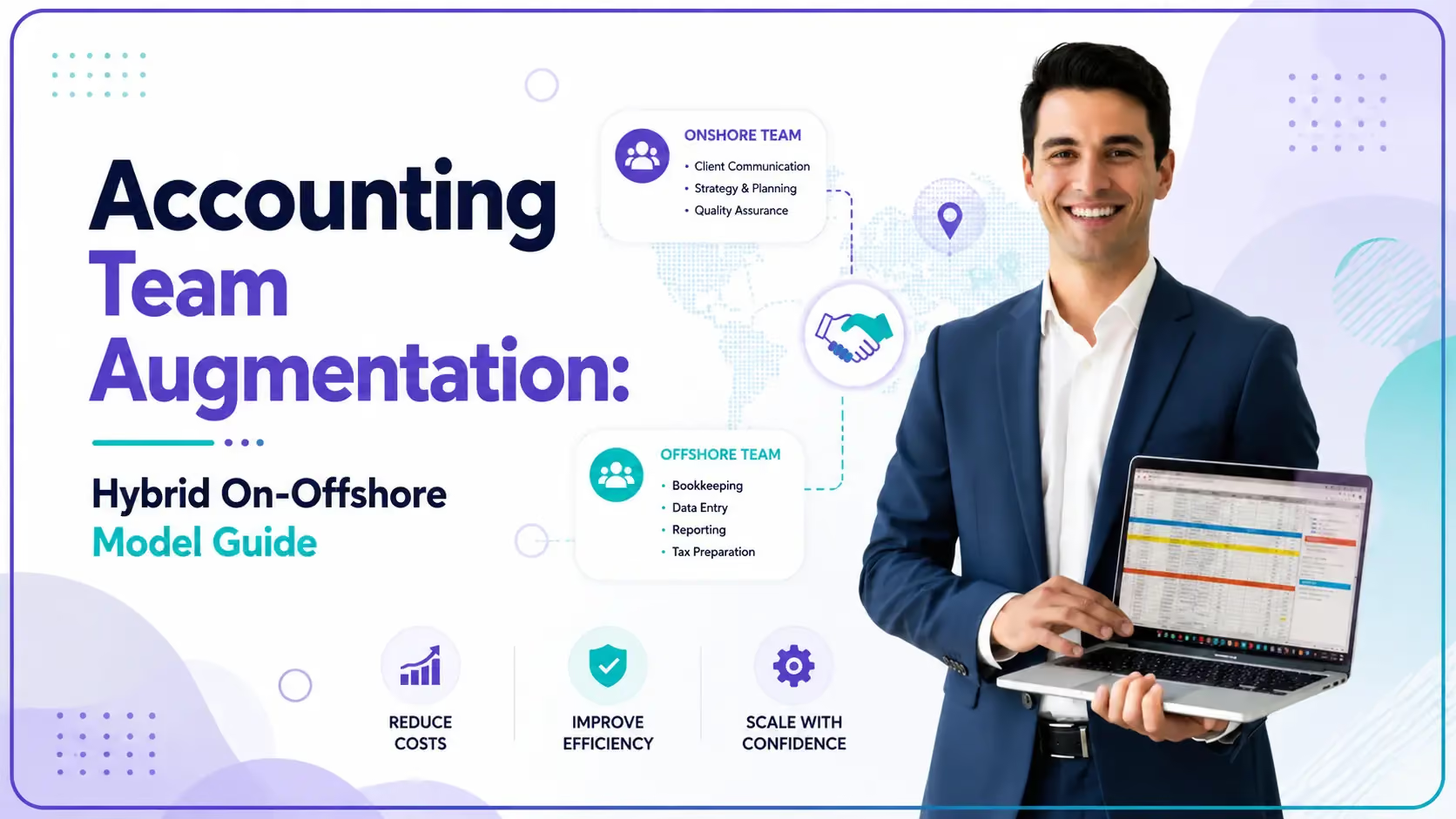
- How the hybrid on-offshore accounting model works
- Augmentation vs. local hiring and cost comparison
- How to implement team augmentation in 4 weeks
- Common use cases and benefits for CPA firms
- Common concerns about offshore accounting teams
- The augmentation vs. outsourcing decision-making process
- Frequently asked questions
Here's a common scenario:
You have a 5-person accounting team. They're good, you trust them. But you're at capacity. You have a waiting list of clients.
Your options seem limited:
- Hire locally: $80K-$100K/year, 12-week hiring timeline, risky
- Outsource everything: Loss of control, quality questions, client concerns
- Stay small: Miss revenue opportunity
But there's a fourth option that nobody talks about: Team augmentation
Team augmentation = Add capacity to your existing team, not replace them.
Your team stays in charge. Offshore staff work for your team (not instead of). Your CPAs do oversight, quality control, client relationships. Offshore staff handle the routine work.
It's the best of both worlds: Scale + Control.
This guide walks you through:
- What augmentation is (and how it differs from outsourcing)
- Why CPAs prefer it to outsourcing
- The hybrid model that works
- Real implementation examples
- Cost breakdown
Augmentation vs. Outsourcing (The Critical Difference)
Most people confuse these two. They're actually very different.
Outsourcing: "Hand It Off"
What it is: You give the entire function to a vendor. They own it.
Example:
- You: "Our bookkeeping is a problem. Fix it."
- Vendor: Takes over all bookkeeping
- You: Review final output
Your role: Minimal (just review)
Vendor's role: Everything (responsibility + execution)
Results:
- ✅ Less work for you
- ❌ Loss of control
- ❌ Client relationships suffer
- ❌ Quality depends on vendor
- ❌ Hard to transition back
Cost: Often cheaper per unit, but you lose strategic control
For a deeper look at how outsourcing itself works day to day, see What Is Outsourced Bookkeeping and Is It Right for Your CPA Firm?
Augmentation: "Add to My Team"
What it is: Add capacity to your existing team. Your team stays in charge.
Example:
- You: "We need 2 more bookkeepers. Add them to our team."
- Augmentation provider: Hires 2 offshore staff
- They work for your team (under your direction)
- You: Guide, oversee, quality check
Your role: Leadership + direction
Augmentation staff role: Execution (following your processes)
Results:
- ✅ You stay in control
- ✅ Your team expands
- ✅ Client relationships stay with you
- ✅ Quality is yours to define
- ✅ Easy to transition (they're your team)
Cost: Slightly higher per unit, but you maintain strategic control
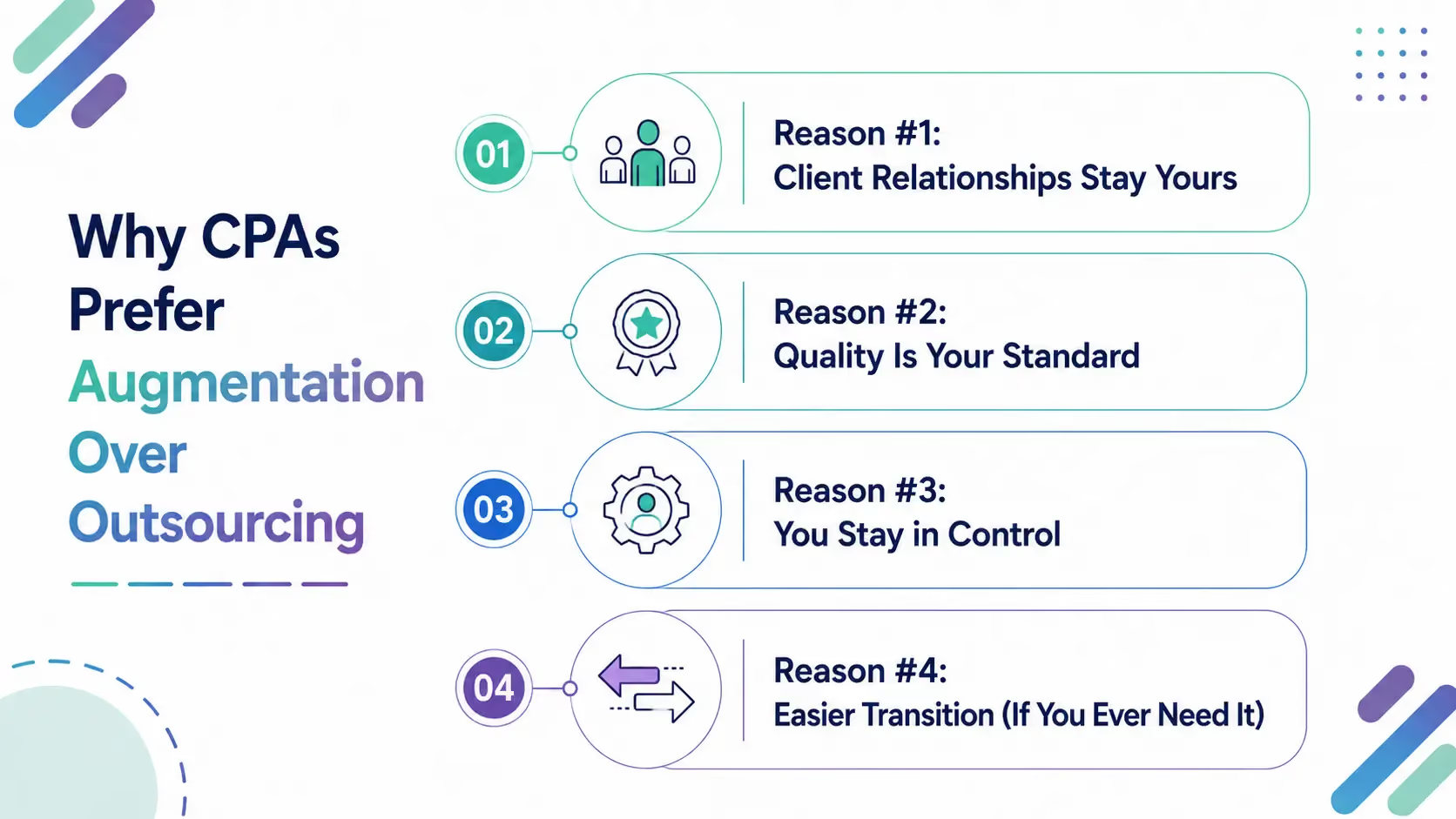
Why CPAs Prefer Augmentation Over Outsourcing
There's a reason augmentation is gaining traction in the accounting world.
Reason #1: Client Relationships Stay Yours
With outsourcing, clients wonder: "Who am I working with?"
With augmentation, clients don't even know there's an offshore team. Your team delivers (with offshore support).
Example:
- CPA reviews the close with client
- Client asks: "Who did the detailed work?"
- CPA: "My team" (which is true, offshore is part of your team)
- No awkward questions about offshore, quality concerns, or trust issues
Reason #2: Quality Is Your Standard
With outsourcing, you inherit their quality culture.
With augmentation, you impose your quality standards.
Example:
- Your standard: 98%+ accuracy on reconciliations
- Augmentation team: Works to YOUR standard, not a generic one
- Outcome: Quality is consistent with your brand
Reason #3: You Stay in Control
With outsourcing, decisions flow from the vendor.
With augmentation, decisions flow from you.
Example:
- Close process changes? You decide + implement
- Client needs special handling? You decide
- Team member underperforms? You manage
- Outcome: It's YOUR firm, still
Reason #4: Easier Transition (If You Ever Need It)
With outsourcing, transitioning back to in-house is painful (6+ months of rework).
With augmentation, transitioning is simple (they're already part of your team).
The Hybrid Model: How It Works in Practice
Here's the structure that works best:
Your On-Premise Team (Leadership + Quality)
Roles:
- Partners/CPAs: Strategy, client meetings, complex work, oversight
- Senior Accountants: Close leadership, quality review, client contact
- Bookkeepers: Close execution, client onboarding, intermediate review
Their job: Run the firm, lead the work, ensure quality
Offshore Augmentation Team (Execution)
Roles:
- Offshore Bookkeepers: Data entry, bank recon, preliminary GL review
- Offshore Specialists: Focused expertise (tax prep, payroll, etc.)
- Offshore Coordinator: Communication bridge, task tracking
Their job: Execute the work following your processes
The Workflow
Day 1-2 (Offshore):
- Data entry and routine work
Day 3-4 (Offshore):
- Preliminary reconciliations and GL review
Day 5 (Your team):
- Final review, exception resolution, sign-off
Day 6-7 (Your team):
- Client delivery, advisory, relationship management
The offshore team is 2-3 days ahead, giving your team time to review and add value.
This mirrors the structured close process described in Month-End Close Services for CPA Firms, where a dedicated close specialist handles the full cycle before it reaches your desk.
Augmentation vs. Local Hiring (The Real Comparison)
Let's compare augmentation to the alternative: hiring locally.
Scenario: You need 2 more bookkeepers
Option A: Hire Locally
Timeline: 12 weeks to productivity
The 7.65% payroll tax figure matches the combined employer FICA rate published by the IRS. Benefits load and total-cost-of-hire benchmarks (typically 1.25–1.4x base salary) are consistent with SHRM's cost-of-hiring research.
Option B: Team Augmentation (Etisson Model)
Timeline: 4 weeks to productivity
You can run your own numbers against these illustrative figures using Etisson's ROI Calculator, which compares US local-hire costs (based on BLS salary data plus standard employer overhead) against a dedicated offshore accountant.
The Comparison:
Bottom Line: Augmentation is 67% cheaper, faster, and more flexible than hiring locally.
For a wider view of how these numbers shift with role, scope, and pricing model, see Outsourced Bookkeeping Rates in 2026: What CPA Firms Actually Pay.
How to Implement Team Augmentation (4 Weeks)
Here's the step-by-step process.
Week 1: Assessment & Planning
What you do:
- List your key processes (close workflow, client onboarding, etc.)
- Identify which tasks go to augmentation staff
- Define skill levels needed
- Set up communication structure
Example breakdown:
- Data entry: Offshore
- Preliminary reconciliation: Offshore
- GL review: Offshore
- Final reconciliation: Your team
- Close review: Your team
- Client delivery: Your team
Your time: 4-5 hours
Week 2: Matching & Onboarding Begins
What happens:
- Etisson matches you with offshore staff based on your needs
- You meet the team (video call intro)
- Offshore staff reads your processes doc
- Cultural/skill fit is confirmed
Outcome:
- Team is assigned
- Initial training starts
- Confidence is building
Your time: 3-4 hours
Week 3: Process Training & Parallel Work
What happens:
- Your team trains offshore staff (walkthroughs, Q&A)
- Offshore team shadows your team (watches real work)
- They start doing work, you review heavily
Outcome:
- Offshore team understands your culture
- Your team is invested in their success
- You see how they work before full launch
Your time: 10-12 hours (training investment pays off)
Week 4: Full Launch & Handoff
What happens:
- Offshore team takes 80-100% of assigned work
- Your team moves from "execute" to "oversee"
- Weekly sync established (30 min check-in)
Outcome:
- Augmentation is live
- Your team is overseeing, not doing routine work
- Capacity is added
Your time: 5-6 hours (ongoing, post-launch)
Illustrative Scenario: Tax CPA Firm's Augmentation Path
The figures below are a hypothetical, illustrative scenario for planning purposes, not a verified client case study. If Etisson has a real client willing to be named/quoted, swap this section for their actual numbers, real case studies convert significantly better than illustrative ones and this section should not be published as-is with "real case study" framing.
Firm Profile (illustrative):
- 6 CPAs
- 150 tax + bookkeeping clients
- $1.8M revenue
- Overwhelmed during tax season (Jan-Apr)
The Problem:
- During tax season, CPAs spent 40% of time on bookkeeping
- Tax planning suffered (no time for it)
- Client relationships deteriorated (rushed)
- Wanted to hire 2 bookkeepers, but $160K/year cost seemed high
A Possible Solution:
- Implement an augmentation model
- 2 offshore bookkeepers added to team
- CPAs supervise, don't execute
- Bookkeeping is done before tax season crunch
Illustrative Results (Year 1):
Cost Analysis (illustrative):
- Augmentation cost: $61,800/year
- Revenue increase: $500K × 30% margin = $150K
- CPAs happier (less burnout, improved retention)
- Net benefit: $150K - $61.8K = $88,200/year
Addressing Common Concerns
Concern #1: "Offshore staff won't understand our culture/clients"
How augmentation solves it:
- Your team trains offshore staff directly
- Cultural immersion happens in Week 2-3
- They're "part of your team" from day one
- Not a vendor, an extension of your team
Concern #2: "We're worried about data security"
How augmentation solves it:
- Client data never leaves your control
- Encryption + access controls + backup protocols
- Security is equal to on-premise
Concern #3: "What if clients find out?"
How augmentation solves it:
- You control what clients know
- Frame it as: "Expanded team using best practices"
- Many firms don't disclose (it's internal operations)
- Clients care about quality + timeliness, not location
Firms navigating client disclosure and engagement-letter language should also see the AICPA's guidance on outsourcing and offshoring services, which covers professional responsibility even when work is performed externally.
Concern #4: "Management will be complicated"
How augmentation solves it:
- Your team manages offshore staff (just like employees)
- Etisson handles HR/admin (salaries, benefits, compliance)
- You focus on work direction, not employment logistics
- Simpler than actually hiring
The Augmentation vs. Outsourcing Decision Tree
Question 1: Do you want to keep control of quality?
- Yes → Augmentation
- No → Outsourcing
Question 2: Do client relationships matter to you?
- Yes → Augmentation
- No → Outsourcing
Question 3: Do you want flexibility to change your team?
- Yes → Augmentation
- No → Outsourcing
Question 4: Is speed to productivity important?
- Yes → Augmentation (4 weeks vs. 12 weeks)
- No → Either works
If you answered "Yes" to 2+ questions → Choose Augmentation
FAQs
Is augmentation the same as contract labor? A:
No. Contract labor = you hire individuals. Augmentation = you augment your team with vetted, trained staff (Etisson manages HR). Very different.
Can we scale up or down easily?
Yes. Need 1 more person next month? Done. Don't need one in Q2? Pause it. Month-to-month flexibility.
What if an offshore staff member isn't working out?
Etisson manages the replacement. No hiring process, no 3-month hiring timeline. Quick transition.
Do we have to disclose to clients that offshore staff are involved?
No. It's your internal operation. Your team delivers the work.
How do we handle communication across time zones?
Etisson staff work during your business hours (6-8 hour overlap). Real-time Slack + weekly 30-min sync. Better communication than many local teams.
Conclusion
CPA firms don't have to choose between hiring expensive local staff and handing their accounting work entirely to an outsourcing provider.
There are several ways to add capacity.
For some firms, local hiring may be the right choice. For others, traditional outsourcing may make more sense.
For firms that want to increase capacity while keeping control of their team, processes, quality, and client relationships, accounting team augmentation can be a practical alternative.
The hybrid on-offshore model allows your CPAs and senior accountants to focus on review, advisory, complex work, and client relationships while dedicated offshore professionals handle routine accounting tasks.
The key is to evaluate the total cost, level of control, scalability, speed to productivity, and quality standards, not simply the cost of hiring another employee.
If your firm is growing faster than your current accounting team can handle, the right augmentation model can help you scale your team, reduce staffing costs, and give your CPAs more time to focus on higher-value work.
Ready to explore your options?
Schedule a free consultation with Etisson and see what a dedicated accounting team could look like for your firm
.avif)