.avif)

Blog Summary / Key Takeaways
- What CPA firm staffing solutions are
- The different staffing models available to accounting firms
- In-house hiring vs. outsourced and offshore staffing
- How the costs compare
- Common use cases for CPA firms
- What to look for in a staffing provider
- How to build an offshore accounting team
- Common concerns about offshore staffing
- Frequently asked questions
Growing a CPA firm sounds simple: win more clients, expand your services, and increase revenue.
In practice, growth often creates a different problem, capacity.
Your firm may have more bookkeeping work, month-end closes, tax preparation, reconciliations, and client requests than your existing team can comfortably handle. Hiring locally can solve the problem, but recruiting qualified accounting professionals in the US can take time and add significant employment costs. According to the Bureau of Labor Statistics, demand for accountants and auditors continues to outpace the supply of qualified local candidates in many US markets, which is part of why firms are increasingly looking beyond traditional hiring.
That is why many CPA firms are exploring different staffing solutions, including outsourced accounting, temporary staffing, dedicated offshore teams, and hybrid staffing models.
The right choice depends on your firm's workload, budget, required level of control, and long-term growth plans.
What Are CPA Firm Staffing Solutions?
CPA firm staffing solutions are ways for accounting firms to add professional capacity without relying exclusively on traditional full-time hiring.
Depending on your needs, this could mean hiring employees directly, working with temporary accounting professionals, outsourcing specific accounting functions, or building a dedicated offshore team.
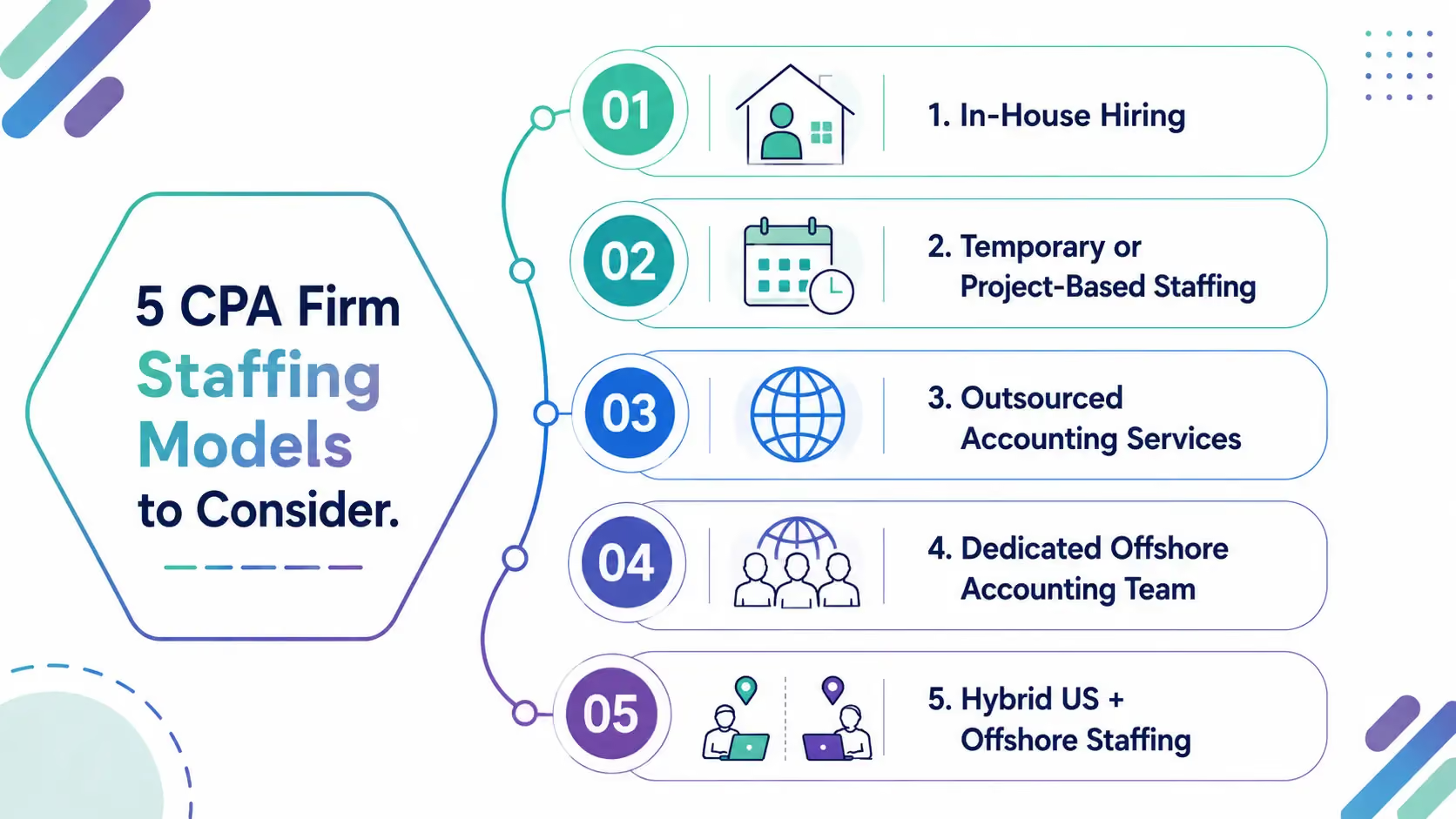
The most common models include:
- In-house hiring
- Temporary or project-based staffing
- Outsourced accounting services
- Dedicated offshore accounting teams
- Hybrid US + offshore teams
There isn't one model that works for every CPA firm.
For example, a firm that needs a tax professional for a long-term leadership position may prefer an in-house employee. A firm dealing with seasonal bookkeeping volume may benefit from temporary or offshore capacity.
The goal is to match the staffing model to the work.
5 CPA Firm Staffing Models to Consider
1. In-House Hiring
The traditional approach is to hire accountants, bookkeepers, tax professionals, or other staff directly.
Best for:
- Long-term internal positions
- Client-facing roles
- Leadership positions
- Roles requiring extensive firm-specific knowledge
- Firms that want maximum direct control
Advantages:
- Direct management
- Strong cultural integration
- Long-term employee development
- Easy access to the employee during business hours
Disadvantages:
- Higher employment costs
- Recruiting can take time
- Benefits and payroll expenses
- Office and equipment costs where applicable
- Turnover and replacement risk
For firms that need permanent local talent, in-house hiring can still be the right choice. The question is whether every role needs to be filled locally.
2. Temporary or Project-Based Staffing
Temporary staffing allows firms to add accounting capacity for a defined period.
For example, a CPA firm may need additional support during tax season or during a large client onboarding project.
Best for:
- Seasonal workload
- Short-term projects
- Temporary employee absences
- Unexpected increases in client volume
Advantages:
- Flexible commitment
- Faster access to additional capacity
- Useful for temporary workload spikes
Disadvantages:
- Staff may have limited knowledge of your firm's processes
- Availability can vary
- Temporary workers may require onboarding
- Costs can become significant for long-term needs
If the workload continues year-round, a dedicated team may provide more consistency.
3. Outsourced Accounting Services
With outsourced accounting, an external provider handles specific accounting functions on behalf of the firm.
Depending on the provider, services may include:
- Bookkeeping
- Reconciliation
- Accounts payable
- Accounts receivable
- Financial reporting
- Data entry
- Month-end close support
Best for:
- Firms that want to delegate specific processes
- Companies that don't need to manage individual staff members
- Firms looking for flexible external expertise
The tradeoff is control. Depending on the outsourcing model, you may have less direct control over who performs individual tasks and how the work is managed.
4. Dedicated Offshore Accounting Team
A dedicated offshore model gives your firm access to accounting professionals who work as an extension of your internal team.
Instead of assigning individual tasks to a shared pool, the same team can work with your firm consistently.
Best for:
- Growing CPA firms
- Recurring bookkeeping work
- Month-end close support
- Reconciliations
- Data entry and accounting operations
- Firms that need additional capacity without adding equivalent US-based headcount
With Etisson's model, for example, firms can build a dedicated accounting team around their workflows and requirements.
The team can become familiar with your processes, clients, technology stack, and quality expectations.
Potential advantages:
- Consistent team
- Scalable capacity
- Lower employment overhead than traditional US hiring
- Process familiarity over time
- Ability to expand the team as workload increases
Potential challenges:
- Requires effective communication
- Processes need to be documented
- Quality-control procedures need to be established
- The firm still needs appropriate supervision and review
Offshore staffing isn't a replacement for good management. It works best when responsibilities, review procedures, communication channels, and expectations are clearly defined. The AICPA's guidance on outsourcing and offshoring services also notes that firms retain professional responsibility for work product regardless of where it's performed, so internal review procedures still matter.
5. Hybrid US + Offshore Staffing
A hybrid model combines your existing US-based professionals with an offshore accounting team.
For example:
US team:
- Client relationships
- Advisory
- Complex accounting decisions
- Final review
- Tax strategy
- Higher-level analysis
Offshore team:
- Bookkeeping
- Reconciliations
- Data preparation
- Routine accounting tasks
- Supporting documentation
- Other repeatable workflows
This model can allow CPAs to spend less time on repetitive operational work while maintaining control over client-facing and higher-value activities. Firms building out advisory capacity alongside this model often pair it with virtual CFO services for higher-level financial strategy work.
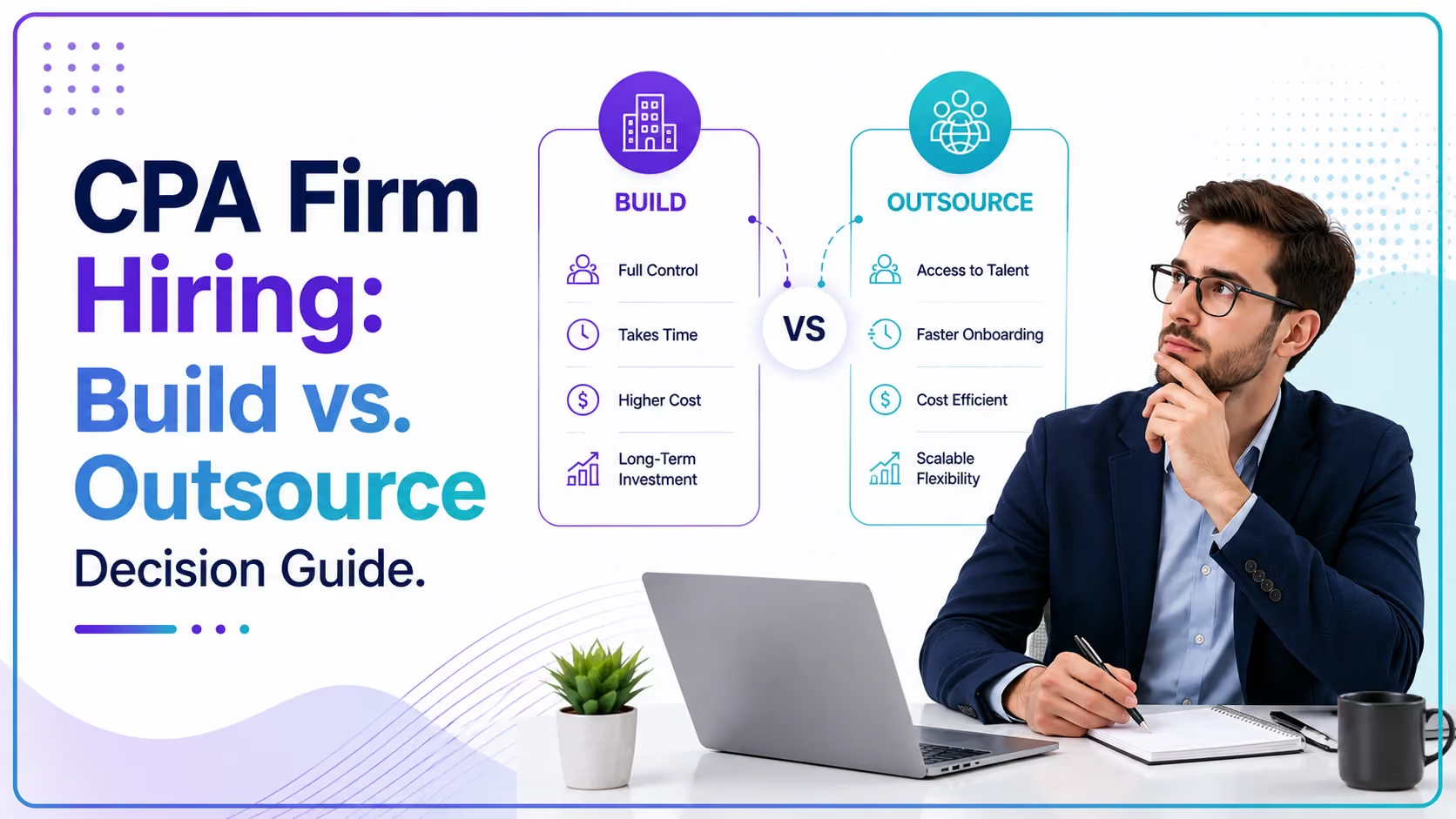
In-House vs. Outsourced vs. Offshore Staffing
The right model depends on what your firm actually needs.
There is no universally "best" staffing model.
The best model is the one that matches your firm's workload and operating model.
How Much Does CPA Firm Staffing Cost?
Cost is one of the biggest reasons firms evaluate alternatives to traditional hiring.
A US employee's cost isn't limited to salary. Depending on the role and employer, total employment costs can also include payroll taxes, benefits, retirement contributions, recruiting, training, equipment, and other overhead. Industry benchmarks from SHRM commonly cite total employment costs running well above base salary once these factors are included, which lines up with what most firms find when they run the full comparison.
For example, suppose a firm hires two accounting professionals at an illustrative salary of $80,000 each.
The firm's actual cost can be substantially higher than the $160,000 combined salary once employment-related expenses are included.
By comparison, a dedicated offshore team may operate under a fixed monthly service fee.
Illustrative comparison
Consider a hypothetical CPA firm that needs the equivalent of two additional accounting professionals.
Illustrative US hiring scenario:
- Base salaries: $160,000
- Payroll taxes and benefits: additional cost
- Training and equipment: additional cost
- Recruiting and replacement costs: potentially additional
Illustrative dedicated offshore scenario:
- Monthly team fee
- Initial onboarding and process documentation
- Ongoing quality control and management
The exact numbers will vary significantly by role, geography, provider, experience level, and workload.
The important comparison isn't simply salary vs. monthly fee. It's total cost of capacity.
Before choosing a model, calculate:
Total employment cost + recruiting + management time + training + technology + turnover risk
against
Staffing/service cost + onboarding + management + quality control.
This gives your firm a more realistic picture of the economics.
When Does Offshore Staffing Make Sense for a CPA Firm?
Offshore staffing isn't appropriate for every position.
It tends to make the most sense when a significant portion of your workload consists of repeatable, process-driven accounting work.
Use Case 1: Month-End Close
Your internal team may spend too much time on:
- Bank reconciliations
- Account reconciliations
- Supporting schedules
- Data preparation
- Preliminary review
- Documentation
An offshore accounting team can take responsibility for defined portions of the workflow, while your CPAs perform review and handle higher-level accounting decisions.
Use Case 2: Bookkeeping Capacity
Suppose your bookkeeping practice is growing from 50 clients toward 100.
Hiring two additional local bookkeepers may require a significant increase in annual payroll and benefits.
A dedicated offshore team could provide additional bookkeeping capacity without requiring the firm to add equivalent US-based headcount.
The exact economics depend on client complexity, transaction volume, service scope, and provider pricing.
Use Case 3: Tax Season Support
Accounting firms often experience significant seasonal workload increases.
Instead of permanently increasing local headcount to accommodate several months of peak demand, firms can consider flexible staffing arrangements.
Potential responsibilities can include:
- Data preparation
- Bookkeeping cleanup
- Documentation
- Reconciliation
- Tax research support
- Administrative accounting work
Complex tax decisions, final review, and client-facing responsibilities can remain with the firm's qualified professionals. For guidance on what preparers themselves are responsible for during filing season, see the IRS's overview of paid preparer due diligence.
How to Build a Dedicated Offshore Accounting Team
Choosing offshore staffing is only the first step.
The implementation process matters just as much.
Week 1: Discovery and Team Matching
Start by defining:
- Services required
- Accounting software used
- Client volume
- Required experience
- Working hours
- Communication preferences
- Review procedures
- Expected turnaround times
The staffing provider can then identify appropriate team members.
With Etisson, the process begins by understanding the firm's requirements and matching the team accordingly.
Week 2: Onboarding and Process Documentation
Document your important workflows.
For example:
- Month-end close checklist
- Reconciliation procedures
- Bookkeeping standards
- Client-specific requirements
- Review procedures
- Escalation process
The goal isn't to create documentation for documentation's sake.
The goal is to make your firm's expectations repeatable.
Week 3: Controlled Ramp-Up
Don't immediately transfer 100% of the workload.
Start with a defined portion of the work.
Your internal team can review outputs, identify issues, and provide feedback.
This gives both teams time to establish the workflow.
Week 4+: Full Production
Once the workflow is stable, the offshore team can gradually take ownership of its assigned responsibilities.
Your internal team can then focus more heavily on review, advisory, client communication, and other higher-value activities.
The timeline will vary depending on the complexity of the work, but a structured onboarding process can reduce unnecessary friction.
What Should You Look for in a CPA Staffing Provider?
Not all staffing providers operate the same way.
Before choosing one, ask:
1. Do they understand accounting firms?
A provider that primarily serves general businesses may not understand the workflows and expectations of CPA firms.
Look for experience with accounting and bookkeeping processes relevant to your firm.
2. Will I have a dedicated team?
Find out whether the same people will consistently work on your firm's accounts.
Team continuity can reduce repeated training and improve process familiarity.
3. How is quality controlled?
Ask about:
- Review procedures
- Accuracy monitoring
- Escalation processes
- Performance tracking
- Service-level expectations
4. What technology do they use?
Confirm that the provider can work with the systems your firm already uses, such as QuickBooks Online, Xero, Excel, accounting practice-management platforms, and other relevant tools.
5. How do they handle security?
Ask about:
- Access controls
- Data security
- Confidentiality
- Employee access
- Security certifications where applicable
- Offboarding procedures
6. What happens if a team member leaves?
A good provider should have a clear replacement and knowledge-transfer process.
You don't want your firm's workflow to depend entirely on one individual.
Common Concerns About Offshore Accounting Staffing
"Will the quality be good enough?"
Quality depends on the people, processes, training, and review system, not simply where the employee is located.
Start with clearly defined responsibilities and maintain appropriate review procedures.
Your firm should continue to own final professional judgment and client-facing accountability where required.
"What about communication?"
Time-zone differences can be a concern, but they don't necessarily prevent effective collaboration.
Look for providers that offer meaningful working-hour overlap with your team and establish clear communication channels.
Slack, Microsoft Teams, email, project-management tools, and scheduled meetings can all support collaboration.
"What if my clients are uncomfortable with offshore staffing?"
This depends on your client agreements, engagement terms, professional obligations, and firm policies.
Before sharing client information with an offshore team, make sure your contracts, confidentiality requirements, data-security procedures, and applicable professional obligations are properly addressed.
Your firm should also determine how and when clients are informed about third-party or offshore support.
"Will I have to train the team from scratch?"
Some training is inevitable because every CPA firm has different processes.
However, a good staffing partner should provide appropriately experienced professionals and support the onboarding process.
Your goal should be to transfer your firm-specific workflow, rather than teach basic accounting from zero.
How Etisson Helps CPA Firms Add Accounting Capacity
Etisson provides dedicated offshore accounting teams designed to work as an extension of CPA firms.
The model is built around:
- Dedicated team members
- Firm-specific processes
- Accounting and bookkeeping support
- Defined workflows
- Communication and collaboration
- Quality-control processes
- Scalable staffing
The exact team structure depends on your firm's workload and requirements.
Instead of treating every accounting task as a separate outsourcing project, a dedicated team can become familiar with your firm's processes and provide ongoing capacity.
Schedule a consultation with Etisson to discuss the type of accounting support your firm needs.
FAQs
What is CPA firm staffing?
CPA firm staffing refers to strategies CPA and accounting firms use to add professional capacity. Options include in-house hiring, temporary staffing, outsourced accounting, dedicated offshore teams, and hybrid staffing models.
How much does CPA staffing cost?
The cost depends on the staffing model, role, experience, location, workload, and provider. When comparing options, consider total employment cost rather than salary alone.
Can CPA firms outsource bookkeeping?
Yes. Bookkeeping is one of the accounting functions that can be outsourced or supported by external accounting professionals. The appropriate level of review and oversight depends on the firm's processes and professional responsibilities.
Can offshore accountants work US business hours?
Many offshore providers structure teams around overlapping working hours with US-based clients. Confirm the specific schedule with the provider before signing an agreement.
What accounting tasks can be handled offshore?
Depending on qualifications, training, and your firm's workflow, offshore teams may support bookkeeping, reconciliations, data preparation, accounts payable, accounts receivable, financial reporting support, month-end close, and other repeatable accounting processes.
Is offshore accounting secure?
Security depends on the provider's technical controls, policies, access management, employee practices, contractual protections, and your firm's own procedures. Ask potential providers about their security framework before granting access to client data.
What is the difference between staffing and accounting outsourcing?
With staffing, you typically have greater involvement in managing the people and their day-to-day work. Outsourcing generally focuses more on delegating a defined process or outcome to an external provider.
Is offshore staffing right for every CPA firm?
No. It works best when a firm has recurring work that can be clearly documented and managed remotely. Firms should evaluate their workload, security requirements, management capacity, client expectations, and professional obligations before choosing an offshore model.
Conclusion
CPA firms don't have to choose between staying small and hiring an expensive local team for every new workload increase.
There are several ways to add capacity.
For some firms, the answer will be local hiring. For others, temporary staffing or traditional outsourcing may make more sense.
For firms with recurring bookkeeping and accounting workloads, a dedicated offshore accounting team can be another option to consider.
The key is to evaluate the total cost, level of control, team continuity, security, quality processes, and scalability, not simply the hourly or monthly price.
If your firm is growing faster than your current accounting team can handle, the right staffing model can help you increase capacity while allowing your CPAs to spend more time on review, advisory, tax strategy, and client relationships.
Ready to explore your options?
Schedule a free consultation with Etisson and see what a dedicated accounting team could look like for your firm.