
.avif)

Blog Summary / Key Takeaways
- Healthcare accounting is more complex than generic small-business bookkeeping.
- Key challenges include delayed insurance reimbursements, complex accounts receivable aging, procedure-level revenue tracking, and compliance considerations.
- CPA firms serving healthcare clients need bookkeeping processes specifically designed around these realities.
- Accounts receivable (AR) management is particularly important because payer reimbursement timing can distort a practice’s cash position if not tracked carefully.
Healthcare accounting services differ from standard small business accounting in three ways. Revenue arrives on a delay through insurance reimbursement, not at the point of service. Compliance requirements around financial and patient data are stricter. And physician compensation models add complexity most other client types don't have. Firms that don't build workflows around these three differences tend to underbill their effort and miscategorize revenue.
The rest of this guide breaks down what that actually looks like in practice, and what a firm needs in place before taking on a medical or dental practice client.
What Makes Healthcare Accounting Services Different From Standard Small Business Accounting?
Healthcare accounting differs because revenue recognition, receivables, and compliance all work on healthcare-specific rules, not general small business norms.
A retail client gets paid when a customer checks out. A medical practice bills a service today and might not see full payment for 30, 60, or even 90 days, depending on the payer.
Three things set healthcare clients apart:
- Delayed, multi-source revenue. Payments come from Medicare, Medicaid, private insurers, and patient copays, often for the same visit.
- Adjustments and denials. Insurers frequently pay less than billed, deny claims outright, or claw back payments after an audit.
- Heavier compliance load. HIPAA governs how patient-linked financial data gets stored and shared, adding a layer most small business clients don't require.
Firms that apply a standard chart of accounts and standard AR assumptions to a healthcare client usually end up rebuilding both within the first year.
Why Does Accounts Receivable Work Differently in Healthcare?
Healthcare AR is aged against insurance payer timelines, not standard 30-day terms, and a single invoice can split across multiple payers before it's fully resolved.
In most industries, an invoice has one customer and one expected payment date. In healthcare, one patient visit can generate:
- A claim to the primary insurer
- A secondary claim to a supplemental payer, if one exists
- A patient responsibility balance for copays, deductibles, or coinsurance
- Potential adjustments if the insurer partially denies the claim
That means a single visit's revenue doesn't fully resolve on one line. It resolves in pieces, sometimes over months.
The AICPA has noted that healthcare providers face unique revenue recognition challenges tied to third-party payer arrangements, contractual adjustments, and the timing difference between service delivery and cash collection. This is exactly why generic AR aging reports misrepresent a medical practice's actual financial position if they're not built around payer-specific timelines.
Firms serving healthcare clients need AR reporting that tracks claims by payer status, not just by days outstanding.
Who Should Handle Bookkeeping for a Medical or Dental Practice?
A dedicated bookkeeper or accounting specialist familiar with healthcare-specific revenue cycles should handle these books, not a generalist rotating across unrelated client types.
Here's how most firms staff it, by practice complexity:
Solo practice, low patient volume. A generalist bookkeeper can often manage this, provided they understand basic insurance reimbursement timing.
Group practice or multi-provider clinic. This needs someone who understands payer mix, physician compensation splits, and multi-source revenue reconciliation. A generalist usually isn't enough here.
Multi-location or specialty practice. This typically needs a dedicated specialist or a small team, since compliance requirements and revenue complexity both scale up.
The staffing mistake firms make most often is treating a healthcare client like any other small business client during onboarding, then discovering the complexity gap once monthly close consistently runs late.
When Should a CPA Firm Bring In Outsourced Support for Medical Billing and Bookkeeping?
Bring in outsourced or offshore support once your firm has more than a handful of healthcare clients, or once in-house staff start falling behind on payer-specific reconciliation each month.
Outsourced medical billing and bookkeeping support works best when it's treated as a defined extension of the firm's process, not a black-box handoff. That distinction is what keeps quality consistent as the client roster grows.
Where Do Medical Practice Accounting Engagements Typically Go Wrong?
Most engagements go wrong in the first few months, when a firm applies a standard chart of accounts and standard AR process to a practice that needs payer-specific tracking from day one.
Real scenario: A regional CPA firm took on a three-physician group practice that had previously self-managed its books using a generic small business accounting setup.
The firm discovered the practice's AR aging report bundled every unpaid claim into one column, regardless of payer. Medicare claims, private insurer claims, and patient balances all sat together with no way to tell which was actually overdue and which was simply mid-cycle for that payer.
The practice believed it had a serious cash flow problem. In reality, most of the "overdue" balance was Medicare claims still within normal processing time.
The firm rebuilt the AR tracking to separate claims by payer type and expected timeline. Once broken out, the practice's actual overdue balance was a fraction of what the combined report had shown. The physicians' perceived cash crisis disappeared, but so did months of unnecessary anxiety and a rushed line-of-credit application that would have cost the practice in fees and interest.
The lesson: generic AR reporting doesn't just create inefficiency in healthcare accounting. It can actively mislead a client about their financial position.
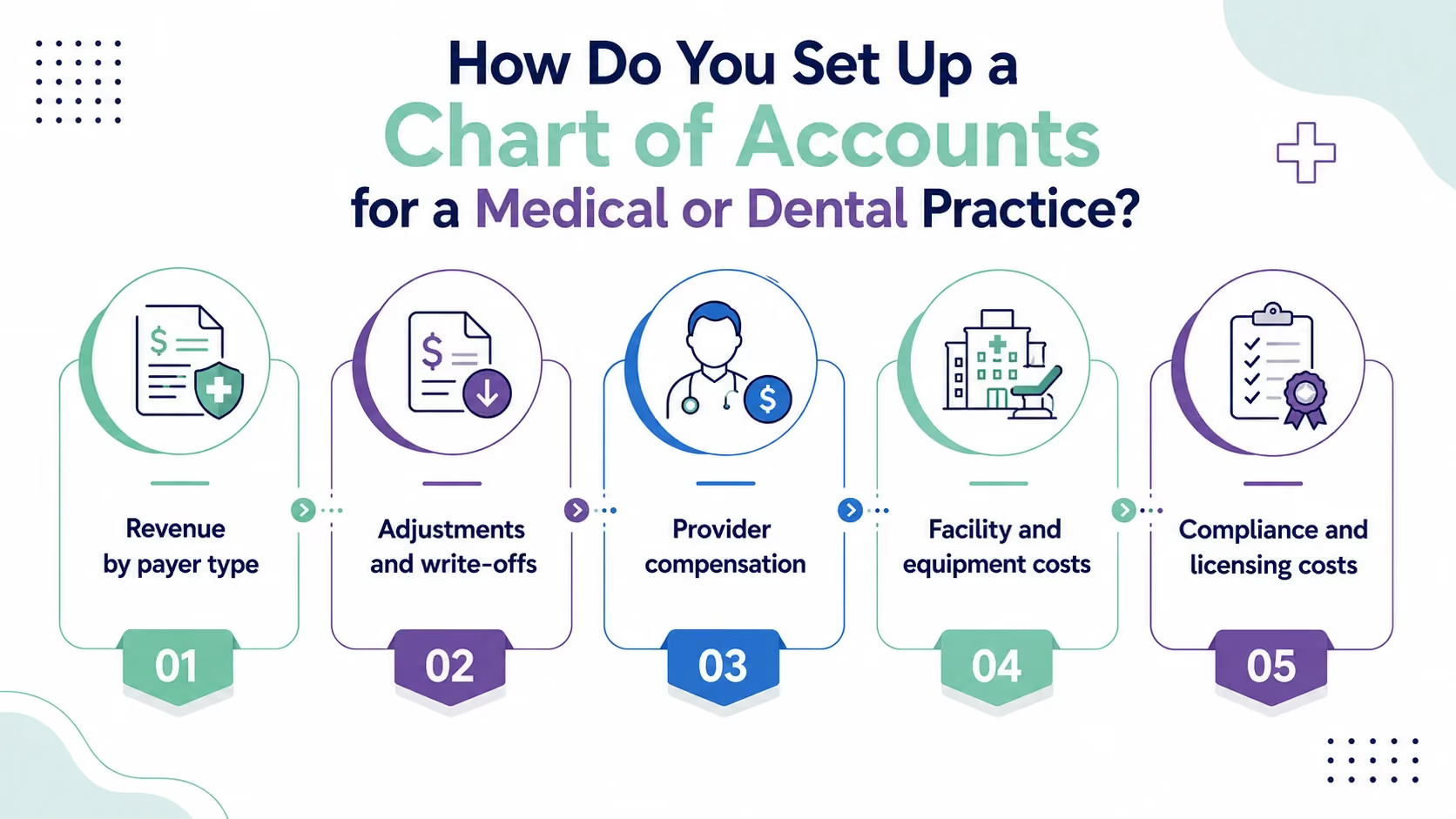
How Do You Set Up a Chart of Accounts for a Medical or Dental Practice?
Build the chart of accounts around payer source and service line, not just standard expense categories, so revenue and receivables can be tracked the way the practice actually gets paid.
A working setup typically separates:
- Revenue by payer type: Medicare, Medicaid, private insurance, self-pay, ancillary services (labs, imaging, etc.)
- Adjustments and write-offs: Tracked separately from gross billed revenue, since the gap between the two is often significant and needs its own visibility
- Provider compensation: Especially important for group practices with production-based or split compensation models
- Facility and equipment costs: Medical and dental equipment often carries different depreciation treatment than standard office equipment
- Compliance and licensing costs: Malpractice insurance, board licensing fees, and continuing education, which don't appear in a standard small business chart of accounts
Getting this structure right in month one avoids a costly rebuild later, especially once a practice starts tracking profitability by provider or service line.
How Does Physician Compensation Structure Affect the Books?
Physician compensation models directly affect how revenue and expenses get allocated, since many practices split income based on production, not a flat salary.
Common models a CPA firm will encounter:
- Straight salary. Simplest to book, functions like standard payroll.
- Production-based (eat what you kill). Each provider's compensation ties to the revenue they personally generate, requiring revenue tracking by provider, not just by practice.
- Hybrid base plus productivity bonus. Combines a salary floor with incentive pay tied to output, requiring both payroll and production tracking.
- Partnership/equity split. Common in established group practices, where profit distribution follows ownership percentage after expenses.
Firms need to know which model a practice uses before setting up the books, since production-based and hybrid models require revenue to be tracked at the provider level, not just the practice level. Getting this wrong creates disputes among partners at year-end, when compensation calculations don't match what providers expected.
What Should CPA Firms Know About HIPAA and Financial Data Handling?
CPA firms handling healthcare client data need to treat patient-linked financial information under HIPAA-aware data handling practices, even though accountants aren't always classified the same way as direct healthcare providers.
A few practical points:
- Business Associate Agreements (BAAs) are often required when a firm's work touches data that could reveal patient information, even indirectly through billing records.
- Data storage and access controls need to meet a higher bar than standard small business bookkeeping, particularly for cloud-based accounting platforms.
- Staff training matters. Anyone touching healthcare client books should understand basic HIPAA-adjacent handling requirements, not just general data security practices.
AccountingToday has reported that firms expanding into healthcare accounting increasingly need to understand HIPAA's Business Associate provisions, since financial and billing data handling can fall within its scope depending on the nature of the engagement. This is a compliance gap firms without healthcare experience often miss entirely.
How Etisson Can Help
Etisson provides offshore accounting and bookkeeping staff trained on healthcare-specific workflows, including payer-based AR tracking, provider compensation reconciliation, and the reporting structure medical and dental practices actually need.
If your firm is building or scaling a healthcare accounting practice, Etisson's staffing model is built to handle the reconciliation and AR complexity outlined above, so your in-house team isn't stretched thin managing it alone.
For firms wanting a structured way to review healthcare client books before they reach the client or a filing, Xenett's practice management and book review tools help formalize the payer-based AR checks that prevented the misread cash flow scenario described earlier.
Quick Reference: Healthcare Client Onboarding Checklist
FAQs
What are healthcare accounting services?
Healthcare accounting services are bookkeeping, tax, and advisory services built around the specific revenue cycles, compliance requirements, and compensation models used by medical and dental practices.
How is medical practice accounting different from regular small business accounting?
It differs mainly in revenue timing, since payments come through insurance reimbursement rather than at the point of service, and in the added compliance requirements around patient-linked financial data.
Why does accounts receivable look different in healthcare?
A single patient visit can generate multiple receivables across different payers, each with its own processing timeline, so healthcare AR needs to be tracked by payer, not just by days outstanding.
Do accountants need to worry about HIPAA?
Yes, in many cases. If a firm's work touches billing or financial data that could reveal patient information, a Business Associate Agreement and HIPAA-aware data handling practices are often required.
What accounting software works best for medical practices?
Software that integrates with practice management or EHR systems and supports payer-based revenue tracking tends to work better than generic small business accounting tools alone.
Should a CPA firm outsource medical billing and bookkeeping?
It depends on client volume. Firms with a handful of healthcare clients can often manage in-house, while firms scaling a healthcare practice benefit from outsourced or offshore support built for the reconciliation workload.
How does physician compensation affect a medical practice's books?
Production-based and hybrid compensation models require revenue to be tracked at the individual provider level, not just at the practice level, which adds complexity beyond standard payroll.
Conclusion
Medical practices need more than standard bookkeeping, they need accounting support that understands payer cycles, reimbursement lags, and healthcare-specific revenue recognition. CPA firms that build this expertise (or partner with a team that already has it) can serve healthcare clients with far more confidence and accuracy than a one-size-fits-all approach allows.
Healthcare accounting isn't harder because the math is different. It's harder because the timing, the payer structure, and the compliance requirements all work differently than they do for most small business clients.
Firms that build their workflows around those differences from day one avoid the costly rebuilds and misread financial pictures that come from applying a generic approach to a client type that isn't generic.
Want to see how Etisson's healthcare-trained staffing model fits your firm's current or planned medical practice clients? Book a 15-minute demo and we'll walk through your specific setup.
.avif)