.avif)

Blog Summary / Key Takeaways
- What a trial balance is and what it actually tells you
- The three types of trial balance and when each is used
- How to prepare a trial balance step by step
- What a trial balance does and does not catch
- How CPA firms use trial balances in their close workflow
Introduction
Every accounting textbook starts here. And most accountants, once they have a few years of experience, stop thinking about it.
The trial balance becomes a checkbox. You run it, confirm debits equal credits, and move on to the next step. It balances so it is fine.
Except that is not what a trial balance tells you.
A balanced trial balance confirms that the books are in mathematical equilibrium. It does not confirm that the right amounts are in the right accounts. It does not catch misclassifications, missing transactions, or revenue recorded in the wrong period. It just confirms the math.
Understanding exactly what a trial balance does and what it does not do is what separates accountants who use it effectively from those who treat it as a pass/fail stamp on the close.
This guide covers all of it.
What Is a Trial Balance?
A trial balance is a report that lists all accounts in the general ledger alongside their debit or credit balances at a specific point in time. Its primary purpose is to verify that total debits equal total credits confirming that the double-entry bookkeeping system is in balance.
Every journal entry in double-entry accounting has a debit and a credit of equal value. If every entry has been posted correctly, the sum of all debit balances must equal the sum of all credit balances. The trial balance confirms this.
A standard trial balance includes:
According to AICPA standards on financial reporting, the trial balance is a precursor to producing GAAP-compliant financial statements it is the internal verification step that confirms the GL data is ready for statement preparation.
Why Does the Trial Balance Matter for CPA Firms?
The trial balance is the gateway to the financial statements. Before a CPA firm can prepare a balance sheet or income statement for a client, the trial balance must be in balance and reviewed for completeness.
For CPA firms managing multiple clients through the close cycle simultaneously, the trial balance serves three functions:
1. Mathematical verification: Confirms that every journal entry has been posted correctly from a debit/credit standpoint. If the trial balance is out of balance, there is a posting error somewhere in the GL that must be found before close can continue.
2. Close readiness checkpoint: A clean, balanced trial balance with reasonable account balances is the first signal that the books are close-ready. Unusual balances a credit balance in an asset account, or a debit balance in a revenue account flag accounts that need investigation before statements go out.
3. Foundation for financial statements: The balances in the adjusted trial balance flow directly into the balance sheet and income statement. Asset and liability account balances go to the balance sheet. Revenue and expense account balances go to the income statement.
Firms that skip a thorough trial balance review before finalizing statements regularly find errors after the fact when a client or their auditor spots something that should have been caught at close.
Who Prepares the Trial Balance and Who Reviews It?
Who prepares it: In most CPA firm workflows, the bookkeeper or junior accountant prepares the unadjusted trial balance by running the report from QBO, Xero, or the firm's accounting software after all transactions for the period have been entered.
Who reviews it: A senior accountant or reviewer examines the trial balance for unusual balances, accounts that are unexpectedly high or low relative to prior periods, and any accounts that need adjusting entries before close.
Who signs off: A partner or manager reviews the adjusted trial balance before financial statements are produced and delivered to the client.
When Is a Trial Balance Prepared in the Close Cycle?
A trial balance is prepared at multiple points in the close cycle not just once at the end.
Day 1–3 of close: Unadjusted trial balance run after all monthly transactions are entered. Used to identify what adjusting entries are needed.
Day 3–7 of close: Adjusted trial balance run after all adjusting entries (accruals, prepaid amortization, depreciation) have been posted. This is the version used to prepare the financial statements.
Year-end only: Post-closing trial balance run after closing entries have been posted to zero out temporary accounts. Confirms only permanent accounts (assets, liabilities, equity) carry forward into the new fiscal year.
Within the close and finalization workflow, the trial balance is the formal checkpoint between "transactions are entered" and "statements are prepared." Nothing should move to statement preparation until the adjusted trial balance has been reviewed and signed off.
What Are the Three Types of Trial Balance?
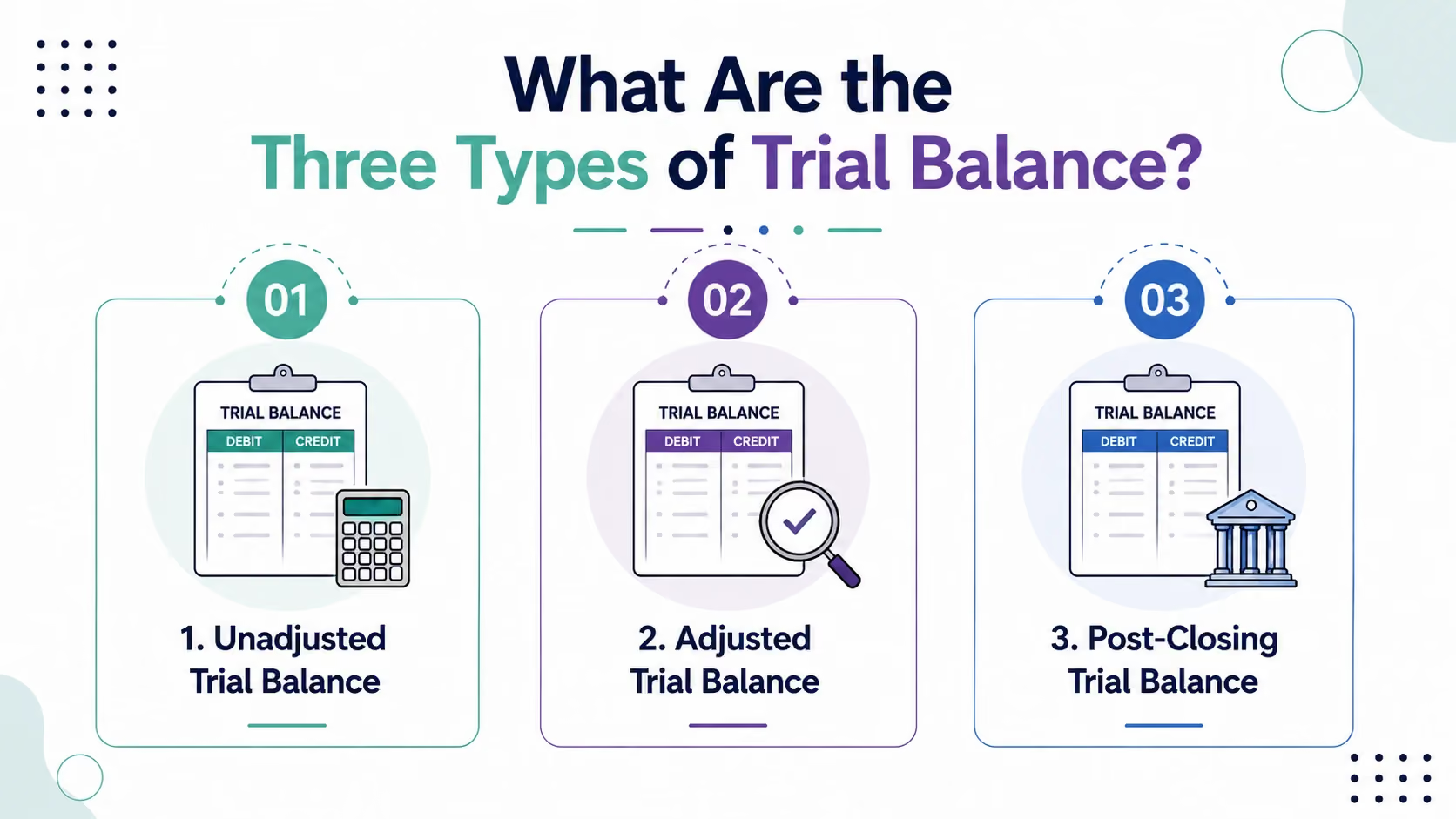
1. Unadjusted Trial Balance
Prepared after all regular transactions for the period are entered but before any adjusting entries. Shows the raw GL balances before accruals, prepaid amortization, and depreciation are posted.
Used for: Identifying what adjusting entries are needed. Spotting accounts that look off before the close process begins.
2. Adjusted Trial Balance
Prepared after all adjusting entries have been posted. This is the version that flows directly into the financial statements.
Used for: Preparing the income statement, balance sheet, and statement of cash flows. This is the most important version it should be reviewed in detail before any statements are finalized.
3. Post-Closing Trial Balance
Prepared after all closing entries have been posted at year-end. At this stage, all revenue, expense, and dividend accounts have been zeroed out and their net balance transferred to retained earnings.
Used for: Confirming that only permanent accounts carry a balance into the new year. Verifying the closing entry process was executed correctly.
How to Prepare a Trial Balance: Step by Step
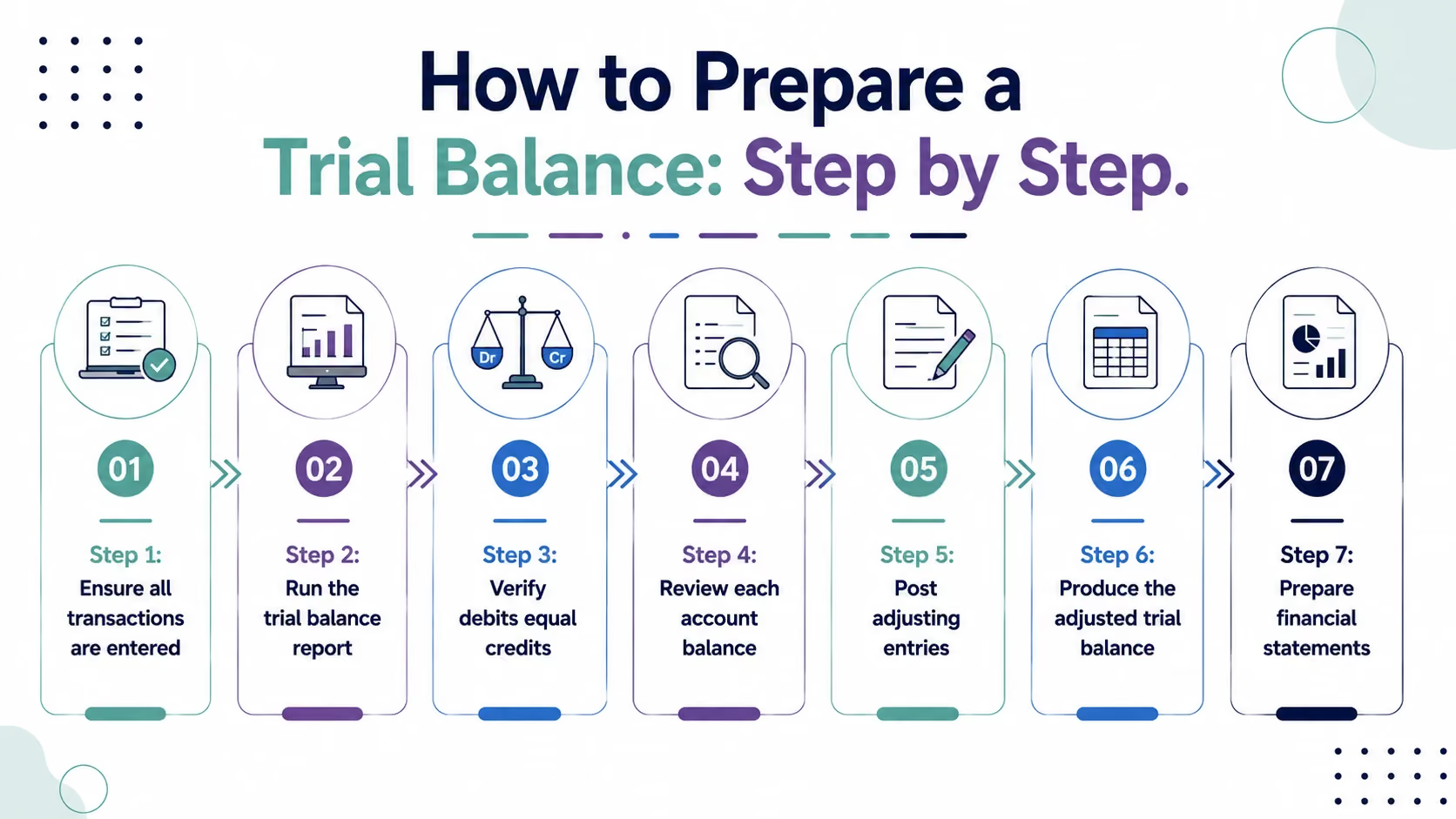
Step 1: Ensure all transactions are entered Before running the trial balance, confirm that all bank feeds are reconciled, all vendor invoices are entered, all payroll journal entries are posted, and no transactions are sitting in draft or unposted status.
Step 2: Run the trial balance report In QBO: Reports → Trial Balance. In Xero: Accounting → Reports → Trial Balance. Set the date to the last day of the period.
Step 3: Verify debits equal credits The total debit column and total credit column must match. If they do not, there is a posting error in the GL that must be identified and corrected before proceeding.
Step 4: Review each account balance Look for accounts that appear unusual:
- Asset accounts with credit balances
- Liability accounts with debit balances
- Revenue accounts with debit balances
- Expense accounts with credit balances
- Any account significantly higher or lower than the prior period without an explanation
Step 5: Post adjusting entries Record all required adjusting entries accruals, prepaid amortization, depreciation, deferred revenue recognition. Run the trial balance again after each batch of adjusting entries to confirm it remains in balance.
Step 6: Produce the adjusted trial balance After all adjusting entries are posted, run the final adjusted trial balance. This is the version that flows into the financial statements.
Step 7: Prepare financial statements Asset and liability balances from the adjusted trial balance populate the balance sheet. Revenue and expense balances populate the income statement.
What Does a Trial Balance Look Like? (With Example)
Here is a simplified adjusted trial balance for a small professional services firm at December 31, 2026:
Total debits = Total credits = $286,500. The trial balance is in balance.
What a Trial Balance Does Not Catch
A balanced trial balance does not mean the books are error-free. It only confirms the math. These errors pass through a balanced trial balance undetected:
Compensating errors: Two errors that cancel each other out a $500 debit posted to the wrong account and a $500 credit posted to another wrong account. Both sides balance, but both accounts are wrong.
Errors of omission: A transaction that was never entered at all. If a vendor invoice was never recorded, debits still equal credits the transaction simply does not exist in the books.
Errors of principle: A capital expenditure posted as an expense, or a personal expense posted as a business expense. The entry is mathematically correct wrong account, right math.
Errors of commission: A transaction posted to the correct type of account but the wrong specific account. An expense coded to utilities when it should be repairs. Debits and credits balance. Classification is wrong.
This is why trial balance review is only one step in the close process not the final step.
Common Trial Balance Errors and How to Resolve Them
Trial balance is out of balance: The total debit column does not equal the total credit column. Start by looking for the difference amount if it is divisible by 9, it is likely a transposition error. If it matches the amount of a recent entry exactly, that entry may have been posted as a debit/debit or credit/credit rather than debit/credit.
Unusual account balance: An asset account shows a credit balance, or a liability shows a debit balance. Check the account detail look for entries that posted to the wrong side, or for negative transactions that should have been reversals.
Account balance significantly higher or lower than prior period: Run a comparison trial balance (current period vs. prior period) in the accounting software. Review the account detail for any large or unusual transactions in the current period.
Revenue or expense account with wrong-direction balance: A revenue account with a debit balance often signals a refund or credit memo posted incorrectly. An expense account with a credit balance often signals a duplicate payment reversal that was applied incorrectly.
Real Scenario: How a Balanced Trial Balance Hid a $34,000 Error
A CPA firm in Colorado was managing a construction client with multiple revenue streams time-and-materials contracts, fixed-price contracts, and equipment rental income. The bookkeeper processed all transactions correctly from a debit/credit standpoint. The trial balance balanced every month.
At year-end, when the partner reviewed the financial statements, the gross margin on fixed-price contracts was 12 points higher than the prior year with no change in pricing or cost structure. That triggered a deeper look.
The investigation found that $34,000 in subcontractor costs had been coded to "equipment rental expense" a different expense account than the one used for job costing. The trial balance balanced. The debits equaled the credits. But the wrong expense account meant job costing reports were showing inflated margins, and the fixed-price contract revenue line was being compared against an incomplete cost base.
The error had been repeating for seven months before anyone noticed. Correction required restating seven months of internal management reports and adjusting the year-end financial statements.
What would have caught it: A monthly account-by-account review comparing balances against prior periods and budget not just a check that debits equal credits. This review is now part of the firm's standard close process, handled by their Etisson senior accountant as part of each month's close sign-off.
How Etisson Handles Trial Balance Preparation for CPA Firms
Etisson's senior accountants and reviewers handle trial balance preparation as part of the standard close and finalization workflow for CPA firm clients.
What Etisson delivers at each close:
- Unadjusted trial balance run and reviewed after all period entries are complete
- Adjusting journal entries posted for accruals, prepaid amortization, and depreciation
- Adjusted trial balance produced and reviewed for unusual balances
- Account-by-account comparison against prior period flagging significant variances
- Close-ready workpapers documenting every adjusting entry and its basis
- Reconciliation of all balance sheet accounts before statements are produced
The division of work:
Etisson's bookkeepers ensure all transactions are entered and reconciled before the close process begins so the senior accountant is working from clean, complete data, not chasing missing entries.
At $2,500/month for a dedicated offshore senior accountant vs. $65,000–$95,000/year fully loaded for a US-based equivalent, the cost difference allows firms to apply senior-level attention to every client not just the largest ones.
Use the Etisson ROI Calculator to see your firm's specific savings.
Book a free strategy call we'll walk through your current close workflow and show you exactly where Etisson plugs in.
FAQs
What is a trial balance in simple terms?
A trial balance is a report listing all accounts in the general ledger and their balances at a specific date. Its purpose is to confirm that total debits equal total credits verifying the double-entry bookkeeping system is in mathematical balance. It is prepared before financial statements to catch posting errors and confirm the books are close-ready.
What are the three types of trial balance?
The three types are: (1) Unadjusted trial balance prepared after all regular transactions are entered, before adjusting entries. (2) Adjusted trial balance prepared after all adjusting entries are posted; this is the version that flows into the financial statements. (3) Post-closing trial balance prepared after year-end closing entries, confirming only permanent accounts carry forward.
What is the difference between a trial balance and a balance sheet?
A trial balance lists all GL accounts both temporary (revenue and expenses) and permanent (assets, liabilities, equity) at a point in time. It is an internal working document used during the close process. A balance sheet lists only permanent accounts (assets, liabilities, equity) and is a formal financial statement prepared from the adjusted trial balance.
What does it mean when a trial balance does not balance?
When a trial balance does not balance total debits do not equal total credits there is a mathematical error in the GL. Common causes include a transaction posted as debit/debit or credit/credit instead of debit/credit, a transposition error (amount entered incorrectly), or a partial entry that was not completed. A difference divisible by 9 often indicates a transposition error.
Does a balanced trial balance mean the books are error-free?
No. A balanced trial balance only confirms mathematical equilibrium that debits equal credits. It does not detect errors of omission (missing transactions), errors of principle (wrong account type), compensating errors (two errors that cancel out), or classification errors (right account type, wrong specific account). A thorough account-by-account review is required in addition to the balance check.
How is a trial balance used to prepare financial statements?
The adjusted trial balance flows directly into the financial statements. Asset, liability, and equity account balances from the trial balance populate the balance sheet. Revenue and expense account balances populate the income statement. This is why the adjusted trial balance must be accurate and reviewed before any statements are produced.
How do CPA firms prepare trial balances efficiently across multiple clients?
Efficient CPA firms build the trial balance review into a standardized close checklist running the unadjusted trial balance as soon as period entries are complete, posting adjusting entries systematically, and doing a comparative review (current vs. prior period) before the adjusted trial balance is finalized. Firms using dedicated offshore senior accountants through providers like Etisson handle this process for every client on a consistent monthly schedule, producing close-ready workpapers and flagging unusual balances before the partner review.
Conclusion
The trial balance is not just a formality. It is a diagnostic checkpoint and like any diagnostic, its value depends entirely on how thoroughly it is used.
A balanced trial balance confirms the math. It does not confirm the accounting. Getting from a balanced trial balance to accurate financial statements requires the account-by-account review that most firms either rush through or skip entirely under deadline pressure.
The CPA firms that close cleanly every month treat the trial balance review as a real step not a checkbox. They look at what the numbers say, compare them against prior periods, and investigate anything that does not fit. That review is what catches the errors that the debit/credit math cannot see.
It is also exactly the kind of structured, repeatable close work that a dedicated offshore senior accountant does well consistently, for every client, every month, without it competing for partner attention at the worst possible time.