.avif)

Blog Summary / Key Takeaways
- AI won't replace the accounting profession, but it's already replacing a shrinking slice of specific tasks within it.
- Exposure varies sharply by role: staff accountant/bookkeeper work is highly exposed, senior accountant work moderately, controller roles low-to-moderate, and partner/firm owner roles face minimal direct exposure.
- As of 2026, clean transaction coding, invoice extraction, outlier flagging, and draft financial statements are already routinely AI-handled.
- Independent professional judgment and liability for filed returns remain 5+ years out, if AI ever gets there at all.
- Case study: a solo Georgia CPA with 18 clients added AI transaction categorization plus one offshore bookkeeper, cutting transaction-level work by 75% while advisory hours billed rose from 8 to 22/month.
- That shift added roughly $33,000/year in net revenue for the same solo practitioner.
- AI confidence scores are not correctness: human review is still what catches the cases where AI is confidently wrong, and 100+ CPA firms already pair AI with an offshore bookkeeper for exactly this reason.
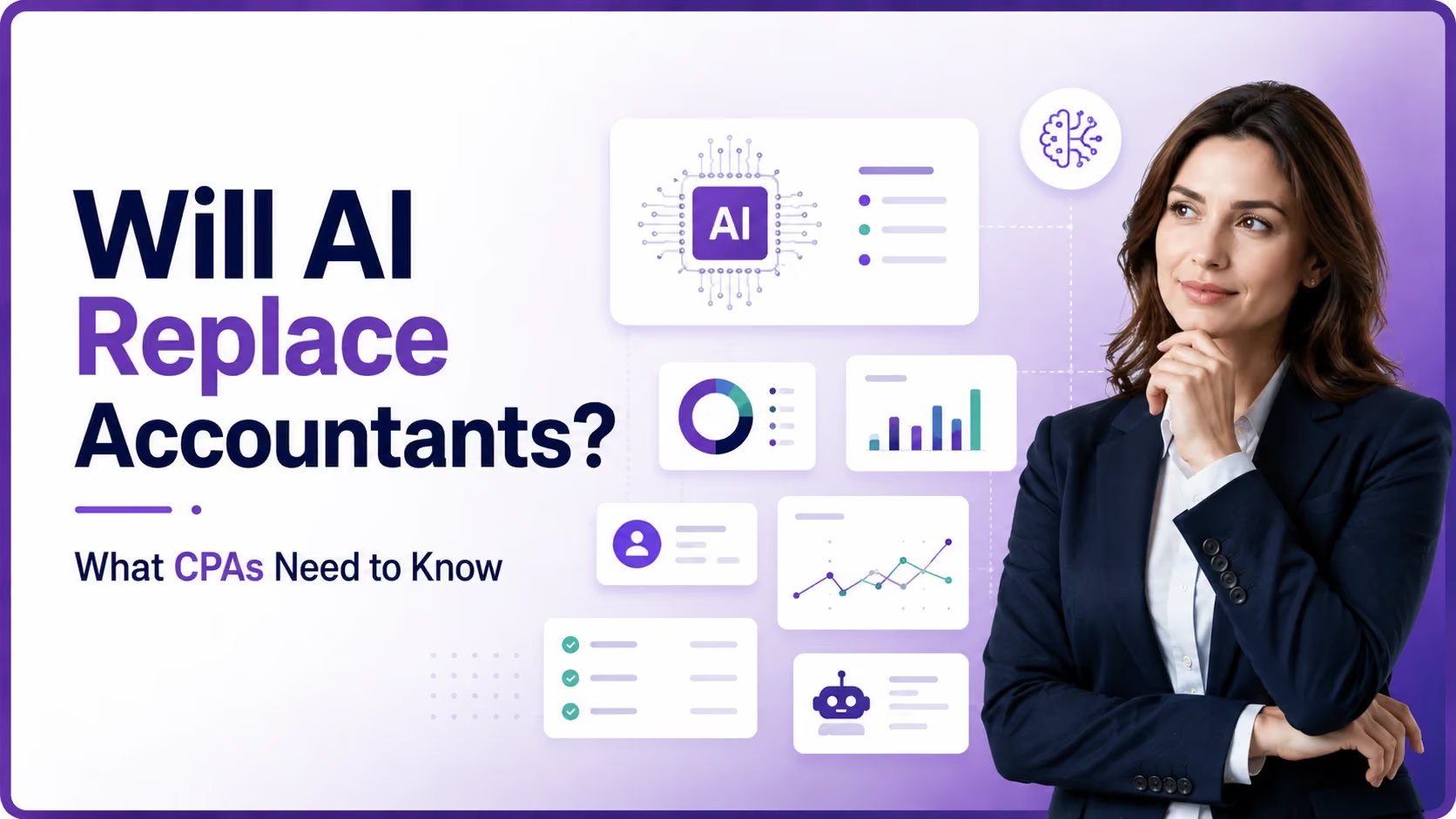
Will AI Replace Accountants? Here's the Complete Answer
Short version: no, not the profession. Yes, for a specific, shrinking slice of tasks inside it. The honest answer needs more than a headline, because "will AI replace accountants" is really three different questions wearing one trench coat: will it replace staff accountants, will it replace partners, and will it replace the profession as a category. The answers are different for each.
This piece is the deep answer. Not a section inside a broader AI-agents piece, the full breakdown: what happens role by role, what's already true versus what's still years out, why the loudest alarmist claims don't hold up under scrutiny, and what an accountant or firm owner should actually do this year.
If you want the broader context on how AI agents fit into accounting workflows generally, categorization, reconciliation, document extraction, and where they need a review layer, see our full breakdown of AI agents in accounting. This piece goes narrower and deeper on the replacement question specifically.
Role by Role: Who's Actually at Risk
"Will AI replace accountants" is the wrong grain of analysis. The honest answer changes depending on which seat someone sits in, so here's the breakdown by role instead of by profession.
The pattern across every row: AI takes the parts of a role that involve producing a first draft from known inputs. It does not take the parts that involve deciding whether the draft is right, or telling a client what it means.
The Timeline: What's True Now vs. What's Still Years Out
Most of the anxiety around this question comes from conflating "AI can technically do X in a demo" with "AI is doing X reliably in production at your firm today." Those are different timelines.
The useful takeaway from the timeline isn't the dates, it's that the tasks disappearing soonest are the ones that were already the least interesting part of the job.
Rebutting the Alarmist Claims
A handful of specific claims keep circulating that don't survive contact with how accounting actually works. Worth addressing them directly instead of vaguely.
Claim: "AI can already do a bookkeeper's whole job, so bookkeepers are done." AI can do the coding and reconciliation matching that make up the bulk of a bookkeeper's hours. It cannot decide what to do when a client's vendor list changes format, when revenue timing is unusual, or when a number looks wrong for a reason that isn't in the training data. The job doesn't disappear, it compresses into fewer hours of higher-judgment work, which is a real disruption but not an extinction.
Claim: "Big Four are already replacing junior staff with AI, so smaller firms will too." Large firms are reducing the volume of junior hires per engagement because AI absorbs first-pass work, but they are not eliminating the junior role, they're compressing what juniors do in year one and expecting them to reach review-level judgment faster. Smaller firms with thinner staffing already run leaner, so the effect there is different: it's less about headcount cuts and more about being able to take on more clients without adding headcount at all.
Claim: "AI accuracy is already higher than human accuracy, so review is just theater." AI accuracy on trained, clean data is high. Accuracy on the specific client's edge cases, the ones that actually cause financial statement errors, is unproven and unmonitored unless a firm is tracking it, which most aren't. Confidence scores describe the model's certainty, not its correctness. Treating a high confidence score as equivalent to a correct answer is the single most common way firms get burned.
Claim: "Once AI can pass the CPA exam, it can do a CPA's job." Passing an exam demonstrates knowledge recall and structured reasoning on a fixed set of scenarios. A CPA's job is mostly the parts an exam doesn't test: managing an anxious client through an IRS notice, deciding how aggressive a tax position should be given a specific client's risk tolerance, and being the named, liable signer on the output. None of that is exam-shaped.
What Should an Accountant or Firm Owner Actually Do About It
Reading about the trend is not a plan. Here's the practical version, split by who's asking.
If you're a staff accountant or bookkeeper: move deliberately toward the review and exception-handling side of the work rather than the data-entry side. Learn to read and challenge an AI-generated first pass, not just produce your own from scratch. That skill, judging AI output rather than replacing it, is becoming the actual job description.
If you're a senior accountant or controller: get fluent in setting up and tuning the confidence thresholds and review rules for whatever AI tools your firm uses. The people who configure the system well become more valuable, not less, as the system does more of the raw work.
If you're a firm owner or partner: audit your billing model. If a meaningful share of revenue still comes from billing hours for transaction-level work, that revenue is exposed regardless of what you do internally, because clients will eventually notice the market rate for that work has dropped. The firms in the best position are already re-pricing toward advisory and review, and reallocating the staff hours that used to go to data entry toward client-facing work instead.
The through-line across all three: the answer to "will AI replace accountants" is mostly answered by what an individual or firm chooses to do with the hours AI frees up, not by the technology itself.
What AI Genuinely Cannot Do, and Why That's Different From "AI Is Bad At It"
It's worth being precise about this distinction, because it's where a lot of the debate goes sideways. Some AI limitations are current-generation weaknesses that will likely improve. Others are structural, meaning no amount of model improvement fixes them, because the limitation isn't about capability.
Liability is the clearest example. A filed tax return or an audited financial statement needs a named, licensed human who is legally and professionally accountable for it. That's not a gap in AI's training data, it's a requirement written into professional licensing and malpractice insurance structures. An AI model has no license to lose and no insurance policy to trigger, which means it structurally cannot be the last signature on regulated work, no matter how accurate it becomes.
The same logic applies to a client who's going through a business crisis, a partnership dissolving, a fraud investigation, a going-concern issue. What they need in that moment isn't a more accurate output. It's a person who will sit with the ambiguity, take a position, and be reachable when it goes wrong. That's a trust relationship, not a data problem, and it doesn't get automated by a better model.
Real Scenario: A Firm Owner Stops Doing the Math Wrong
A sole practitioner CPA in Georgia was doing her own bookkeeping for 18 clients.
She told herself it kept her close to the numbers. What it actually did was take 60 hours a month away from advisory work she could have billed at $250/hour.
In 2025, she added two tools: AI-assisted transaction categorization in QBO, and one dedicated offshore bookkeeper through Etisson.
The AI handled first-pass coding on clean clients. The offshore bookkeeper handled reconciliations, AR/AP, and close prep. She reviewed and approved.
Time spent on transaction-level work: down 75%. Advisory hours billed: up from 8 to 22 per month. Net revenue change: up approximately $33,000 annually.
She did not replace herself. She replaced the work that was holding her back.
How Etisson Fits Into the AI + Offshore Model
Etisson provides dedicated offshore accounting staff, bookkeepers, senior accountants, tax associates, who work inside your firm's existing processes and tools.
As AI handles more of the first-pass automation, Etisson's offshore staff take on the execution layer: reviewing AI output, handling exceptions, completing reconciliations, preparing review-ready workpapers.
Your US CPAs focus on review, judgment, and client relationships.
We support bookkeeping, close and finalization, tax prep and compliance, and controller services.
100+ CPA firms are running this model today. The 40-hour free pilot lets you see how it fits before you commit.
FAQs
Will AI replace accountants?
No, not as a profession. It's already replacing specific tasks, transaction coding, data extraction, first-pass reconciliation, and that shift hits some roles (staff accountants, bookkeepers) much harder than others (partners, advisors). The exposure is role-specific, not profession-wide.
Which accounting roles are most at risk from AI?
Staff accountants and bookkeepers whose work is mostly transaction-level data entry face the most task compression. Controllers and partners see less direct exposure and more of a shift in how they spend their time, less prep, more review and client-facing work.
Is there a realistic timeline for AI replacing accountants entirely?
Not a credible one. What's true today: reliable automation of clean, high-volume transaction work. What's plausible in 2-3 years: better handling of moderately irregular data and AI-assisted advisory drafts. What's still 5+ years out, if ever: independent judgment on novel situations and taking professional liability, which is a licensing and trust barrier, not just a technology one.
Isn't AI accuracy already better than human accuracy, so why keep a review step?
AI accuracy is strong on trained, clean data, but confidence scores reflect the model's certainty, not correctness on a specific client's edge cases. Firms that skip review on the assumption that high confidence equals correct are the ones who get burned at reconciliation or year-end.
What should a firm owner do right now if they're worried about AI's impact on staffing?
Audit how much revenue depends on billing hours for transaction-level work, since that's the part most exposed to price compression. Then start reallocating staff time and pricing toward review, judgment, and advisory work, the parts of the job AI supports but doesn't replace.
How is this different from just asking whether AI agents are useful in accounting?
AI agents in accounting is the broader question, what these tools do across categorization, reconciliation, and workflow generally. This piece is narrower: specifically whether accountants as professionals get replaced, broken down by role, timeline, and what to do about it.
Conclusion
The complete answer to "will AI replace accountants" is role-specific, not profession-wide: heavy task compression for data-entry-heavy roles, moderate reallocation for senior and controller roles, and minimal direct exposure for partners, with the caveat that firms who don't adapt their pricing and staffing model will feel indirect pressure regardless of role.
The CPA who understands that and restructures their firm accordingly ends up with more time for the work clients actually pay a premium for.
Book a 15-minute call to discuss how Etisson's offshore model fits alongside your firm's AI tools.