

Key Takeaways
- 55% of multi-owner CPA firms were already facing succession challenges in 2020, up from 26% in 2016 (AICPA PCPS survey, via Journal of Accountancy).
- About three-quarters of multi-owner firms expected succession challenges within ten years (AICPA, 2020 survey).
- 26% of single owners and sole practitioners planned to retire within five years (Journal of Accountancy, 2020 survey).
- There are four main routes: internal transition, merger, sale to another firm, or a continuity agreement.
- A good plan covers ownership, leadership, clients and staff, and is written down and reviewed every year.
- Plan on three to five years from first conversation to handover (our rule of thumb, not a survey figure).
- Fewer accounting graduates and a thin hiring market mean fewer ready successors, so start earlier.
- Offshore support can free owners and successors from repeatable work. 25% of firms already offshore and 12% plan to start (AICPA 2023 MAP Survey).
If you own a CPA firm, you will leave it one day. It might be retirement, a sale, an illness or just a change of plans. The real question is whether the firm is ready when that day comes.
Many firms are not. In the AICPA's 2020 survey, 55% of multi-owner firms were already struggling with succession. This guide covers your options, a step-by-step plan, a realistic timeline, and how extra staff capacity makes the handover easier.
What is CPA firm succession planning?
CPA firm succession planning is deciding who will own, lead and serve the clients of your firm after you step back, and writing that down well before you need it.
A plan covers four things:
- Ownership: who buys in, or buys you out.
- Leadership: who runs the firm day to day.
- Clients: how they move to the new owner without leaving.
- Staff: who stays, and why they would.
Skip one and the other three get shaky. A plan also covers the unplanned exits, such as illness, disability or death. It is not only for owners close to retirement.
Why is succession such a problem for CPA firms right now?
Many firms are already struggling to hand over, and the pipeline of new accountants is thin.
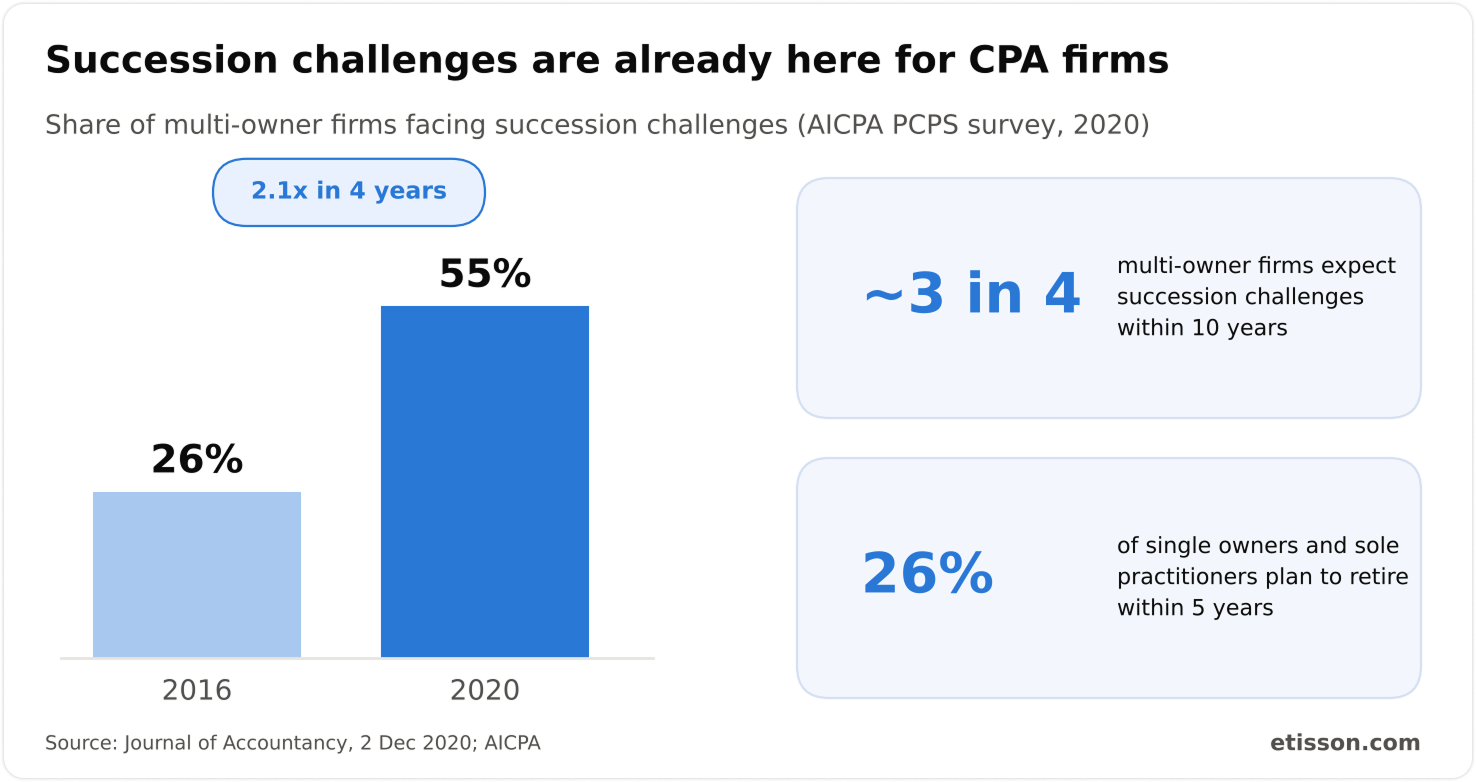
In the AICPA's 2020 succession survey, 55% of multi-owner firms said they were already facing succession challenges, up from 26% in 2016. About three-quarters expected to face them within the next ten years. Among single owners and sole practitioners, 26% planned to retire within five years.
The survey runs every four years. The 2020 edition is the latest we could verify, so treat these figures as a 2020 snapshot.
The people who would normally buy in or take over are in short supply. US schools awarded 55,152 accounting bachelor's and master's degrees in 2023-24, down 6.6% for the third year in a row. Hiring experienced staff is also the No. 1 current issue for firms with 11 to 30 professionals in the AICPA's 2026 survey. We pulled the full numbers in our accountant and CPA shortage statistics.
A smaller pool of successors means the plan has to start earlier, not later.
What are your succession options?
You have four main routes: promote from within, merge with another firm, sell to another firm, or set up a continuity agreement. Many firms mix more than one.
| Option | How it works | Works best when | Watch out for |
|---|---|---|---|
| Internal transition | Ownership moves to partners or senior staff over several years | You have a ready successor and want the firm's culture to continue | Successors may struggle to fund a buy-in, and need time to be trained |
| Merger | You combine with another firm and share ownership | You want scale and a bench of partners, and the clients fit | Culture clash, client overlap, unclear partner roles |
| Sale to another firm | A larger firm buys your client base and takes your staff | You want a clean exit on a set date | The price may depend on how many clients stay |
| Continuity agreement | Another CPA agrees to serve your clients if you retire or die | You are a sole practitioner with no successor | It covers an emergency, it does not build a long-term successor |
Before signing anything, talk to an attorney and a practice valuation specialist.
How do you build a CPA firm succession plan?
Work through six steps, in this order.
- Set your exit date and goals. Write down when you want out, how involved you want to stay afterwards, and what you need financially.
- Value the firm. Get a practice valuation from a specialist, so you plan around a real number and not a guess.
- Pick the route. Choose between internal transition, merger, sale or a mix, using the table above.
- Choose and train successors. Name the people. Give them client contact and move them toward owner-level work, such as review, pricing and client relationships, in stages.
- Plan the client handover. Introduce successors to your top clients early. Do it over months, not in your last week.
- Write it down and review it yearly. Put the plan and the emergency steps in writing. Review it once a year and after any big change, like a new partner or a major client loss.
How long does succession planning take?
Plan on three to five years from the first conversation to the handover. This is our rule of thumb, not a survey figure.
Here is how that can look:
- Year 1: set goals, get a valuation, pick the route.
- Year 2: name successors and start moving client relationships and review work to them.
- Year 3: start the ownership transfer and get the agreements in place.
- Years 4 to 5: step back in stages and stay on as an adviser while clients settle in.
If you are closer than two years from your exit, focus on steps 1 to 3 and the handover plan for your top clients first.
What happens to clients and staff during a transition?
Clients and staff are the two groups most likely to be unsettled, so tell them early and give them a reason to stay.
- Clients: introduce the successor to your top clients 6 to 12 months ahead, keep the same service team where you can, and make a follow-up call after the handover.
- Staff: tell key people about the plan before it turns into a rumour, show them a path to ownership or leadership, and be clear about who reviews and who decides.
How can extra staff capacity make succession easier?
It frees up the two groups that matter most: the owners who are handing over and the successors who are taking over.
Succession works when owners can pass client relationships to successors, and successors have time to learn the owner's work. That is hard when everyone is buried in return prep, bookkeeping and reconciliations.
Offshore support takes that repeatable work off the senior team's plate. About a quarter of firms already outsource work to offshore workers, and another 12% planned to start, based on the AICPA 2023 National MAP Survey. To decide what to hand off, see our guides on CPA firm hiring: build vs. outsource and accounting firm capacity planning.
Etisson places dedicated offshore accounting professionals with US CPA firms. Onboarding takes 48 hours, and you can see the work before you commit with a free 40-hour pilot. It will not replace a succession plan, but it gives your successors more room to step up.
Want to see how offshore capacity would fit your firm's plan? Book a free 40-hour pilot call.
Sources
- Multi-owner firms facing succession challenges: 55% in 2020, 26% in 2016. Single owners and sole practitioners planning to retire within five years: 26%. (Journal of Accountancy, 2 Dec 2020, on the 2020 AICPA PCPS and Succession Institute survey) Source
- Nearly 75% of multi-owner firms expect succession challenges within ten years. (AICPA, 2020 CPA Firm Succession Planning Survey, multi-owner report) Source
- Accounting degrees awarded in 2023-24: 55,152, down 6.6%. (AICPA, 27 Oct 2025) Source
- Hiring experienced staff is the No. 1 current issue for firms with 11 to 30 professionals. (AICPA, 23 Jun 2026) Source
- Firms that outsource to offshore workers: 25%; plan to start offshoring: 12%. (Journal of Accountancy, 1 Nov 2024, on the AICPA 2023 National MAP Survey) Source
FAQs
When should a CPA firm start succession planning?
Ideally three to five years before the planned exit. If that window has closed, start with a valuation and a handover plan for your top clients.
What are the options for succeeding a CPA firm?
The main routes are an internal transition to partners or staff, a merger, a sale to another firm, or a continuity agreement with another CPA. Many firms combine more than one.
Do sole practitioners need a succession plan?
Yes. In the 2020 survey, 26% of single owners and sole practitioners planned to retire within five years. At the very least, decide who would serve your clients if something happened to you.
How many CPA firms struggle with succession?
In the AICPA's 2020 survey, 55% of multi-owner firms were already facing succession challenges, and nearly three-quarters expected them within ten years.
Can offshore staff help with succession?
Indirectly. Offshore staff can take on repeatable work, which gives owners time to hand over clients and gives successors room to take on owner-level work.